


Post-hoc analysis reveals RAP-219's early and consistent efficacy in reducing seizure severity in drug-resistant focal onset seizures.
Quiver AI Summary
Rapport Therapeutics announced promising results from a post-hoc analysis of its Phase 2a trial of RAP-219, a potential treatment for drug-resistant focal onset seizures (FOS). The analysis showed RAP-219's early onset of action and consistent efficacy in reducing seizure frequency and severity, regardless of patients' baseline disease severity. Notably, patients reported significant improvements in daily functioning and quality of life. The trial, which enrolled 30 participants, revealed a 77.8% reduction in clinical seizures and a low rate of treatment discontinuation. Rapport plans to advance into pivotal Phase 3 trials in 2026 and is also exploring RAP-219 for bipolar disorder and diabetic peripheral neuropathic pain, highlighting its potential as a first-in-class medication with a differentiated profile.
Potential Positives
- Positive post-hoc analysis of RAP-219 Phase 2a data indicates early onset of action and consistent efficacy, suggesting strong therapeutic potential for patients with drug-resistant focal onset seizures.
- RAP-219 achieved a statistically significant 77.8% reduction in clinical seizures, with 24% of participants experiencing seizure freedom during the treatment period.
- Improvement in patient-reported outcomes, including reduced seizure severity and better daily functioning, highlights RAP-219's potential to enhance the quality of life for individuals with epilepsy.
- The company is positioned to advance RAP-219 into registrational trials, indicating confidence in its clinical development pathway and future commercialization efforts.
Potential Negatives
- The small sample size of 30 participants in the Phase 2a trial may limit the generalizability of the results and raise questions about the robustness of the findings.
- The company is still in early-stage clinical trials, which poses inherent uncertainties regarding the efficacy and safety of RAP-219, along with potential regulatory hurdles that could delay market entry.
- While there is positive data, the reliance on a post-hoc analysis to support claims of efficacy may draw scrutiny from investors and regulators regarding the strength of the conclusions drawn.
FAQ
What are the key findings from the RAP-219 Phase 2a trial?
The trial showed early onset of action, consistent efficacy, and significant improvements in patient-reported seizure severity.
How effective is RAP-219 for drug-resistant focal onset seizures?
RAP-219 achieved a 77.8% reduction in clinical seizures and substantial improvements in daily functioning for patients.
What safety profile did RAP-219 demonstrate in the trial?
The drug was generally well-tolerated, with a low discontinuation rate and most adverse events being mild.
When does Rapport plan to begin Phase 3 trials for RAP-219?
Rapport anticipates initiating pivotal Phase 3 trials in the third quarter of 2026.
What is the potential of RAP-219 for patients with epilepsy?
RAP-219 is positioned as a potential best-in-class anti-seizure medication for patients with drug-resistant epilepsy.
Disclaimer: This is an AI-generated summary of a press release distributed by GlobeNewswire. The model used to summarize this release may make mistakes. See the full release here.
$RAPP Insider Trading Activity
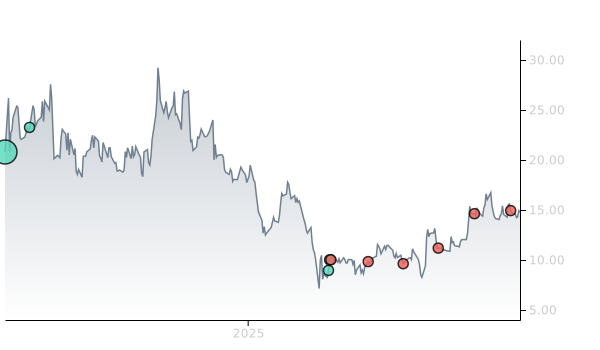
$RAPP insiders have traded $RAPP stock on the open market 28 times in the past 6 months. Of those trades, 4 have been purchases and 24 have been sales.
Here’s a breakdown of recent trading of $RAPP stock by insiders over the last 6 months:
- ABRAHAM CEESAY (Chief Executive Officer) has made 0 purchases and 12 sales selling 98,252 shares for an estimated $2,567,973.
- STEVEN M PAUL has made 2 purchases buying 41,666 shares for an estimated $1,027,111 and 0 sales.
- DAVID BREDT (Chief Scientific Officer) has made 0 purchases and 10 sales selling 51,000 shares for an estimated $978,885.
- REID M HUBER purchased 20,400 shares for an estimated $499,373
- CHERYL GAULT (Chief Operating Officer) has made 0 purchases and 2 sales selling 10,000 shares for an estimated $342,136.
- WENDY B. YOUNG purchased 3,500 shares for an estimated $79,100
To track insider transactions, check out Quiver Quantitative's insider trading dashboard.
$RAPP Hedge Fund Activity
We have seen 84 institutional investors add shares of $RAPP stock to their portfolio, and 37 decrease their positions in their most recent quarter.
Here are some of the largest recent moves:
- UBS AM, A DISTINCT BUSINESS UNIT OF UBS ASSET MANAGEMENT AMERICAS LLC added 1,540,636 shares (+631.7%) to their portfolio in Q3 2025, for an estimated $45,756,889
- FMR LLC added 1,442,362 shares (+26.3%) to their portfolio in Q3 2025, for an estimated $42,838,151
- GOLDMAN SACHS GROUP INC added 1,186,941 shares (+96.1%) to their portfolio in Q3 2025, for an estimated $35,252,147
- BAKER BROS. ADVISORS LP added 997,000 shares (+181.2%) to their portfolio in Q3 2025, for an estimated $29,610,900
- VESTAL POINT CAPITAL, LP added 950,000 shares (+inf%) to their portfolio in Q3 2025, for an estimated $28,215,000
- POLAR CAPITAL HOLDINGS PLC added 938,952 shares (+inf%) to their portfolio in Q3 2025, for an estimated $27,886,874
- CAPITAL INTERNATIONAL INVESTORS added 800,000 shares (+30.7%) to their portfolio in Q3 2025, for an estimated $23,760,000
To track hedge funds' stock portfolios, check out Quiver Quantitative's institutional holdings dashboard.
$RAPP Analyst Ratings
Wall Street analysts have issued reports on $RAPP in the last several months. We have seen 4 firms issue buy ratings on the stock, and 0 firms issue sell ratings.
Here are some recent analyst ratings:
- BTIG issued a "Buy" rating on 11/19/2025
- Citizens issued a "Market Outperform" rating on 11/07/2025
- Truist Securities issued a "Buy" rating on 09/16/2025
- HC Wainwright & Co. issued a "Buy" rating on 09/08/2025
To track analyst ratings and price targets for $RAPP, check out Quiver Quantitative's $RAPP forecast page.
$RAPP Price Targets
Multiple analysts have issued price targets for $RAPP recently. We have seen 5 analysts offer price targets for $RAPP in the last 6 months, with a median target of $44.0.
Here are some recent targets:
- Kambiz Yazdi from BTIG set a target price of $47.0 on 11/19/2025
- Jason N. Butler from Citizens set a target price of $80.0 on 11/07/2025
- Joon Lee from Truist Securities set a target price of $44.0 on 09/16/2025
- Douglas Tsao from HC Wainwright & Co. set a target price of $34.0 on 09/08/2025
- Jason Butler from JMP Securities set a target price of $28.0 on 07/08/2025
Full Release
Post-hoc analysis of RAP-219 Phase 2a data showed early onset of action and consistency of median response over the entire treatment period, along with consistent efficacy data regardless of patients’ disease severity
RAP-219 demonstrated meaningful improvements in patient-reported seizure severity among those with moderate or greater baseline impairment
BOSTON and SAN DIEGO, Dec. 05, 2025 (GLOBE NEWSWIRE) -- Rapport Therapeutics, Inc. (Nasdaq: RAPP) (Rapport or the Company), a clinical-stage biotechnology company dedicated to the discovery and development of small molecule precision medicines for patients with neurological or psychiatric disorders, today announced new data and post hoc analysis on clinical and patient reported benefits of RAP-219 in drug-resistant focal onset seizures (FOS), alongside topline efficacy and safety data from its recently reported Phase 2a FOS trial. The results were presented at the 2025 American Epilepsy Society (AES) Annual Meeting and include RAP-219’s early treatment effects and consistent median efficacy data across the full treatment period, its performance across varying levels of baseline disease severity, and its impact on seizure severity.
“These additional results build upon the robust efficacy data we observed in the Phase 2a trial and further expand the growing body of evidence supporting RAP-219’s potential as a best-in-class anti-seizure medication for patients with drug-resistant focal onset seizures,” said Jeffrey Sevigny, M.D., chief medical officer of Rapport. “Our analysis showed that RAP-219 demonstrated strong clinical response - early in treatment, consistent over time, and across the spectrum of disease severity. Additionally, RAP-219 substantially reduced the impact of seizures on patients’ daily functioning, reinforcing its potential to make a meaningful difference in the lives of patients with epilepsy. With these results, we believe we are well positioned to advance into registrational trials, as we continue the development of RAP-219 as a potential therapy for people living with epilepsy.”
The Company plans to hold an end-of-Phase 2 meeting with the U.S. Food and Drug Administration this quarter and anticipates initiating two pivotal Phase 3 trials of RAP-219 using traditional clinical seizure endpoints in the third quarter of 2026.
Rapport announced topline results from the Phase 2a study in September 2025. The trial enrolled 30 participants and met the primary endpoint, demonstrating a statistically significant reduction in long episodes (LEs) compared with baseline over the 8-week treatment period. Study participants achieved a 77.8% reduction in clinical seizures compared with baseline (p=0.01), with 24% achieving seizure freedom during the 8-week treatment period (p<0.0001). RAP-219 was generally well-tolerated in the trial, with the majority of treatment-emergent adverse events (TEAEs) being mild and a low (10%) discontinuation rate.
The new findings highlighted in the Company’s presentations at AES are detailed below.
Early Onset of Action and Consistency of Efficacy Data
RAP-219 demonstrated early treatment clinical response and consistent, clinically meaningful median reductions throughout the 8-week treatment period, as assessed by change in LE and clinical seizure frequency during treatment weeks 1-4, 5-8, and 1-8 (overall).
| 1-4 Weeks | 5-8 Weeks | 1-8 Weeks | |
| Median Percent Reduction in Long Episodes (LEs) from Baseline | 74.7% | 74.7% | 71.0% |
| Median Percent Reduction in Clinical Seizures from Baseline | 85.0% | 77.2% | 77.8% |
Robust Efficacy Data Across Disease Severity Levels
RAP-219 provided a consistent and clinically meaningful response regardless of patients’ baseline disease severity, as assessed by ≥30% LE and ≥50% clinical seizure responder rates.
- In patients with a median baseline LE frequency of ≤48 and >48, 85.7% and 84.6% achieved ≥30% reduction in LE frequency, respectively
- In patients with a median baseline clinical seizure frequency of ≤10 and >10, 69.2% and 75% achieved ≥50% reduction in clinical seizure frequency, respectively
-
Seizure freedom was achieved over the entire 8-week treatment period at a similar rate regardless of baseline clinical seizure frequency (23.1% in patients with ≤10 baseline clinical seizures; 25% in patients with >10 baseline clinical seizures)
Clinically Relevant Improvements in Seizure Severity
The primary goal of ASM treatment is to eliminate or markedly reduce seizures, but it’s also important to lessen the impact on daily activity of any seizures that persist. Treatment with RAP-219 improved overall seizure intensity as well as time to recovery, ability to concentrate, and reduced seizure interference with daily activity following a seizure, as measured by the Seizure Severity Response Questionnaire (SSRQ). Improvements in these domains suggest the potential of RAP-219 to improve quality of life in patients with drug-resistant FOS.
In this post-hoc analysis, change in seizure severity in patients treated with RAP-219 was assessed in those patients reporting moderate or greater ( > 4 out of 10) impairment at baseline in the domains measured by the SSRQ. At week 8, patients experienced significant median percent decreases from baseline in 3 of the 4 domains assessed:
- time to recovery (n=8; 100%, P=0.195),
- ability to think or concentrate after a seizure (n=15; 71.4%, P=0.013),
- interference with daily activity (n=12; 94.4%, P=0.002), and
- overall intensity (n=15; 75%, P=0.001).
PET receptor occupancy study
Rapport also presented data that (1) confirmed the expression and distribution of TARPγ8 in the cortex and mesial temporal lobes, the brain regions where seizures originate and propagate, and (2) demonstrated that therapeutic concentrations of RAP-219 are achieved after 2 weeks of daily dosing across a range of doses.
To learn more and view the posters presented at AES, please visit Rapport’s website here .
About the Phase 2a Focal Onset Seizures Trial
The proof-of-concept, multi-center, open-label Phase 2a clinical trial was designed to evaluate the efficacy, safety, and tolerability of RAP-219 in adult patients with drug-resistant focal onset seizures. The trial enrolled 30 patients with focal onset seizures who had an implanted RNS
®
System. Patients received 0.75 mg RAP-219 oral tablet daily for 5 days followed by 1.25 mg RAP-219 oral tablet daily for the remainder of the 8-week treatment period. The primary efficacy endpoint was the change in frequency of RNS-recorded long episodes (LEs) in patients with focal onset seizures evaluated both as the proportion of responders achieving ≥30% reduction in LEs from baseline, which has been demonstrated to be associated with ≥50% reduction in clinical seizures, and median percent change from baseline in LE frequency. Secondary endpoints included clinical seizure frequency reductions (assessed as median percent change from baseline, responder proportion who achieve a ≥50% reduction in seizure frequency, and seizure freedom), safety, and tolerability.
The trial enrolled 12 women and 18 men, and the mean age of patients enrolled was 40.1 years. The mean age of enrolled patients at the time of their first seizure was 16.6 years. Patients were taking a median of 3 concomitant antiseizure medications, with the highest proportion of patients taking lamotrigine (50%), levetiracetam (40%), and cenobamate (37%) medications. These demographics and baseline characteristics are consistent with that of patients expected to be enrolled in future registrational trials of RAP-219.
About RAP-219
RAP-219 is a potential first-in-class, clinical-stage TARPγ8-specific AMPA receptor (AMPAR) negative allosteric modulator (NAM). Whereas AMPARs are distributed widely in the central nervous system, the receptor associated protein (RAP) TARPγ8 is expressed only in discrete brain regions, including the hippocampus and neocortex, where focal seizures often originate. By contrast, TARPγ8 has minimal expression in the hindbrain, where drug effects are often associated with intolerable adverse events. With this precision approach, the Company believes RAP-219 has the potential to provide a differentiated profile as compared to traditional neuroscience medications. Due to the role of AMPA biology in various neurological disorders and the selective targeting of TARPγ8, the Company believes RAP-219 has pipeline-in-a-product potential and is evaluating the compound as a potential treatment for patients with focal onset seizures, bipolar disorder, and peripheral neuropathic pain.
Additional RAP-219 Development Plans
Rapport is conducting an open-label long term safety trial to allow patients enrolled in the RAP-219-FOS-201 trial to continue RAP-219. Preliminary results of the trial are expected in the second half of 2026.
Additionally, Rapport continues development of a long-acting injectable (LAI) formulation of RAP-219. Up to half of patients are nonadherent to prescribed ASMs, which can present a significant issue in optimizing treatment benefit and lead to potential breakthrough seizures. The Company believes a LAI formulation has the potential to improve patient adherence and expand the potential clinical utility across all of RAP-219’s indications.
Outside of epilepsy, Rapport is evaluating RAP-219 in a Phase 2 trial in bipolar mania. The trial is currently enrolling patients and is on track, with topline results expected in the first half of 2027. An update on next steps for a Phase 2 trial in diabetic peripheral neuropathic pain is expected in the first quarter of 2026.
About Rapport Therapeutics
Rapport Therapeutics is a clinical-stage biotechnology company dedicated to discovering and developing small molecule precision medicines for patients with neurological or psychiatric disorders. The Company’s founders have made pioneering discoveries related to the function of receptor associated proteins (RAPs) in the brain. Their findings form the basis of Rapport’s RAP technology platform, which enables a differentiated approach to generate precision small molecule product candidates with the potential to overcome many limitations of conventional neurology drug discovery. Rapport’s precision neuroscience pipeline includes the Company’s lead investigational drug, RAP-219, designed to achieve neuroanatomical specificity through its selective targeting of a RAP expressed in only discrete regions of the brain. The Company is currently pursuing RAP-219 as a potential treatment for drug-resistant focal onset seizures, bipolar mania and diabetic peripheral neuropathic pain. Additional preclinical and late-stage discovery stage programs are also underway, including targeting chronic pain and hearing disorders.
Availability of Other Information About Rapport Therapeutics
Rapport Therapeutics uses and intends to continue to use its Investor Relations website and LinkedIn (Rapport Therapeutics) as a means of disclosing material nonpublic information and for complying with its disclosure obligations under Regulation FD. Accordingly, investors should monitor the Company’s Investor Relations website and LinkedIn, in addition to following the Company’s press releases, SEC filings, public conference calls, presentations, and webcasts. The contents of the Company’s website or social media shall not be deemed incorporated by reference in any filing under the Securities Act of 1933, as amended.
Forward-Looking Statements
This press release contains “forward-looking statements” within the meaning of Section 27A of the Securities Act of 1933 and Section 21E of the Securities Exchange Act of 1934, each as amended. The words “anticipate,” “believe,” “continue,” “could,” “estimate,” “expect,” “intend,” “may,” “plan,” “potential,” “predict,” “project,” “should,” “target,” “will,” “would” and similar expressions are intended to identify forward-looking statements, although not all forward-looking statements contain these identifying words. These forward-looking statements include, but are not limited to, express or implied statements regarding: the clinical development of RAP-219 for the treatment of focal onset seizures, bipolar mania, and diabetic peripheral neuropathic pain, including the initiation, timing, progress and results of the ongoing and planned clinical trials; expectations for the efficacy, tolerability, and commercial potential of RAP-219; the future release of data from the ongoing 8-week follow-up period of the Phase 2a trial for RAP-219; expectations for the development of a LAI formulation of RAP-219 and the potential of a LAI to improve patient adherence; the Company’s expectations for upcoming regulatory interactions; and the potential of Rapport’s RAP technology platform.
Forward looking statements are based on management’s current expectations and are subject to risks and uncertainties that could negatively affect Rapport’s business, operating results, financial condition and stock value. Factors that could cause actual results to differ materially from those currently anticipated include: risks relating to the Company’s research and development activities; Rapport’s ability to execute on its strategy including obtaining the requisite regulatory approvals on the expected timeline, if at all; uncertainties relating to preclinical and clinical development activities; the Company’s dependence on third parties to conduct clinical trials, manufacture its product candidates and develop and commercialize its product candidates, if approved; Rapport’s ability to attract, integrate and retain key personnel; risks related to the Company’s financial condition and need for substantial additional funds in order to complete development activities and commercialize a product candidate, if approved; risks related to regulatory developments and approval processes of the U.S. Food and Drug Administration and comparable foreign regulatory authorities; risks related to establishing and maintaining Rapport’s intellectual property protections; and risks related to the competitive landscape for Rapport’s product candidates; as well as other risks described in “Risk Factors,” in the Company’s Annual Report on Form 10-K and most recent Quarterly Report on Form 10-Q, as well as discussions of potential risks, uncertainties, and other important factors in Rapport’s subsequent filings with the Securities and Exchange Commission. Any forward-looking statements represent Rapport’s views only as of today and should not be relied upon as representing its views as of any subsequent date. Rapport expressly disclaims any obligation or undertaking to release publicly any updates or revisions to any forward-looking statements contained herein to reflect any change in its expectations or any changes in events, conditions or circumstances on which any such statement is based, except as required by law, and claims the protection of the safe harbor for forward-looking statements contained in the Private Securities Litigation Reform Act of 1995.
Contact
Julie DiCarlo
Head of Communications & IR
Rapport Therapeutics
[email protected]