
A study shows AI-driven breast cancer screening increases detection rates and benefits diverse patient populations across the U.S.
Quiver AI Summary
RadNet, Inc. and its subsidiary DeepHealth have released results from a groundbreaking study published in Nature Health, representing the largest real-world analysis of AI-driven breast cancer screening in the U.S. The study involved over 579,000 women and examined the effectiveness of DeepHealth’s AI technology in enhancing cancer detection rates while ensuring equitable outcomes across diverse patient demographics. The findings revealed a 21.6% increase in cancer detection compared to traditional 3D mammography, and a 22.7% increase for women with dense breasts. This research emphasizes the real-world applicability and effectiveness of AI in community imaging centers, demonstrating its potential to improve early detection and comprehensive care for all women, especially those vulnerable to higher mortality rates from breast cancer.
Potential Positives
- Results from the largest real-world analysis of AI-driven breast cancer screening show a 21.6% increase in cancer detection rates compared to traditional 3D mammography, highlighting the effectiveness of RadNet's Enhanced Breast Cancer Detection™ program.
- The study included over 579,000 mammograms from diverse patient populations, demonstrating equitable benefits across various racial, ethnic, and breast density groups, which enhances the company's reputation for inclusivity in healthcare.
- The AI-powered workflow maintained recall rates within American College of Radiology guidelines while boosting positive predictive value by 15%, indicating a reliable and effective diagnostic process.
- RadNet’s approach showcases the potential of AI in improving access to expert-level breast cancer care in community settings, positioning the company as a leader in innovative healthcare solutions.
Potential Negatives
- Concerns regarding reliance on AI technology may arise, as the press release highlights the increased cancer detection rate driven by an AI-based workflow, which could lead to skepticism about the accuracy and reliability of AI in medical diagnostics.
- The forward-looking statements section underscores inherent risks and uncertainties, indicating the potential for actual results to differ materially from anticipated outcomes, which may raise doubts among investors regarding the company's future performance.
- The company’s financial projections and business strategies are contingent upon various external factors, including legislative and regulatory changes, which could negatively impact the company's operations and market position.
FAQ
What are the results of the AI-driven breast cancer screening study?
The study showed a 21.6% increase in cancer detection rates compared to 3D mammography screening.
Who conducted the largest real-world analysis of breast cancer screening?
RadNet, Inc. and its subsidiary DeepHealth conducted this extensive analysis on AI-driven breast cancer screening.
What populations were included in the ASSURE study?
The study included a diverse patient population, with over 150,000 Black women among the 579,000 participants.
How does the EBCD™ program work?
The EBCD™ program combines AI technology with expert review to enhance breast cancer detection in mammograms.
Where can I learn more about the Enhanced Breast Cancer Detection program?
Visit myebcdmammo.com to learn more about the Enhanced Breast Cancer Detection program.
Disclaimer: This is an AI-generated summary of a press release distributed by GlobeNewswire. The model used to summarize this release may make mistakes. See the full release here.
$RDNT Insider Trading Activity
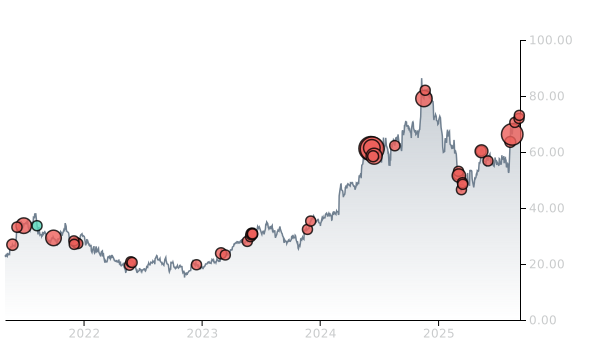
$RDNT insiders have traded $RDNT stock on the open market 10 times in the past 6 months. Of those trades, 0 have been purchases and 10 have been sales.
Here’s a breakdown of recent trading of $RDNT stock by insiders over the last 6 months:
- RANJAN JAYANATHAN (Chief Information Officer) sold 65,598 shares for an estimated $4,427,865
- MARK STOLPER (EVP, Chief Financial Officer) sold 35,000 shares for an estimated $2,586,150
- DAVID JEFFREY KATZ (EVP and Chief Legal Officer) has made 0 purchases and 2 sales selling 31,000 shares for an estimated $2,203,430.
- NORMAN R HAMES (Pres and COO-West Operations) has made 0 purchases and 2 sales selling 15,000 shares for an estimated $1,082,900.
- MICHAEL N MURDOCK (EVP, Mergers and Acquisitions) sold 11,132 shares for an estimated $646,212
- CORNELIS WESDORP (Pres & CEO, Digital Health) has made 0 purchases and 3 sales selling 2,500 shares for an estimated $172,530.
To track insider transactions, check out Quiver Quantitative's insider trading dashboard.
$RDNT Hedge Fund Activity
We have seen 180 institutional investors add shares of $RDNT stock to their portfolio, and 160 decrease their positions in their most recent quarter.
Here are some of the largest recent moves:
- PRICE T ROWE ASSOCIATES INC /MD/ added 1,924,549 shares (+1312.8%) to their portfolio in Q3 2025, for an estimated $146,669,879
- POLAR CAPITAL HOLDINGS PLC added 832,214 shares (+inf%) to their portfolio in Q3 2025, for an estimated $63,423,028
- VAN BERKOM & ASSOCIATES INC. added 817,808 shares (+14163.6%) to their portfolio in Q3 2025, for an estimated $62,325,147
- ROCKEFELLER CAPITAL MANAGEMENT L.P. added 771,859 shares (+733.7%) to their portfolio in Q3 2025, for an estimated $58,823,374
- FULLER & THALER ASSET MANAGEMENT, INC. added 705,659 shares (+inf%) to their portfolio in Q3 2025, for an estimated $53,778,272
- UBS AM, A DISTINCT BUSINESS UNIT OF UBS ASSET MANAGEMENT AMERICAS LLC added 646,924 shares (+152.1%) to their portfolio in Q3 2025, for an estimated $49,302,078
- WESTFIELD CAPITAL MANAGEMENT CO LP added 525,820 shares (+inf%) to their portfolio in Q3 2025, for an estimated $40,072,742
To track hedge funds' stock portfolios, check out Quiver Quantitative's institutional holdings dashboard.
$RDNT Analyst Ratings
Wall Street analysts have issued reports on $RDNT in the last several months. We have seen 2 firms issue buy ratings on the stock, and 0 firms issue sell ratings.
Here are some recent analyst ratings:
- Barclays issued a "Overweight" rating on 11/13/2025
- B. Riley Securities issued a "Buy" rating on 06/13/2025
To track analyst ratings and price targets for $RDNT, check out Quiver Quantitative's $RDNT forecast page.
$RDNT Price Targets
Multiple analysts have issued price targets for $RDNT recently. We have seen 4 analysts offer price targets for $RDNT in the last 6 months, with a median target of $80.5.
Here are some recent targets:
- Andrew Mok from Barclays set a target price of $86.0 on 11/13/2025
- David Macdonald from Truist Securities set a target price of $90.0 on 11/12/2025
- John Ransom from Raymond James set a target price of $75.0 on 08/13/2025
- Yuan Zhi from B. Riley Securities set a target price of $69.0 on 06/13/2025
Full Release
Largest real-world analysis of AI-driven breast cancer screening in U.S. history 1 demonstrates increased cancer detection rate with consistent benefits across patient populations
LOS ANGELES and SOMERVILLE, Mass., Nov. 17, 2025 (GLOBE NEWSWIRE) -- RadNet, Inc. (NASDAQ: RDNT), the nation's largest provider of outpatient diagnostic imaging services, and its wholly owned subsidiary, DeepHealth, a global leader in AI-powered health informatics, today announced results from the largest real-world analysis of AI-driven breast cancer screening ever conducted in the United States. 1 Published in Nature Health , the findings support the clinical effectiveness and benefit of DeepHealth’s AI technology to deliver equitable results across several racial, ethnic and breast density patient groups.
The AI-Supported Safeguard Review Evaluation (ASSURE) study examined the AI-powered workflow that is at the heart of RadNet’s Enhanced Breast Cancer Detection™ (EBCD™) program. This study included mammograms from over 579,000 women across 109 community-based imaging sites in California, Delaware, Maryland and New York. The research compared state-of-the-art 3D mammography screening to a novel AI-driven protocol that combines DeepHealth’s FDA-cleared computer-aided detection and diagnosis (CADe/x) software with an AI-supported Safeguard Review workflow, which can trigger a second breast imaging expert review of high-suspicion cases—a workflow that RadNet now offers as EBCD™.
“Beyond the remarkable results, what sets this research apart is its scale, diversity and real-world applicability,” said Dr. Howard Berger, President and Chief Executive Officer of RadNet. “There has never been a similar study of this size in the United States, much less one with such a diverse patient population, that examines the patient impact and efficacy of AI-assisted breast cancer screening.”
The ASSURE study demonstrated that the AI-powered workflow led to a 21.6% increase in cancer detection rate compared to state-of-the-art 3D mammography screening, while maintaining recall rates within American College of Radiology guidelines 2 and increasing positive predictive value by 15%. This workflow is enabled by the applications that make up DeepHealth’s Breast Suite offering. Together, they deliver these benefits across patient populations, including the more than 150,000 Black women enrolled. Black women face 40% higher breast cancer mortality in the United States. 3 Furthermore, the ASSURE study showed that the workflow underlying RadNet’s EBCD™ program delivered a 22.7% boost in cancer detection rate compared to 3D mammography screening for women with dense breasts, who experience both increased cancer risk and diagnostic challenges. 4
“Unlike many academically focused studies, these screenings took place at community imaging centers, where most women get their mammograms,” said Dr. Gregory Sorensen, co-author of the ASSURE study and Chief Science Officer at RadNet. “To avoid potential selection bias, the AI-enabled workflow was provided to all patients at no additional charge during the study period. These real-world findings demonstrate how AI can improve access to specialist-level care for women, no matter where they live. When breast cancer is found early, women have far more options for care.”
Launched nationwide at RadNet-affiliated centers in 2023, EBCD™ runs on the AI that powers the applications within DeepHealth’s Breast Suite, helping detect lesions that are suspicious of being cancer, including those that are considered more difficult to find. 6 Learn more about EBCD™ at myebcdmammo.com and discover Breast Suite at the DeepHealth booth (#1329 South Hall) at the Radiological Society of North America 2025 Annual Meeting (RSNA 2025).
About RadNet, Inc.
RadNet, Inc. is a leading national provider of freestanding, fixed-site diagnostic imaging services in the United States based on the number of locations and annual imaging revenue. RadNet has a network of 407 owned and/or operated outpatient imaging centers. RadNet’s markets include Arizona, California, Delaware, Florida, Maryland, New Jersey, New York and Texas. In addition, RadNet provides radiology information technology and artificial intelligence solutions marketed under the DeepHealth brand, teleradiology professional services and other related products and services to customers in the diagnostic imaging industry. Together with contracted radiologists, and inclusive of full-time and per diem employees and technologists, RadNet has about 11,000 team members. For more information, visit
radnet.com
.
About DeepHealth
DeepHealth is a wholly owned subsidiary of RadNet, Inc. (NASDAQ: RDNT) and serves as the umbrella brand for all companies within RadNet’s Digital Health segment. DeepHealth provides AI-powered health informatics with the aim of empowering breakthroughs in care through imaging. Building on the strengths of the companies it has integrated and is rebranding (e.g., CIMAR UK cloud-native healthcare image management solutions, eRAD Radiology Information and Image Management Systems and Picture Archiving and Communication System, Aidence lung AI, DeepHealth, Kheiron and iCAD breast AI, Quantib prostate and brain AI, and See-Mode thyroid and breast AI), DeepHealth leverages advanced AI for operational efficiency and improved clinical outcomes in brain, breast, chest, prostate, and thyroid health. At the heart of DeepHealth’s portfolio is a cloud-native operating system – DeepHealth OS – that unifies data across the clinical and operational workflow and personalizes AI-powered workspaces for everyone in the radiology continuum. Thousands of imaging centers and radiology departments around the world use DeepHealth solutions to enable earlier, more reliable, and more efficient disease detection, including in large-scale cancer screening programs. DeepHealth’s human-centered, intuitive technology aims to push the boundaries of what’s possible in healthcare.
https://deephealth.com/
Forward-Looking Statements
This communication contains certain “forward-looking statements” within the meaning of the safe harbor provisions of the U.S. Private Securities Litigation Reform Act of 1995, Section 27A of the Securities Act of 1933, as amended, and Section 21E of the Securities Exchange Act of 1934, as amended. Forward-looking statements can be identified by words such as: “anticipate,” “believe,” “could,” “estimate,” “expect,” “forecast,” “intend,” “may,” “outlook,” “plan,” “potential,” “possible,” “predict,” “project,” “seek,” “should,” “target,” “will” or “would,” the negative of these words, and similar references to future periods. Examples of forward-looking statements include statements regarding the Enhanced Breast Cancer Detection (EBCD) program delivering equitable results for diverse populations across different racial, ethnic and breast density patient groups, and are qualified by the inherent risks and uncertainties surrounding future expectations generally, all of which are subject to change. Actual results could differ materially from those currently anticipated due to a number of risks and uncertainties, many of which are beyond RadNet’s control.
Forward-looking statements are neither historical facts nor assurances of future performance. Instead, they are based only on management’s current beliefs, expectations and assumptions regarding the future of RadNet’s business, future plans and strategies, projections, anticipated events and trends, the economy and other future conditions. Because forward-looking statements relate to the future, they are subject to inherent uncertainties, risks and changes in circumstances that are difficult to predict and many of which are outside of RadNet’s control. RadNet’s actual results and financial condition may differ materially from those indicated in the forward-looking statements as a result of various factors. Neither RadNet nor its directors, executive officers, or advisors, provide any representation, assurance or guarantee that the occurrence of the events expressed or implied in any forward-looking statements will actually occur, or if any of them do occur, what impact they will have on the business, results of operations or financial condition of RadNet. Should any risks and uncertainties develop into actual events, these developments could have a material adverse effect on RadNet’s business and the ability to realize the expected benefits of the acquisition. Risks and uncertainties that could cause results to differ from expectations include, but are not limited to: (1) the ability to recognize the anticipated benefits of the technology, and (2) the risk of legislative, regulatory, economic, competitive, and technological changes. The foregoing review of important factors should not be construed as exhaustive and should be read in conjunction with the other cautionary statements that are included elsewhere. Additional information concerning risks, uncertainties and assumptions can be found in RadNet’s filings with the Securities and Exchange Commission (the “SEC”), including the risk factors discussed in RadNet’s most recent Annual Report on Form 10-K, as updated by its Quarterly Reports on Form 10-Q and future filings with the SEC.
Forward-looking statements included herein are made only as of the date hereof and, except as required by applicable law, RadNet does not undertake any obligation to update any forward-looking statements, or any other information in this communication, as a result of new information, future developments or otherwise, or to correct any inaccuracies or omissions in them which become apparent. All forward-looking statements in this communication are qualified in their entirety by this cautionary statement.
Media Contact
Jane Mazur
SVP, Corporate Communications
RadNet
+1 585-355-5978
[email protected]
Mark Stolper
Executive Vice President and Chief Financial Officer
RadNet
+1 310-445-2800
References
1) Based on a review of all PubMed results as of November 2025 from the search query: (mammography) AND (AI) AND (cancer detection rate OR real world OR United States).
2) Seidenwurm D, Lee CS, Bhargavan-Chatfield M, et al. “ Assessing the Recall Rate for Screening Mammography: Comparing the Medicare Hospital Compare Dataset With the National Mammography Database .” American Journal of Roentgenology . 2018.
3) “ Breast cancer death rates are highest for Black women—again .” American Cancer Society. October 3, 2022.
4) “ About Dense Breasts .” Centers for Disease Control and Prevention. September 11, 2024.
5) Data on file. RadNet.
6) Kim et al. “ Impact of a Categorical AI System for Digital Breast Tomosynthesis on Breast Cancer Interpretation by Both General Radiologists and Breast Imaging Specialists. ” Radiology: Artificial Intelligence. February 7, 2024.