


PatentVest analyzed OpenAI's patent portfolio, revealing insights on its IP strategy and competitive positioning in generative AI.
Quiver AI Summary
PatentVest has released its latest report titled "What Is OpenAI Actually Patenting?" which analyzes OpenAI's patent portfolio and its alignment with the company's AI product ecosystem and competitive strategy. The report highlights OpenAI's role in the evolving landscape of generative AI, examining 69 published patent families that include both internally developed and acquired patents. The analysis reveals insights into OpenAI's focus on expanding from conversational AI into generative media and developer infrastructure. Additionally, the report compares OpenAI's patent strategy with those of major players like Microsoft, IBM, Google, and Anthropic, emphasizing the strategic significance of these patents as the company prepares for potential public market activity. Overall, the findings indicate that OpenAI's patents serve as a roadmap to its future growth and innovation in the AI sector.
Potential Positives
- PatentVest released a comprehensive analysis of OpenAI's patent portfolio, highlighting the company's strategic roadmap and future growth potential in the generative AI sector.
- The report distinguishes between OpenAI's internally developed patents and acquired patents, providing a clearer insight into its organic intellectual property strategy.
- By analyzing OpenAI's patents in the context of major competitors like Microsoft and Google, PatentVest positions itself as a critical resource for understanding the competitive landscape in AI development.
- The findings indicate OpenAI's significant investments in diverse technology categories, reinforcing its leadership in the generative AI market and its readiness for potential public market activities.
Potential Negatives
- PatentVest's analysis suggests that OpenAI is increasingly vulnerable in a competitive landscape where patent litigation may become significant as market valuations rise and competition intensifies.
- The report highlights OpenAI's reliance on a combination of internally developed and acquired patents, which may indicate a lack of entirely unique innovations within their IP strategy.
- As OpenAI approaches the public markets, the emphasis on its patent portfolio as a strategic business asset raises concerns about the potential for future legal challenges and the need for a robust defense against patent infringement claims.
FAQ
What is the focus of PatentVest's latest analysis on OpenAI?
PatentVest's analysis focuses on OpenAI's patent portfolio and how it aligns with their expanding AI product ecosystem.
How many patent families does OpenAI have according to the report?
The report notes that OpenAI has 69 published patent families, representing approximately 35 underlying inventions across various technology categories.
What key insights does the report provide about OpenAI's patent strategy?
The report reveals that OpenAI's patents indicate a strategic roadmap for their evolution from conversational AI to generative media and software agents.
How does OpenAI's patent strategy compare to other companies?
PatentVest compares OpenAI's strategy with those of Microsoft, IBM, Google, and Anthropic, highlighting differences in their approaches to intellectual property.
Where can I access the full analysis of OpenAI's patent portfolio?
The complete analysis can be downloaded from PatentVest's website at https://insights.patentvest.com/openai-and-anthropics-ip-portfolios.
Disclaimer: This is an AI-generated summary of a press release distributed by GlobeNewswire. The model used to summarize this release may make mistakes. See the full release here.
$MDBH Insider Trading Activity
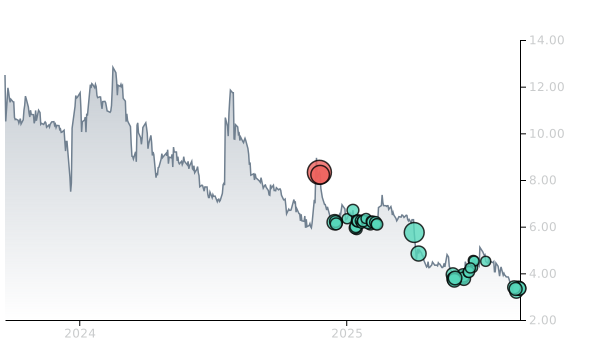
$MDBH insiders have traded $MDBH stock on the open market 1 times in the past 6 months. Of those trades, 0 have been purchases and 1 have been sales.
Here’s a breakdown of recent trading of $MDBH stock by insiders over the last 6 months:
- JEREMY WILLIAM JAMES (CFO) sold 60 shares for an estimated $200
To track insider transactions, check out Quiver Quantitative's insider trading dashboard. You can access data on insider stock transactions through the Quiver Quantitative API insider transaction endpoint.
$MDBH Hedge Fund Activity
We have seen 2 institutional investors add shares of $MDBH stock to their portfolio, and 3 decrease their positions in their most recent quarter.
Here are some of the largest recent moves:
- BEACON POINTE ADVISORS, LLC added 30,000 shares (+inf%) to their portfolio in Q1 2026, for an estimated $89,400
- CITADEL ADVISORS LLC removed 24,668 shares (-100.0%) from their portfolio in Q1 2026, for an estimated $73,510
- SUSQUEHANNA INTERNATIONAL GROUP, LLP added 12,397 shares (+inf%) to their portfolio in Q1 2026, for an estimated $36,943
- DRW SECURITIES, LLC removed 12,283 shares (-100.0%) from their portfolio in Q1 2026, for an estimated $36,603
- UBS GROUP AG removed 1,145 shares (-2.1%) from their portfolio in Q1 2026, for an estimated $3,412
- PASADENA PRIVATE WEALTH, LLC added 0 shares (+0.0%) to their portfolio in Q1 2026, for an estimated $0
- MORGAN STANLEY added 0 shares (+0.0%) to their portfolio in Q1 2026, for an estimated $0
To track hedge funds' stock portfolios, check out Quiver Quantitative's institutional holdings dashboard. You can access data on hedge funds moves and 13F filings through the Quiver Quantitative API 13F endpoint.
Full Release
DALLAS, Texas, July 23, 2026 (GLOBE NEWSWIRE) -- PatentVest, the first fully integrated IP intelligence, strategy, and law firm, today released its latest PatentVest Pulse, an in-depth analysis of OpenAI's published patent portfolio and intellectual property strategy. Titled "What Is OpenAI Actually Patenting?", the report examines how OpenAI's patent activity aligns with its expanding AI product ecosystem and long-term competitive positioning.
Generative AI is rapidly evolving beyond conversational interfaces into intelligent systems capable of creating media, writing and executing code, operating software, coordinating workflows, and supporting persistent digital work. OpenAI has played a defining role in that transformation through products including ChatGPT, Canvas, Sora, its developer platform, and emerging computer-use and automation capabilities.
Why This Matters
While much of the industry focuses on foundation models, patents provide a different perspective. Published patent filings reveal where companies are investing to build long-term competitive advantages beyond the underlying AI models.
By analyzing OpenAI's published patent portfolio as a whole, PatentVest identifies the technologies, product categories, and infrastructure that may shape the company's next stage of growth.
What the Analysis Revealed
Rather than examining individual patents in isolation, PatentVest analyzed all 69 published patent families owned by OpenAI, representing approximately 35 underlying inventions across 13 technology categories.
The report distinguishes between the 49 patent families developed internally by OpenAI and the 20 additional families acquired through Rain Neuromorphics and Rockset, providing a clearer understanding of OpenAI's organic intellectual property strategy.
Viewed together, the portfolio resembles a strategic roadmap documenting OpenAI's expansion from conversational AI into generative media, AI agents, developer infrastructure, personalization, and persistent digital work.
A significant portion of OpenAI's visible patent portfolio has entered the public record only recently. By consolidating these newly published filings, the report offers one of the most current portfolio-level views of OpenAI's patent strategy available today.
Competitive Landscape
Beyond OpenAI itself, the report analyzes patent citation relationships with Microsoft, IBM, and Google while comparing OpenAI's strategy with Anthropic's smaller, largely acquisition-driven patent portfolio.
Together, these portfolios provide valuable insight into how frontier AI companies are building intellectual property around products, platforms, and infrastructure rather than solely around foundation models.
Key Insights
- Product Leadership Across Generative AI: OpenAI's patents span conversational AI, document editing, generative media, AI agents, personalization, and adaptive interfaces that closely align with the company's commercial product roadmap.
- From Conversational AI to Persistent Agents: Patents covering computer-use, automation, memory, state management, and multi-agent systems illustrate OpenAI's evolution toward software capable of maintaining context and completing work over time.
- Developer Platform and Infrastructure at Scale: Patents involving APIs, tool use, code execution, retrieval systems, and model serving reinforce OpenAI's position as infrastructure for developers building AI-powered applications.
- A Product Roadmap Recorded in Patents: Many of the published filings closely mirror the introduction of ChatGPT capabilities, Sora, Canvas, AI agents, and other product initiatives.
- The Broader Competitive Landscape: The report compares OpenAI's patent strategy with Microsoft, Google, IBM, and Anthropic, highlighting how leading AI companies are approaching intellectual property in the generative AI era.
"OpenAI's patent portfolio is most revealing when viewed as an integrated strategy rather than as individual filings. Together, the patents map the company's expansion from conversational AI into generative media, software agents, and the infrastructure for persistent digital work. As OpenAI moves toward the public markets, its intellectual property portfolio becomes more than a record of product development, it becomes a strategic business asset. Patent litigation has not yet defined generative AI, but as valuations rise, products converge, and competition intensifies, that is unlikely to last." said Tyler Teske, Business Development & Training Manager at PatentVest.
Access the Full OpenAI Patent Portfolio Analysis
Explore PatentVest's complete analysis of OpenAI's patent portfolio, technology categories, competitive positioning, and intellectual property strategy.
Download the full PatentVest Pulse here: https://insights.patentvest.com/openai-and-anthropics-ip-portfolios .
For additional information, visit www.patentvest.com or contact the PatentVest team.
Methodology
The analysis is based on published patent materials and portfolio data available as of July 2026. Product mappings reflect the subject matter described in the patents and should not be interpreted as legal conclusions regarding claim scope, validity, or enforceability.
About PatentVest
PatentVest, a division of MDB Capital Holdings (Nasdaq: MDBH), is the first integrated IP intelligence, patent strategy, and intellectual property law firm helping visionary companies build defensible innovation strategies. By combining proprietary patent intelligence, AI-driven analytics, and expert legal analysis, PatentVest delivers actionable insights that help organizations strengthen competitive positioning, reduce IP risk, and make informed strategic decisions.
Learn more at www.patentvest.com .
Media Contact
[email protected]