


Organogenesis announces Phase 3 trial results of ReNu for knee osteoarthritis, showing numerical pain reduction and plans for FDA meeting.
Quiver AI Summary
Organogenesis Holdings Inc. announced that its second Phase 3 trial for ReNu, an innovative therapy for knee osteoarthritis, did not meet its primary endpoint of statistical significance, but showed a numerical improvement in pain reduction compared to the first trial. The trial demonstrated a baseline pain reduction of -6.9 for ReNu versus -6.0 in the first trial. Although the results were not statistically significant in the second trial, the company will request a pre-BLA meeting with the FDA to discuss the submission pathway, combining data from both trials to support a Biologics License Application. ReNu has shown a favorable safety profile and has received FDA Regenerative Medicine Advanced Therapy designation, underscoring its potential to fulfill unmet medical needs for millions suffering from knee OA.
Potential Positives
- Company maintains confidence in ReNu's potential as an innovative pain management therapy despite not meeting the primary endpoint, showing a numerical improvement in pain reduction over previous trials.
- Statistically significant maintenance of function (p<0.0001) indicates positive functional outcomes for patients using ReNu.
- Organogenesis plans to request a pre-BLA meeting with the FDA, demonstrating proactive steps toward regulatory submission and potential approval.
- ReNu received FDA Regenerative Medicine Advanced Therapy (RMAT) designation, emphasizing its potential to address an unmet medical need in knee osteoarthritis treatment.
Potential Negatives
- The second Phase 3 trial did not achieve statistical significance for its primary endpoint, which may raise concerns about the efficacy of ReNu compared to saline.
- Despite numerical improvements, the failure to meet the primary endpoint could undermine confidence among investors and stakeholders regarding the product's market potential.
- The need for a pre-BLA meeting with the FDA suggests uncertainty in the approval process, indicating that additional regulatory hurdles may lie ahead for ReNu.
FAQ
What is ReNu and its purpose?
ReNu is a cryopreserved amniotic suspension allograft developed to manage symptoms associated with knee osteoarthritis.
What were the results of the second Phase 3 trial for ReNu?
The second Phase 3 trial showed numerical improvement in baseline pain reduction but did not meet the primary endpoint.
What is the significance of the FDA's RMAT designation for ReNu?
The RMAT designation indicates ReNu has the potential to address an unmet medical need for knee osteoarthritis treatment.
How many patients were involved in the ReNu clinical trials?
ReNu has been studied in three large randomized controlled trials with more than 1,300 patients combined.
What are the next steps for ReNu in the FDA approval process?
Organogenesis plans to request a pre-BLA meeting with the FDA to discuss the submission pathway for ReNu.
Disclaimer: This is an AI-generated summary of a press release distributed by GlobeNewswire. The model used to summarize this release may make mistakes. See the full release here.
$ORGO Insider Trading Activity
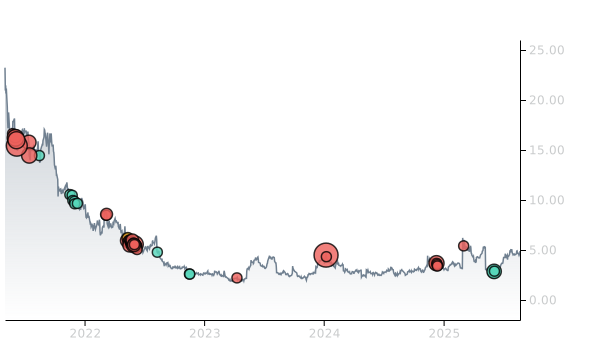
$ORGO insiders have traded $ORGO stock on the open market 3 times in the past 6 months. Of those trades, 3 have been purchases and 0 have been sales.
Here’s a breakdown of recent trading of $ORGO stock by insiders over the last 6 months:
- LORI FREEDMAN (Chief Admin. and Legal Officer) has made 3 purchases buying 252,264 shares for an estimated $725,290 and 0 sales.
To track insider transactions, check out Quiver Quantitative's insider trading dashboard.
$ORGO Hedge Fund Activity
We have seen 50 institutional investors add shares of $ORGO stock to their portfolio, and 98 decrease their positions in their most recent quarter.
Here are some of the largest recent moves:
- FIRST LIGHT ASSET MANAGEMENT, LLC added 6,777,163 shares (+inf%) to their portfolio in Q2 2025, for an estimated $24,804,416
- DEERFIELD MANAGEMENT COMPANY, L.P. removed 4,447,740 shares (-100.0%) from their portfolio in Q2 2025, for an estimated $16,278,728
- ASSENAGON ASSET MANAGEMENT S.A. added 2,520,941 shares (+748.1%) to their portfolio in Q2 2025, for an estimated $9,226,644
- DRIEHAUS CAPITAL MANAGEMENT LLC removed 1,795,347 shares (-100.0%) from their portfolio in Q2 2025, for an estimated $6,570,970
- INVESCO LTD. removed 920,555 shares (-86.1%) from their portfolio in Q2 2025, for an estimated $3,369,231
- DEUTSCHE BANK AG\ added 836,047 shares (+34.2%) to their portfolio in Q2 2025, for an estimated $3,059,932
- VANGUARD GROUP INC added 765,378 shares (+17.3%) to their portfolio in Q2 2025, for an estimated $2,801,283
To track hedge funds' stock portfolios, check out Quiver Quantitative's institutional holdings dashboard.
$ORGO Analyst Ratings
Wall Street analysts have issued reports on $ORGO in the last several months. We have seen 1 firms issue buy ratings on the stock, and 0 firms issue sell ratings.
Here are some recent analyst ratings:
- Cantor Fitzgerald issued a "Overweight" rating on 08/08/2025
To track analyst ratings and price targets for $ORGO, check out Quiver Quantitative's $ORGO forecast page.
Full Release
Company maintains confidence in ReNu as innovative pain management therapy
-
Second Phase 3 trial demonstrates numerical improvement in baseline pain reduction over the first Phase 3 trial despite not meeting the primary endpoint
-
Statistically significant maintenance of function (p<0.0001)
-
Company will request pre-BLA meeting with FDA to discuss submission pathway
CANTON, Mass., Sept. 25, 2025 (GLOBE NEWSWIRE) -- Organogenesis Holdings Inc. (Nasdaq: ORGO), a leading regenerative medicine company focused on the development, manufacture and commercialization of product solutions for the Advanced Wound Care and Surgical and Sports Medicine markets, today announced that the second Phase 3 randomized controlled trial (RCT) of ReNu, a cryopreserved amniotic suspension allograft (ASA) for the management of symptoms associated with knee osteoarthritis (OA), did not achieve statistical significance for its primary endpoint, despite the ReNu results demonstrating a numerical improvement in baseline pain reduction over the first Phase 3 trial. Baseline pain reduction at six months for ReNu was -6.9 for the second Phase 3 study compared to -6.0 in the first Phase 3 study. Additionally, the ReNu results continued to demonstrate a favorable safety profile.
The primary endpoint for the study is the difference between ReNu and Saline groups in the reduction in knee pain at six months assessed by the Western Ontario and McMaster Universities Arthritis Index (WOMAC) pain scale. The study demonstrated a numerical improvement of -0.5 1 favoring ReNu (p=0.0393 one-sided p-value, compared to p=0.023 target threshold). The first Phase 3 trial achieved improvement of -0.7 2 favoring ReNu, which was statistically significant (p=0.0177, one sided p-value, compared to p=0.023 target threshold).
“Given the first Phase 3 trial achieved a statistically significant reduction in pain compared to Saline and the second Phase 3 trial demonstrated a numerical improvement in baseline pain reduction over the first Phase 3, we believe these results support the potential approval of ReNu for pain symptoms associated with knee OA, including those patients classified as most severe,” said Patrick Bilbo, Chief Operating Officer of Organogenesis. “As a next step, we will request a pre-BLA meeting with the FDA by the end of October to discuss the submission pathway, including using the combined efficacy analysis from both Phase 3 studies to support a BLA approval.”
ReNu has now been studied in three large RCTs of more than 1,300 patients combined. Organogenesis believes the totality of this data is compelling evidence for the FDA to review in a Biologics License Application (BLA). Additionally, the FDA granted ReNu Regenerative Medicine Advanced Therapy (RMAT) designation based on ReNu demonstrating the potential to treat an unmet medical need related to a serious condition.
“The results for ReNu support our continued confidence in the potential of ReNu as an innovative pain management product,” said Gary S. Gillheeney, Sr., President, Chief Executive Officer and Chair of the Board for Organogenesis. “We believe ReNu, if approved, will address a significant unmet medical need for the millions of Americans suffering from symptomatic knee OA.”
Knee OA is a degenerative joint disease that is estimated to affect more than 30 million Americans. It is ranked among the most common causes of disability and poor quality of life, generally characterized by pain and functionality deficits. End stage management of the disease in these patients is typically a total knee replacement when all other treatment options are exhausted.
The fully enrolled 594 patient second Phase 3 trial is a prospective, double-blind, multicenter, saline-controlled, parallel group, RCT of ReNu ASA, for the treatment of subjects with mild to severe symptomatic knee OA. Patients were randomized to receive a single intra-articular (IA) injection of either saline control or ReNu.
Additional top-line data tables from both Phase 3 studies are available in a Current Report on Form 8-K, which the Company filed today with the SEC and can be found at SEC.gov.
About ReNu®
ReNu is a cryopreserved, amniotic suspension allograft (ASA) developed for the management of symptomatic knee osteoarthritis. ReNu consists of amniotic fluid cells and micronized amniotic membrane and contains cellular, growth factor, and extracellular matrix components. ReNu received FDA Regenerative Medicine Advanced Therapy (RMAT) designation for Knee OA in 2021.
About Organogenesis Holdings Inc.
Organogenesis Holdings Inc. is a leading regenerative medicine company focused on the development, manufacture, and commercialization of solutions for the advanced wound care and surgical and sports medicine markets. Organogenesis offers a comprehensive portfolio of innovative regenerative products to address patient needs across the continuum of care. For more information, visit www.organogenesis.com .
Forward-Looking Statements
This release contains forward-looking statements within the meaning of the Private Securities Litigation Reform Act of 1995. These forward-looking statements relate to expectations or forecasts of future events. Forward-looking statements may be identified by the use of words such as “intend,” “seek,” “anticipate,” “believe,” “expect,” “estimate,” “potential” and other similar expressions that predict or indicate future events or trends or that are not statements of historical matters. These statements concern, and these risks and uncertainties include, among others: the risks and uncertainties inherent in clinical development; the FDA may require additional evidence for ReNu before we can submit a BLA or get a BLA approved, which we may not be able to obtain; that other clinical trials of ReNu may produce different results; the likelihood and timing of possible regulatory approval and commercial launch of ReNu; determinations by regulatory and administrative governmental authorities which may delay or restrict our ability to develop or commercialize ReNu; ongoing regulatory obligations and oversight impacting ReNu; unforeseen safety issues resulting from the administration of ReNu in patients; competing products and product candidates that may be superior to our products and product candidates; uncertainty of market acceptance and commercial success of ReNu and the impact of studies (whether conducted by us or others and whether mandated or voluntary) on the commercial success of ReNu; our ability to manufacture and manage supply components for ReNu; the availability and extent of reimbursement of ReNu from third-party payers, including private payer healthcare and insurance programs and government programs such as Medicare and Medicaid; coverage and reimbursement determinations by such payers, including local coverage determinations by Medicare Part A/B Medicare Administrative Contractors; new policies and procedures adopted by such payers; unanticipated expenses; the costs of developing, producing, and selling ReNu; our ability to meet our sales or other financial projections or guidance and changes to the assumptions underlying those projections or guidance; and other risks and uncertainties described in the Company's filings with the Securities and Exchange Commission, including Item 1A (Risk Factors) of the Company's Form 10-K for the year ended December 31, 2024 and its subsequently filed periodic reports. You are cautioned not to place undue reliance upon any forward-looking statements, which speak only as of the date made. Although it may voluntarily do so from time to time, the Company undertakes no commitment to update or revise the forward-looking statements, whether as a result of new information, future events or otherwise, except as required by applicable securities laws.
1 Second Phase 3 Reduction in baseline knee pain at six months assessed by WOMAC pain scale: ReNu -6.9 & Saline -6.4
2 First Phase 3 Reduction in baseline knee pain at six months assessed by WOMAC pain scale: ReNu -6.0 & Saline -5.3