


Opus Genetics advances its BEST1 trial after positive safety review, seeking to address vision loss in Best disease patients.
Quiver AI Summary
Opus Genetics announced that the Independent Data Monitoring Committee (IDMC) has recommended continuing the Phase 1/2 BEST1 clinical trial (BIRD-1) of their gene therapy OPGx-BEST1 for patients with Best disease, a form of inherited retinal disease. The recommendation follows a positive safety review of data from the first participant, allowing the company to proceed with recruiting and dosing additional participants. CEO George Magrath expressed confidence in advancing the trial, which aims to evaluate the safety, tolerability, and efficacy of OPGx-BEST1 in treating Best Vitelliform Macular Dystrophy and Autosomal-Recessive Bestrophinopathy. Opus Genetics focuses on gene therapies to treat inherited retinal diseases and is developing multiple AAV-based programs to address the genetic causes of severe retinal disorders.
Potential Positives
- IDMC issued a positive recommendation to continue the Phase 1/2 BEST1 clinical trial, indicating the trial has met safety benchmarks.
- The safety review of the first participant's data showed encouraging results, allowing the company to proceed with enrolling additional participants.
- This progress reinforces the potential of OPGx-BEST1 as a treatment for Best disease, addressing a significant unmet medical need in a rare patient population.
- The company has a comprehensive pipeline of gene therapy programs targeting various inherited retinal diseases, highlighting its commitment to advancing treatments in this field.
Potential Negatives
- While the Independent Data Monitoring Committee recommended continuing the trial, the fact that this is only a Phase 1/2 trial indicates that the product is still in early development and may not lead to market availability for an extended period.
- The reliance on forward-looking statements in the press release highlights inherent risks and uncertainties that could impact the company's future performance and the successful development of their therapies.
- The mention of a limited patient population affected by Best disease (approximately 9,000 in the U.S.) raises concerns about the commercial viability and market size of the treatment, potentially limiting revenue prospects.
FAQ
What is Opus Genetics known for?
Opus Genetics specializes in developing gene therapies aimed at restoring vision and preventing blindness from inherited retinal diseases.
What is the Phase 1/2 BEST1 trial about?
The BEST1 trial evaluates the safety and efficacy of OPGx-BEST1 in patients with Best disease through a dose-exploring study.
What was the outcome of the IDMC's review?
The IDMC recommended to continue the trial as planned, based on positive safety results from the first participant.
What is Best disease?
Best disease is a rare inherited condition that leads to vision loss due to mutations in the BEST1 gene affecting retinal function.
How does OPGx-BEST1 work?
OPGx-BEST1 delivers a functional BEST1 gene copy to retinal cells via an AAV-based gene therapy platform, potentially restoring vision.
Disclaimer: This is an AI-generated summary of a press release distributed by GlobeNewswire. The model used to summarize this release may make mistakes. See the full release here.
$IRD Revenue
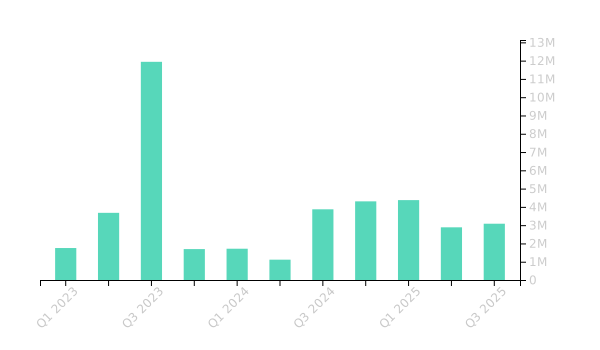
$IRD had revenues of $3.1M in Q3 2025. This is a decrease of -20.38% from the same period in the prior year.
You can track IRD financials on Quiver Quantitative's IRD stock page.
$IRD Hedge Fund Activity
We have seen 21 institutional investors add shares of $IRD stock to their portfolio, and 13 decrease their positions in their most recent quarter.
Here are some of the largest recent moves:
- ADAGE CAPITAL PARTNERS GP, L.L.C. added 954,996 shares (+inf%) to their portfolio in Q3 2025, for an estimated $1,575,743
- AWM INVESTMENT COMPANY, INC. removed 524,245 shares (-100.0%) from their portfolio in Q2 2025, for an estimated $493,891
- VANGUARD GROUP INC added 349,825 shares (+35.3%) to their portfolio in Q3 2025, for an estimated $577,211
- CREATIVE PLANNING added 128,366 shares (+inf%) to their portfolio in Q3 2025, for an estimated $211,803
- MILLENNIUM MANAGEMENT LLC removed 127,844 shares (-100.0%) from their portfolio in Q3 2025, for an estimated $210,942
- ROYAL BANK OF CANADA removed 127,220 shares (-100.0%) from their portfolio in Q3 2025, for an estimated $209,913
- OPALEYE MANAGEMENT INC. removed 120,000 shares (-9.8%) from their portfolio in Q3 2025, for an estimated $198,000
To track hedge funds' stock portfolios, check out Quiver Quantitative's institutional holdings dashboard.
$IRD Analyst Ratings
Wall Street analysts have issued reports on $IRD in the last several months. We have seen 5 firms issue buy ratings on the stock, and 0 firms issue sell ratings.
Here are some recent analyst ratings:
- Piper Sandler issued a "Overweight" rating on 11/25/2025
- Chardan Capital issued a "Buy" rating on 11/13/2025
- Wedbush issued a "Outperform" rating on 10/29/2025
- HC Wainwright & Co. issued a "Buy" rating on 06/27/2025
- LUCID CAPITAL MARKETS issued a "Buy" rating on 06/17/2025
To track analyst ratings and price targets for $IRD, check out Quiver Quantitative's $IRD forecast page.
$IRD Price Targets
Multiple analysts have issued price targets for $IRD recently. We have seen 5 analysts offer price targets for $IRD in the last 6 months, with a median target of $8.0.
Here are some recent targets:
- Biren Amin from Piper Sandler set a target price of $7.0 on 11/25/2025
- Daniil Gataulin from Chardan Capital set a target price of $9.0 on 11/13/2025
- Yun Zhong from Wedbush set a target price of $8.0 on 10/29/2025
- Matthew Caufield from HC Wainwright & Co. set a target price of $8.0 on 06/27/2025
- Dev Prasad from LUCID CAPITAL MARKETS set a target price of $5.0 on 06/17/2025
Full Release
RESEARCH TRIANGLE PARK, N.C., Dec. 09, 2025 (GLOBE NEWSWIRE) -- Opus Genetics (Nasdaq: IRD) (“Opus Genetics” or the “Company”), a clinical-stage biopharmaceutical company developing gene therapies to restore vision and prevent blindness in patients with inherited retinal diseases (IRDs), today announced that the Independent Data Monitoring Committee (IDMC) issued a positive recommendation to continue as planned in the Company’s Phase 1/2 BEST1 clinical trial (BIRD-1), which is a multi-center, adaptive, open-label, dose-exploring study evaluating OPGx-BEST1 in participants with Best disease.
The IDMC overseeing the trial completed its pre-specified safety review of the one-month data from the sentinel participant and recommended advancing enrollment and dosing of additional participants in the trial, without modification.
“We are thrilled with this outcome from the first participant, whose encouraging safety results at one month enable us to proceed with dosing the next four participants in our BEST1 Phase 1/2 trial,” said George Magrath, M.D., Chief Executive Officer, Opus Genetics. “The IDMC’s safety review and recommendation to continue the trial reinforces our confidence as we advance this program. BEST1-associated retinal diseases constitute a substantial unmet medical need, and this progress with OPGx-BEST1 represents an important step toward potentially preserving and restoring visual function for patients with Best disease.”
About OPGx-BEST1 and the Phase 1/2 Trial
OPGx-BEST1 leverages Opus Genetics’ proprietary AAV-based gene therapy platform, designed to deliver a functional copy of the BEST1 gene directly to the retinal pigment epithelium (RPE) cells where the defective gene resides. The program builds on extensive preclinical work demonstrating restoration of BEST1 protein expression and improved retinal function in relevant disease models.
The multi-center, adaptive, open-label, dose-exploring study, known as BIRD-1, will evaluate the safety, tolerability, and preliminary efficacy of OPGx-BEST1 in participants with Best Vitelliform Macular Dystrophy (BVMD) or Autosomal-Recessive Bestrophinopathy (ARB). Treatment will be administered via a single subretinal injection in one eye of each participant with two dosing cohorts. The trial will also explore biological activity through functional and anatomical endpoints, including changes in visual function and retinal structure.
About BEST1 Inherited Retinal Disease
Best disease, or vitelliform macular dystrophy, is a rare inherited retinal condition caused by mutations in the BEST1 gene, leading to impaired retinal pigment epithelium (RPE) function, progressive vision loss, and, in some cases, blindness. The BEST1 gene is responsible for providing instructions to produce bestrophin, a protein that acts as a channel to manage the movement of charged chloride ions in and out of retinal cells. Variants (mutations) in the BEST1 gene, as well as the PRPH2 gene, can result in the formation of abnormally shaped channels that cannot properly control chloride flow. BEST1 plays a key role in the RPE, which is essential for healthy vision, and such mutations can lead to BEST1-related inherited retinal diseases (bestrophinopathies). These rare conditions affect an estimated 9,000 patients across the United States and can lead to progressive vision loss and blindness.
About Opus Genetics
Opus Genetics is a clinical-stage biopharmaceutical company developing gene therapies to restore vision and prevent blindness in patients with inherited retinal diseases (IRDs). The Company is developing durable, one-time treatments designed to address the underlying genetic causes of severe retinal disorders. The Company’s pipeline includes seven AAV-based programs, led by OPGx-LCA5 for LCA5-related mutations and OPGx-BEST1 for BEST1-related retinal degeneration, with additional candidates targeting RHO, RDH12, and MERTK. Opus Genetics is also advancing Phentolamine Ophthalmic Solution 0.75%, an approved small-molecule therapy for pharmacologically induced mydriasis, with additional indications in late-stage development for presbyopia and low-light visual disturbances following keratorefractive surgery. The Company is based in Research Triangle Park, NC. For more information, please visit www.opusgtx.com .
Forward Looking Statements
This press release contains forward-looking statements within the meaning of the Private Securities Litigation Reform Act of 1995. Such statements include, but are not limited to, statements related to the clinical development, clinical results, preclinical data, and future plans for Phentolamine Ophthalmic Solution 0.75%, OPGx-LCA5, OPGx-BEST1, RDH12, and earlier stage programs, and expectations regarding us, our business prospects, and our results of operations and are subject to certain risks and uncertainties posed by many factors and events that could cause our actual business, prospects and results of operations to differ materially from those anticipated by such forward-looking statements. Factors that could cause or contribute to such differences include, but are not limited to, those described under the heading “Risk Factors” included in our Annual Report on Form 10-K for the fiscal year ended December 31, 2024 and in our other filings with the U.S. Securities and Exchange Commission. Readers are cautioned not to place undue reliance on these forward-looking statements, which speak only as of the date of this press release. These forward-looking statements are based upon our current expectations and involve assumptions that may never materialize or may prove to be incorrect. Actual results and the timing of events could differ materially from those anticipated in such forward-looking statements as a result of various risks and uncertainties. In some cases, you can identify forward-looking statements by the following words: “anticipate,” “believe,” “continue,” “could,” “estimate,” “expect,” “intend,” “aim,” “may,” “ongoing,” “plan,” “potential,” “predict,” “project,” “should,” “strive,” “will,” “would” or the negative of these terms or other comparable terminology, although not all forward-looking statements contain these words. We undertake no obligation to revise any forward-looking statements in order to reflect events or circumstances that might subsequently arise.
Contacts
Investors
Jenny Kobin
Remy Bernarda
IR Advisory Solutions
[email protected]
Media
Kimberly Ha
KKH Advisors
917-291-5744
[email protected]
Source: Opus Genetics, Inc.