

NVIDIA launches Alpamayo, an open AI model family enhancing autonomous vehicle reasoning with simulation tools and extensive datasets.
Quiver AI Summary
NVIDIA has announced the launch of the Alpamayo family, the first open reasoning vision language action (VLA) model aimed at enhancing autonomous vehicle (AV) development, especially in addressing long-tail driving challenges. This family includes Alpamayo 1, a chain-of-thought reasoning model for the AV research community, as well as AlpaSim, a comprehensive simulation framework, and Physical AI Open Datasets that provide extensive driving data for refining reasoning capabilities in AV systems. These tools aim to enable vehicles to operate safely in complex environments and to articulate their decision-making processes, fostering greater trust and safety in autonomous driving. Major industry players like Lucid, Uber, and JLR are backing this initiative, which emphasizes the need for reasoning-based models to handle unpredictable driving scenarios and achieve level 4 autonomy.
Potential Positives
- NVIDIA is the first company to launch an open reasoning VLA model aimed at addressing long-tail challenges in autonomous driving, showcasing innovation in a key technology area.
- The Alpamayo family of tools, including simulation frameworks and extensive datasets, provides a comprehensive environment for developers, which can significantly accelerate the development of safe and efficient autonomous vehicles.
- Prominent partnerships with industry leaders like JLR, Lucid, and Uber indicate strong market support and collaboration in advancing level 4 autonomy.
- The open-source nature of the Alpamayo models fosters transparency and encourages innovation across the automotive industry, positioning NVIDIA as a leader in AI for autonomous mobility.
Potential Negatives
- Heavy reliance on third parties for manufacturing, which could present risks if there are disruptions in the supply chain or quality issues.
- Forward-looking statements indicate uncertainty in performance and market acceptance, creating potential risks for investors and stakeholders.
- Acknowledgment of various factors that could cause actual results to differ materially from expectations, highlighting inherent business risks.
FAQ
What is the NVIDIA Alpamayo family?
The NVIDIA Alpamayo family consists of open AI models, simulation tools, and datasets aimed at enhancing autonomous vehicle development.
How does Alpamayo improve autonomous vehicle safety?
Alpamayo introduces reasoning-based models that help vehicles analyze rare scenarios, improving decision-making and overall safety in complex driving environments.
Who are the key industry partners using Alpamayo?
Key partners include mobility leaders like JLR, Lucid, Uber, and the AV research community, helping to advance reasoning-based AV development.
Where can developers access Alpamayo tools?
Developers can access Alpamayo tools, including Alpamayo 1 and AlpaSim, through platforms like Hugging Face and GitHub.
What makes Alpamayo's datasets unique?
The Physical AI Open Datasets provide over 1,700 hours of diverse driving data essential for developing reasoning architectures in AVs.
Disclaimer: This is an AI-generated summary of a press release distributed by GlobeNewswire. The model used to summarize this release may make mistakes. See the full release here.
$NVDA Insider Trading Activity
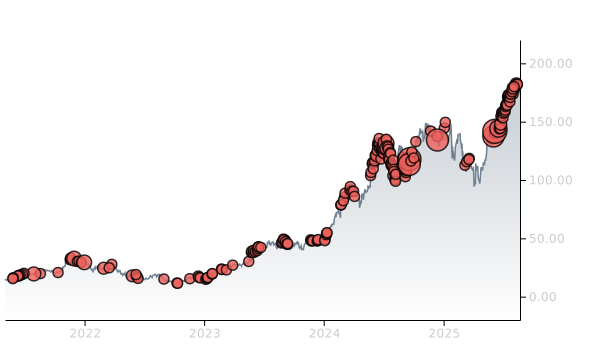
$NVDA insiders have traded $NVDA stock on the open market 479 times in the past 6 months. Of those trades, 0 have been purchases and 479 have been sales.
Here’s a breakdown of recent trading of $NVDA stock by insiders over the last 6 months:
- JEN HSUN HUANG (President and CEO) has made 0 purchases and 336 sales selling 5,325,000 shares for an estimated $944,877,603.
- MARK A STEVENS has made 0 purchases and 5 sales selling 1,420,297 shares for an estimated $253,987,187.
- HARVEY C JONES has made 0 purchases and 2 sales selling 500,000 shares for an estimated $88,387,150.
- DEBORA SHOQUIST (EVP, Operations) has made 0 purchases and 20 sales selling 309,840 shares for an estimated $56,186,171.
- COLETTE KRESS (EVP & Chief Financial Officer) has made 0 purchases and 84 sales selling 291,570 shares for an estimated $53,095,710.
- A BROOKE SEAWELL has made 0 purchases and 20 sales selling 308,548 shares for an estimated $50,340,691.
- DAWN E HUDSON has made 0 purchases and 2 sales selling 90,000 shares for an estimated $15,381,064.
- PERSIS DRELL sold 40,000 shares for an estimated $7,106,120
- DONALD F JR ROBERTSON (Principal Accounting Officer) has made 0 purchases and 7 sales selling 28,090 shares for an estimated $5,043,024.
- STEPHEN C NEAL sold 28,000 shares for an estimated $4,972,343
- JOHN DABIRI sold 626 shares for an estimated $112,316
To track insider transactions, check out Quiver Quantitative's insider trading dashboard.
$NVDA Revenue
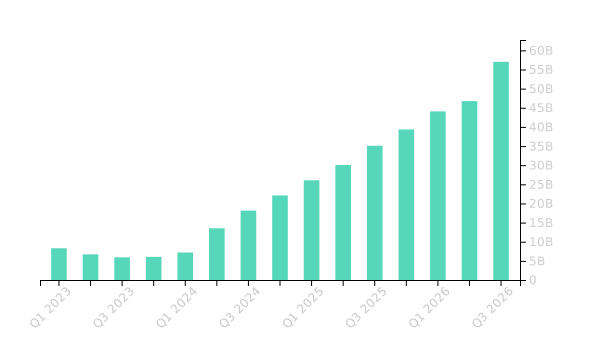
$NVDA had revenues of $57B in Q3 2026. This is an increase of 62.49% from the same period in the prior year.
You can track NVDA financials on Quiver Quantitative's NVDA stock page.
$NVDA Congressional Stock Trading
Members of Congress have traded $NVDA stock 44 times in the past 6 months. Of those trades, 38 have been purchases and 6 have been sales.
Here’s a breakdown of recent trading of $NVDA stock by members of Congress over the last 6 months:
- REPRESENTATIVE DWIGHT EVANS purchased up to $15,000 on 11/21.
- REPRESENTATIVE GILBERT RAY CISNEROS, JR. has traded it 2 times. They made 2 purchases worth up to $65,000 on 11/18, 10/17 and 0 sales.
- REPRESENTATIVE LISA C. MCCLAIN has traded it 3 times. They made 1 purchase worth up to $50,000 on 10/30 and 2 sales worth up to $100,000 on 10/31, 10/30.
- REPRESENTATIVE CLEO FIELDS has traded it 32 times. They made 32 purchases worth up to $5,500,000 on 10/30, 09/03, 08/22, 08/20, 08/15, 08/13, 08/06, 08/01, 07/29, 07/17, 07/16, 07/14, 07/10 and 0 sales.
- SENATOR SHELDON WHITEHOUSE has traded it 3 times. They made 0 purchases and 3 sales worth up to $150,000 on 10/20, 09/04, 07/07.
- REPRESENTATIVE VAL T. HOYLE sold up to $100,000 on 09/23.
- SENATOR JOHN BOOZMAN purchased up to $15,000 on 08/22.
- SENATOR ANGUS S. KING JR. purchased up to $15,000 on 07/21.
To track congressional stock trading, check out Quiver Quantitative's congressional trading dashboard.
$NVDA Hedge Fund Activity
We have seen 2,536 institutional investors add shares of $NVDA stock to their portfolio, and 2,352 decrease their positions in their most recent quarter.
Here are some of the largest recent moves:
- KINGSTONE CAPITAL PARTNERS TEXAS, LLC removed 382,240,291 shares (-100.0%) from their portfolio in Q3 2025, for an estimated $71,318,393,494
- UBS AM, A DISTINCT BUSINESS UNIT OF UBS ASSET MANAGEMENT AMERICAS LLC added 155,215,336 shares (+65.3%) to their portfolio in Q3 2025, for an estimated $28,960,077,390
- JPMORGAN CHASE & CO added 26,032,415 shares (+5.6%) to their portfolio in Q3 2025, for an estimated $4,857,127,990
- CAPITAL RESEARCH GLOBAL INVESTORS added 22,896,705 shares (+16.1%) to their portfolio in Q3 2025, for an estimated $4,272,067,218
- BLACKROCK, INC. added 19,470,172 shares (+1.0%) to their portfolio in Q3 2025, for an estimated $3,632,744,691
- DANSKE BANK A/S removed 18,086,339 shares (-96.9%) from their portfolio in Q3 2025, for an estimated $3,374,549,130
- FMR LLC removed 15,271,223 shares (-1.5%) from their portfolio in Q3 2025, for an estimated $2,849,304,787
To track hedge funds' stock portfolios, check out Quiver Quantitative's institutional holdings dashboard.
$NVDA Analyst Ratings
Wall Street analysts have issued reports on $NVDA in the last several months. We have seen 31 firms issue buy ratings on the stock, and 0 firms issue sell ratings.
Here are some recent analyst ratings:
- Truist Securities issued a "Buy" rating on 12/29/2025
- Stifel issued a "Buy" rating on 12/29/2025
- Baird issued a "Outperform" rating on 12/26/2025
- B of A Securities issued a "Buy" rating on 12/26/2025
- Bernstein issued a "Outperform" rating on 12/26/2025
- Tigress Financial issued a "Strong Buy" rating on 12/18/2025
- Morgan Stanley issued a "Overweight" rating on 12/01/2025
To track analyst ratings and price targets for $NVDA, check out Quiver Quantitative's $NVDA forecast page.
$NVDA Price Targets
Multiple analysts have issued price targets for $NVDA recently. We have seen 35 analysts offer price targets for $NVDA in the last 6 months, with a median target of $250.0.
Here are some recent targets:
- William Stein from Truist Securities set a target price of $275.0 on 12/29/2025
- Ruben Roy from Stifel set a target price of $250.0 on 12/29/2025
- Stacy Rasgon from Bernstein set a target price of $275.0 on 12/26/2025
- Vivek Arya from B of A Securities set a target price of $275.0 on 12/26/2025
- Tristan Gerra from Baird set a target price of $275.0 on 12/26/2025
- Ivan Feinseth from Tigress Financial set a target price of $350.0 on 12/18/2025
- Joseph Moore from Morgan Stanley set a target price of $250.0 on 12/01/2025
Full Release
News Summary:
- NVIDIA is the first to release an open reasoning VLA model designed to tackle long-tail autonomous driving challenges; NVIDIA Alpamayo family also includes simulation tools and datasets for AV development.
- Alpamayo 1, AlpaSim and Physical AI Open Datasets enable the development of vehicles that perceive, reason and act with humanlike judgment — enabling developers to fine-tune, distill and test models that unlock greater safety, robustness and scalability.
-
With Alpamayo, mobility leaders such as JLR, Lucid and Uber, along with the AV research community including Berkeley DeepDrive, can fast-track safe, reasoning‑based level 4 deployment roadmaps.
LAS VEGAS, Jan. 05, 2026 (GLOBE NEWSWIRE) -- CES— NVIDIA today unveiled the NVIDIA Alpamayo family of open AI models, simulation tools and datasets designed to accelerate the next era of safe, reasoning‑based autonomous vehicle (AV) development.
AVs must safely operate across an enormous range of driving conditions. Rare, complex scenarios, often called the “long tail,” remain some of the toughest challenges for autonomous systems to safely master. Traditional AV architectures separate perception and planning, which can limit scalability when new or unusual situations arise. Recent advances in end-to-end learning have made significant progress, but overcoming these long-tail edge cases requires models that can safely reason about cause and effect, especially when situations fall outside a model’s training experience.
The Alpamayo family introduces chain-of-thought, reasoning-based vision language action (VLA) models that bring humanlike thinking to AV decision-making. These systems can think through novel or rare scenarios step by step, improving driving capability and explainability — which is critical to scaling trust and safety in intelligent vehicles — and are underpinned by the NVIDIA Halos safety system.
“The ChatGPT moment for physical AI is here — when machines begin to understand, reason and act in the real world,” said Jensen Huang, founder and CEO of NVIDIA. “Robotaxis are among the first to benefit. Alpamayo brings reasoning to autonomous vehicles, allowing them to think through rare scenarios, drive safely in complex environments and explain their driving decisions — it’s the foundation for safe, scalable autonomy.”
A Complete, Open Ecosystem for Reasoning‑Based Autonomy
Alpamayo integrates three foundational pillars — open models, simulation frameworks and datasets — into a cohesive, open ecosystem that any automotive developer or research team can build upon.
Rather than running directly in-vehicle, Alpamayo models serve as large-scale teacher models that developers can fine-tune and distill into the backbones of their complete AV stacks.
At CES, NVIDIA is releasing:
- Alpamayo 1 : The industry’s first chain-of-thought reasoning VLA model designed for the AV research community, now on Hugging Face . With a 10-billion-parameter architecture, Alpamayo 1 uses video input to generate trajectories alongside reasoning traces, showing the logic behind each decision. Developers can adapt Alpamayo 1 into smaller runtime models for vehicle development, or use it as a foundation for AV development tools such as reasoning-based evaluators and auto-labeling systems. Alpamayo 1 provides open model weights and open-source inferencing scripts. Future models in the family will feature larger parameter counts, more detailed reasoning capabilities, more input and output flexibility, and options for commercial usage.
- AlpaSim : A fully open‑source, end-to-end simulation framework for high‑fidelity AV development, available on GitHub . It provides realistic sensor modeling, configurable traffic dynamics and scalable closed‑loop testing environments, enabling rapid validation and policy refinement.
-
Physical AI Open Datasets
: NVIDIA offers the most diverse large-scale, open dataset for AV that contains 1,700+ hours of driving data collected across the widest range of geographies and conditions, covering rare and complex real-world edge cases essential for advancing reasoning architectures. These datasets are available on
Hugging Face
.
Together, these tools enable a self-reinforcing development loop for reasoning-based AV stacks.
Broad AV Industry Supports Alpamayo
Mobility leaders and industry experts, including Lucid, JLR, Uber and Berkeley DeepDrive, are showing interest in Alpamayo to develop reasoning-based AV stacks that will enable level 4 autonomy.
“The shift toward physical AI highlights the growing need for AI systems that can reason about real-world behavior, not just process data,” said Kai Stepper, vice president of ADAS and autonomous driving at Lucid Motors. “Advanced simulation environments, rich datasets and reasoning models are important elements of the evolution.”
“Open, transparent AI development is essential to advancing autonomous mobility responsibly,” said Thomas Müller, executive director of product engineering at JLR. “By open-sourcing models like Alpamayo, NVIDIA is helping to accelerate innovation across the autonomous driving ecosystem, giving developers and researchers new tools to tackle complex real-world scenarios safely.”
“Handling long-tail and unpredictable driving scenarios is one of the defining challenges of autonomy,” said Sarfraz Maredia, global head of autonomous mobility and delivery at Uber. “Alpamayo creates exciting new opportunities for the industry to accelerate physical AI, improve transparency and increase safe level 4 deployments.”
“Alpamayo 1 enables vehicles to interpret complex environments, anticipate novel situations and make safe decisions, even in scenarios not previously encountered,” said Owen Chen, senior principal analyst of S&P Global. “The model’s open-source nature accelerates industry-wide innovation, allowing partners to adapt and refine the technology for their unique needs.”
“The launch of the Alpamayo portfolio represents a major leap forward for the research community,” said Wei Zhan, codirector of Berkeley DeepDrive. “NVIDIA’s decision to make this openly available is transformative as its access and capabilities will enable us to train at unprecedented scale — giving us the flexibility and resources needed to push autonomous driving into the mainstream.”
Beyond Alpamayo, developers can tap into NVIDIA’s rich library of tools and models, including from the NVIDIA Cosmos ™ and NVIDIA Omniverse ™ platforms. Developers can fine-tune model releases on proprietary fleet data, integrate them into the NVIDIA DRIVE Hyperion™ architecture built with NVIDIA DRIVE AGX Thor™ accelerated compute, and validate performance in simulation before commercial deployment.
Learn more by watching NVIDIA Live at CES .
About NVIDIA
NVIDIA
(NASDAQ: NVDA) is the world leader in AI and accelerated computing.
For further information, contact:
Jessica Soares
Corporate Communications
NVIDIA Corporation
[email protected]
Certain statements in this press release including, but not limited to, statements as to:
the ChatGPT moment for physical AI being here; robotaxis being among the first to benefit; Alpamayo bringing reasoning to autonomous vehicles, allowing them to think through rare scenarios, drive safely in complex environments and explain their driving decisions and being the foundation for safe, scalable autonomy; the benefits, impact, performance, and availability of NVIDIA’s products, services, and technologies; expectations with respect to NVIDIA’s third party arrangements, including with its collaborators and partners; expectations with respect to technology developments; and other statements that are not historical facts are forward-looking statements within the meaning of Section 27A of the Securities Act of 1933, as amended, and Section 21E of the Securities Exchange Act of 1934, as amended, which are subject to the “safe harbor” created by those sections based on management’s beliefs and assumptions and on information currently available to management and are subject to risks and uncertainties that could cause results to be materially different than expectations. Important factors that could cause actual results to differ materially include: global economic and political conditions; NVIDIA’s reliance on third parties to manufacture, assemble, package and test NVIDIA’s products; the impact of technological development and competition; development of new products and technologies or enhancements to NVIDIA’s existing product and technologies; market acceptance of NVIDIA’s products or NVIDIA’s partners’ products; design, manufacturing or software defects; changes in consumer preferences or demands; changes in industry standards and interfaces; unexpected loss of performance of NVIDIA’s products or technologies when integrated into systems; and changes in applicable laws and regulations, as well as other factors detailed from time to time in the most recent reports NVIDIA files with the Securities and Exchange Commission, or SEC, including, but not limited to, its annual report on Form 10-K and quarterly reports on Form 10-Q. Copies of reports filed with the SEC are posted on the company’s website and are available from NVIDIA without charge. These forward-looking statements are not guarantees of future performance and speak only as of the date hereof, and, except as required by law, NVIDIA disclaims any obligation to update these forward-looking statements to reflect future events or circumstances.
Many of the products and features described herein remain in various stages and will be offered on a when-and-if-available basis. The statements above are not intended to be, and should not be interpreted as a commitment, promise, or legal obligation, and the development, release, and timing of any features or functionalities described for our products is subject to change and remains at the sole discretion of NVIDIA. NVIDIA will have no liability for failure to deliver or delay in the delivery of any of the products, features or functions set forth herein.
© 2026 NVIDIA Corporation. All rights reserved. NVIDIA, the NVIDIA logo, NVIDIA Cosmos, NVIDIA DRIVE AGX Thor, NVIDIA DRIVE Hyperion and NVIDIA Omniverse are trademarks and/or registered trademarks of NVIDIA Corporation in the U.S. and other countries. Other company and product names may be trademarks of the respective companies with which they are associated. Features, pricing, availability and specifications are subject to change without notice.
A photo accompanying this announcement is available at https://www.globenewswire.com/NewsRoom/AttachmentNg/a4f214a0-8d69-402e-8f17-a7292a2f5a96