


Moleculin Biotech announces preclinical research involving Annamycin at UNC to explore its efficacy in treating pancreatic cancer.
Quiver AI Summary
Moleculin Biotech, Inc. has announced a collaboration with the University of North Carolina at Chapel Hill to conduct preclinical research on Annamycin, a cancer treatment, specifically targeting pancreatic cancer. The agreement will allow researchers at UNC, led by Professor William C. Zamboni, to investigate how Annamycin, alongside novel therapeutic agents, can improve tumor delivery compared to existing treatments like Doxil. This initiative aligns with Moleculin's goal to advance Annamycin's potential in oncology, particularly given the high unmet medical need in pancreatic cancer. Moleculin's CEO, Walter Klemp, highlighted the drug's ability to target pancreatic cancer effectively, further emphasizing the strategic expansion of its applications within the oncology market. Annamycin is also undergoing Phase 3 trials for acute myeloid leukemia, showcasing its potential across multiple cancer types.
Potential Positives
- Collaboration with the University of North Carolina provides a prestigious research platform for Annamycin in the treatment of pancreatic cancer, enhancing the company's credibility and visibility in oncology research.
- Preclinical studies indicate Annamycin may target key factors in pancreatic cancer, presenting a strategic opportunity to address a significant unmet medical need.
- Annamycin's existing Fast Track Status and Orphan Drug Designation from the FDA for acute myeloid leukemia demonstrate regulatory support, potentially expediting its development and approval process.
- The ongoing Phase 3 “MIRACLE” trial reinforces the robustness of Moleculin's clinical pipeline and showcases the company's commitment to advancing innovative cancer therapies.
Potential Negatives
- The press release highlights the need for significant additional financing for the company's clinical trials, without any commitments currently in place, which raises concerns about the company's financial stability and ability to proceed with its plans.
- There is an acknowledgment of risks and uncertainties associated with forward-looking statements, which may undermine investor confidence in the company's projections and potential outcomes.
- The statement that pancreatic cancer has limited effective treatment options suggests that the company's current approach may face significant challenges in achieving successful outcomes in a highly competitive and desperate market.
FAQ
What is Annamycin being studied for?
Annamycin is being studied for the treatment of pancreatic cancer in preclinical research at UNC.
Which institution is collaborating with Moleculin for Annamycin research?
The University of North Carolina at Chapel Hill (UNC) is collaborating with Moleculin for this research.
What is the significance of Annamycin in cancer treatment?
Annamycin targets critical factors in pancreatic cancer and has the potential to improve treatment outcomes.
What other cancers is Annamycin being evaluated for?
Annamycin is also being evaluated for acute myeloid leukemia (AML) and soft tissue sarcoma (STS).
What trial is currently ongoing for Annamycin?
The ongoing trial for Annamycin is the MIRACLE trial, which evaluates its effectiveness in AML patients.
Disclaimer: This is an AI-generated summary of a press release distributed by GlobeNewswire. The model used to summarize this release may make mistakes. See the full release here.
$MBRX Insider Trading Activity
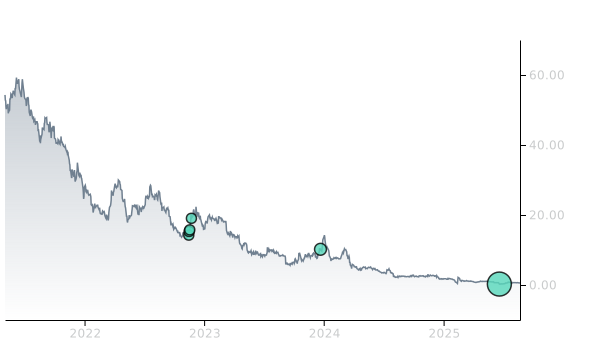
$MBRX insiders have traded $MBRX stock on the open market 2 times in the past 6 months. Of those trades, 2 have been purchases and 0 have been sales.
Here’s a breakdown of recent trading of $MBRX stock by insiders over the last 6 months:
- WALTER V KLEMP (CEO and President) purchased 675,675 shares for an estimated $249,999
- JONATHAN P. FOSTER (Chief Financial Officer) purchased 270,270 shares for an estimated $99,999
To track insider transactions, check out Quiver Quantitative's insider trading dashboard.
$MBRX Hedge Fund Activity
We have seen 12 institutional investors add shares of $MBRX stock to their portfolio, and 8 decrease their positions in their most recent quarter.
Here are some of the largest recent moves:
- ARMISTICE CAPITAL, LLC removed 1,250,000 shares (-100.0%) from their portfolio in Q2 2025, for an estimated $377,375
- VANGUARD GROUP INC added 208,984 shares (+675.6%) to their portfolio in Q3 2025, for an estimated $110,761
- CITIGROUP INC removed 85,283 shares (-100.0%) from their portfolio in Q3 2025, for an estimated $45,199
- CETERA INVESTMENT ADVISERS removed 70,000 shares (-100.0%) from their portfolio in Q2 2025, for an estimated $21,133
- XTX TOPCO LTD added 62,642 shares (+541.2%) to their portfolio in Q2 2025, for an estimated $18,911
- VIRTU FINANCIAL LLC added 59,278 shares (+inf%) to their portfolio in Q2 2025, for an estimated $17,896
- VERUS CAPITAL PARTNERS, LLC removed 43,000 shares (-100.0%) from their portfolio in Q3 2025, for an estimated $22,790
To track hedge funds' stock portfolios, check out Quiver Quantitative's institutional holdings dashboard.
$MBRX Analyst Ratings
Wall Street analysts have issued reports on $MBRX in the last several months. We have seen 1 firms issue buy ratings on the stock, and 0 firms issue sell ratings.
Here are some recent analyst ratings:
- HC Wainwright & Co. issued a "Buy" rating on 09/10/2025
To track analyst ratings and price targets for $MBRX, check out Quiver Quantitative's $MBRX forecast page.
$MBRX Price Targets
Multiple analysts have issued price targets for $MBRX recently. We have seen 2 analysts offer price targets for $MBRX in the last 6 months, with a median target of $4.0.
Here are some recent targets:
- Sara Nik from HC Wainwright & Co. set a target price of $4.0 on 09/10/2025
Full Release
Preclinical research to be conducted at the University of North Carolina at Chapel Hill (UNC)
Annamycin will be used in conjunction with novel agents and modalities
Preclinical studies indicate Annamycin targets key factors in pancreatic cancer
HOUSTON, Nov. 12, 2025 (GLOBE NEWSWIRE) -- Moleculin Biotech, Inc. , (Nasdaq: MBRX) (“Moleculin” or the “Company”), a late-stage pharmaceutical company with a broad portfolio of drug candidates targeting hard-to-treat cancers and viral infections, today announced it has entered into research and material transfer agreement with the University of North Carolina at Chapel Hill (UNC) for investigator-initiated preclinical research evaluating Annamycin for the treatment of pancreatic cancer.
Under the terms of the agreement Moleculin will supply Annamycin and William C. Zamboni, PharmD, PhD, professor at the UNC Eshelman School of Pharmacy, UNC Lineberger Comprehensive Cancer Center, and Carolina Institute of Nanomedicine will conduct the planned preclinical research as part of a series of funded grants . The studies covered under this agreement will evaluate the ability of novel treatment agents and modalities to enhance the tumor delivery of liposomal Annamycin (L-Annamycin) and Free-Annamycin as compared to Doxil and Free-doxorubicin in the PDAC GEMM models.
Walter Klemp, Chairman and CEO of Moleculin, commented, “We are pleased to establish this agreement with the team at UNC-Chapel Hill, a leading institution in oncology innovation and translational research, and take another important step in our strategy to advance and develop Annamycin through multiple investigator-initiated studies to realize its full potential. Pancreatic cancer remains one of the most lethal and underserved cancers, with limited effective treatment options and a clear need for new therapeutic approaches. Evaluating Annamycin in collaboration with UNC’s world-class translational scientists dovetails well with our recently announced investigator-funded clinical trial in pancreatic cancer patients.”
“Annamycin has a demonstrated high affinity for and ability to concentrate in the pancreas, and recently published data reveals that the upregulation of topoisomerase II, the primary target of Annamycin, is highly correlated with poor survival in pancreatic cancer patients,” continued Mr. Klemp. “This is why we believe targeting pancreatic cancer in addition to acute myeloid leukemia and soft tissue sarcoma provides a critical strategic opportunity to expand the potential clinical applications of our technology into an indication with significant unmet need and market potential. We look forward to generating data that will help define Annamycin’s role in pancreatic cancer and further strengthen our oncology development pipeline as we work to deliver meaningful value for patients and shareholders.”
Annamycin, also known by its non-proprietary name of naxtarubicin, currently has Fast Track Status and Orphan Drug Designation from the FDA for the treatment of relapsed or refractory AML, in addition to Orphan Drug Designation for the treatment of STS lung mets. Furthermore, Annamycin has Orphan Drug Designation for the treatment of relapsed or refractory AML from the EMA.
Moleculin is currently conducting pivotal Phase 2B/3, multi-center, randomized, double-blind, placebo-controlled, adaptive design study of Annamycin in combination with cytarabine (also known as “Ara-C” and for which the combination of Annamycin and Ara-C is referred to as “AnnAraC”) for the treatment of adult patients with acute myeloid leukemia (AML) who are refractory to or relapsed (R/R) after induction therapy (R/R AML). This Phase 3 “MIRACLE” trial (derived from M olecul i n R /R AML A nnAraC Cl inical E valuation) is a global approval trial, including sites in the US, Europe and the Middle East.
For more information about the MIRACLE trial, visit clinicaltrials.gov and reference identifier NCT06788756. Additionally, the clinical trial in the EU is on euclinicaltrials.eu and the reference identifier there is 2024-518359-47-00.
About Moleculin Biotech, Inc.
Moleculin Biotech, Inc. is a Phase 3 clinical stage pharmaceutical company advancing a pipeline of therapeutic candidates addressing hard-to-treat tumors and viruses. The Company’s lead program, Annamycin, is a next-generation highly efficacious and well tolerated anthracycline designed to avoid multidrug resistance mechanisms and to lack the cardiotoxicity common with currently prescribed anthracyclines. Annamycin is currently in development for the treatment of relapsed or refractory acute myeloid leukemia (AML) and soft tissue sarcoma (STS) lung metastases.
The Company has begun the MIRACLE (
M
olecul
i
n
R
/R AML
A
nnAraC
Cl
inical
E
valuation) Trial (MB-108), a pivotal, adaptive design Phase 3 trial evaluating Annamycin in combination with cytarabine, together referred to as AnnAraC, for the treatment of relapsed or refractory acute myeloid leukemia. Following a successful Phase 1B/2 study (MB-106), with input from the FDA, the Company believes it has substantially de-risked the development pathway towards a potential approval for Annamycin for the treatment of AML. This study remains subject to appropriate future filings with potential additional feedback from the FDA and their foreign equivalents.
Additionally, the Company is developing WP1066, an Immune/Transcription Modulator capable of inhibiting p-STAT3 and other oncogenic transcription factors while also stimulating a natural immune response, targeting brain tumors, pancreatic and other cancers. Moleculin also has in its pipeline a portfolio of antimetabolites, including WP1122 for the potential treatment of pathogenic viruses, as well as certain cancer indications.
For more information about the Company, please visit www.moleculin.com and connect on X , LinkedIn and Facebook .
Forward-Looking Statements
Some of the statements in this release are forward-looking statements within the meaning of Section 27A of the Securities Act of 1933, Section 21E of the Securities Exchange Act of 1934 and the Private Securities Litigation Reform Act of 1995, which involve risks and uncertainties. Forward-looking statements in this press release include, without limitation, statements regarding the research to be conducted at UNC, the potential outcomes of such research, and the timing of the commencement of the investigator-initiated clinical trial described. Moleculin will require significant additional financing, for which the Company has no commitments, in order to conduct its clinical trials as described in this press release, and the milestones described in this press release assume the Company’s ability to secure such financing on a timely basis. Although Moleculin believes that the expectations reflected in such forward-looking statements are reasonable as of the date made, expectations may prove to have been materially different from the results expressed or implied by such forward-looking statements. Moleculin has attempted to identify forward-looking statements by terminology including ‘believes,’ ‘estimates,’ ‘anticipates,’ ‘expects,’ ‘plans,’ ‘projects,’ ‘intends,’ ‘potential,’ ‘may,’ ‘could,’ ‘might,’ ‘will,’ ‘should,’ ‘approximately’ or other words that convey uncertainty of future events or outcomes to identify these forward-looking statements. These statements are only predictions and involve known and unknown risks, uncertainties, and other factors, including those discussed under Item 1A. “Risk Factors” in our most recently filed Form 10-K filed with the Securities and Exchange Commission (SEC) and updated from time to time in our Form 10-Q filings and in our other public filings with the SEC. Any forward-looking statements contained in this release speak only as of its date. We undertake no obligation to update any forward-looking statements contained in this release to reflect events or circumstances occurring after its date or to reflect the occurrence of unanticipated events.
Investor Contact:
JTC Team, LLC
Jenene Thomas
(908) 824-0775
[email protected]