


HealthEquity's survey reveals younger Americans are adopting HSAs but face significant economic anxiety impacting workplace performance.
Quiver AI Summary
HealthEquity, the largest health savings account (HSA) custodian in the U.S., has released its first Healthcare Affordability Pulse survey, highlighting a generational paradox where younger Americans, particularly Gen Z and Millennials, are adopting HSAs at higher rates but also reporting significant economic anxiety. The survey indicates that while 56% of Gen Z and 50% of Millennials have HSAs, they experience the highest levels of financial stress, with 84% of Gen Z feeling economically concerned. Despite their proactive approach to healthcare savings, younger workers are more likely to struggle with unexpected healthcare expenses and report that financial stress impacts their workplace performance. The findings emphasize the need for enhanced financial education and employer support to help young Americans better manage healthcare costs and improve their financial security.
Potential Positives
- HealthEquity is positioned as the largest HSA custodian in the U.S., highlighting its market leadership and potential for growth.
- The inaugural Healthcare Affordability Pulse survey provides valuable insights into the financial behaviors and needs of younger generations, allowing HealthEquity to tailor its products and services to meet evolving consumer demands.
- The findings emphasize the importance of health savings accounts (HSAs) in improving financial preparedness, reinforcing HealthEquity's role in promoting financial health among consumers.
- HealthEquity is actively engaging with the community through a complimentary webinar, showcasing their commitment to educating consumers on benefits trends and healthcare affordability.
Potential Negatives
- The survey results indicate that despite high adoption rates of HSAs among younger generations, they also report significant economic anxiety, suggesting a disconnect between the usage of financial tools and actual financial security.
- The finding that younger Americans are cutting back on essential services such as mental health care may raise concerns about their overall wellbeing and reflect poorly on the effectiveness of HSAs in alleviating financial stress.
- The statement from the CEO emphasizes the need for employer support and education, indicating that the company may not be adequately addressing the needs of younger employees with their current offerings.
FAQ
What does the Healthcare Affordability Pulse survey reveal?
The survey found that younger Americans adopt HSAs more but experience higher economic anxiety.
Which generation has the highest HSA adoption rates?
Gen Z leads in HSA adoption at 56%, followed closely by Millennials at 50%.
How does economic anxiety affect younger workers?
Younger workers report that financial stress impacts their workplace performance significantly more than older generations.
What is the relationship between HSA holders and financial preparedness?
HSA holders across all ages are more financially prepared for healthcare expenses compared to non-HSA holders.
How can healthcare affordability issues be addressed?
Employer support and enhanced benefits education are vital in helping employees manage healthcare affordability.
Disclaimer: This is an AI-generated summary of a press release distributed by GlobeNewswire. The model used to summarize this release may make mistakes. See the full release here.
$HQY Insider Trading Activity
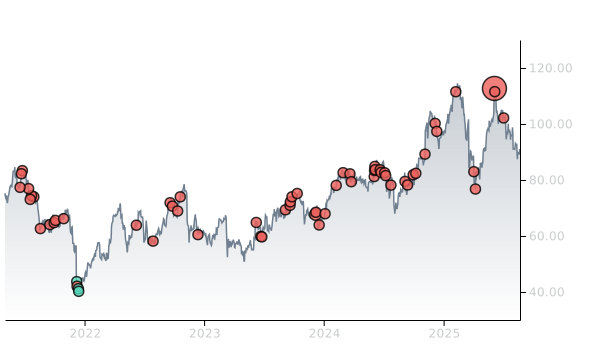
$HQY insiders have traded $HQY stock on the open market 9 times in the past 6 months. Of those trades, 0 have been purchases and 9 have been sales.
Here’s a breakdown of recent trading of $HQY stock by insiders over the last 6 months:
- DELANO LADD (EVP, General Counsel) has made 0 purchases and 5 sales selling 9,000 shares for an estimated $859,592.
- MICHAEL HENRY FIORE (EVP, CHIEF COMMERCIAL OFFICER) has made 0 purchases and 3 sales selling 3,575 shares for an estimated $339,600.
- EVELYN S DILSAVER sold 3,461 shares for an estimated $322,915
To track insider transactions, check out Quiver Quantitative's insider trading dashboard.
$HQY Revenue
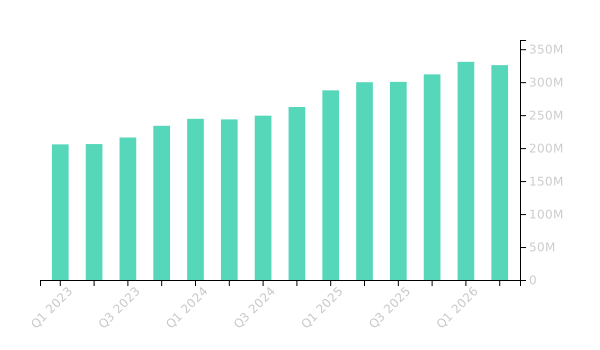
$HQY had revenues of $322.2M in Q3 2026. This is an increase of 7.23% from the same period in the prior year.
You can track HQY financials on Quiver Quantitative's HQY stock page.
$HQY Congressional Stock Trading
Members of Congress have traded $HQY stock 3 times in the past 6 months. Of those trades, 1 have been purchases and 2 have been sales.
Here’s a breakdown of recent trading of $HQY stock by members of Congress over the last 6 months:
- REPRESENTATIVE LISA C. MCCLAIN has traded it 2 times. They made 1 purchase worth up to $15,000 on 06/11 and 1 sale worth up to $15,000 on 06/17.
- REPRESENTATIVE GILBERT RAY CISNEROS, JR. sold up to $15,000 on 06/16.
To track congressional stock trading, check out Quiver Quantitative's congressional trading dashboard.
$HQY Hedge Fund Activity
We have seen 246 institutional investors add shares of $HQY stock to their portfolio, and 285 decrease their positions in their most recent quarter.
Here are some of the largest recent moves:
- FMR LLC removed 1,550,235 shares (-30.8%) from their portfolio in Q3 2025, for an estimated $146,915,770
- CIBC PRIVATE WEALTH GROUP LLC removed 913,648 shares (-81.1%) from their portfolio in Q3 2025, for an estimated $86,586,420
- VAUGHAN NELSON INVESTMENT MANAGEMENT, L.P. removed 835,413 shares (-100.0%) from their portfolio in Q2 2025, for an estimated $87,517,865
- PRICE T ROWE ASSOCIATES INC /MD/ added 833,361 shares (+119.0%) to their portfolio in Q3 2025, for an estimated $78,977,621
- CITADEL ADVISORS LLC removed 783,572 shares (-64.7%) from their portfolio in Q3 2025, for an estimated $74,259,118
- AQR CAPITAL MANAGEMENT LLC added 656,820 shares (+59.3%) to their portfolio in Q3 2025, for an estimated $62,246,831
- T. ROWE PRICE INVESTMENT MANAGEMENT, INC. removed 590,267 shares (-98.1%) from their portfolio in Q3 2025, for an estimated $55,939,603
To track hedge funds' stock portfolios, check out Quiver Quantitative's institutional holdings dashboard.
$HQY Analyst Ratings
Wall Street analysts have issued reports on $HQY in the last several months. We have seen 7 firms issue buy ratings on the stock, and 0 firms issue sell ratings.
Here are some recent analyst ratings:
- Citizens issued a "Market Outperform" rating on 12/04/2025
- BTIG issued a "Buy" rating on 12/04/2025
- Keybanc issued a "Overweight" rating on 10/08/2025
- Jefferies issued a "Buy" rating on 09/03/2025
- JP Morgan issued a "Overweight" rating on 09/03/2025
- Barrington Research issued a "Outperform" rating on 09/03/2025
- RBC Capital issued a "Outperform" rating on 08/28/2025
To track analyst ratings and price targets for $HQY, check out Quiver Quantitative's $HQY forecast page.
$HQY Price Targets
Multiple analysts have issued price targets for $HQY recently. We have seen 10 analysts offer price targets for $HQY in the last 6 months, with a median target of $123.5.
Here are some recent targets:
- Constantine Davides from Citizens set a target price of $122.0 on 12/04/2025
- Alexander Paris from Barrington Research set a target price of $125.0 on 12/04/2025
- David Larsen from BTIG set a target price of $130.0 on 12/04/2025
- Alexei Gogolev from JP Morgan set a target price of $129.0 on 12/04/2025
- Sean Dodge from BMO Capital set a target price of $100.0 on 11/13/2025
- Scott Schoenhaus from Keybanc set a target price of $120.0 on 10/08/2025
- Daniel R. Perlin from RBC Capital set a target price of $110.0 on 09/03/2025
Full Release
DRAPER, Utah, Dec. 09, 2025 (GLOBE NEWSWIRE) -- As healthcare costs continue to strain American families, HealthEquity (NASDAQ: HQY), the nation's largest health savings account (HSA) custodian by number of accounts*, today released its inaugural Healthcare Affordability Pulse survey results, revealing a striking generational paradox: younger Americans are leading in HSA adoption and benefits engagement, yet they simultaneously report the highest levels of economic anxiety and workplace financial distraction.
The Fall 2025 Healthcare Affordability Pulse surveyed employed Americans and found that 56% of Gen Z and 50% of Millennials have HSAs, significantly outpacing Gen X (35%) and Boomers (24%). Despite this proactive approach to healthcare savings, Gen Z reports the highest economic concern at 84%, and younger workers are significantly more likely to say financial stress affects their workplace performance.
"We're seeing a generation that's financially engaged and taking advantage of tools like HSAs earlier in their careers, but they're also carrying a heavier burden of economic anxiety," said Scott Cutler, HealthEquity President and CEO. "Gen Z and Millennials know they need to save for healthcare and are doing their part, but they’re doing it in a very different economy, one where higher costs and uncertainty are creating real stress that follows them into the workplace. Giving them simple, portable ways to save and pay for healthcare is one of the most important steps we can take to support their financial health.”
Young Americans Lead in HSA Adoption and Benefits Understanding
The research reveals that younger generations are significantly more engaged with their healthcare benefits. Gen Z (53%) and Millennials (62%) report understanding their benefits "very well" or "extremely well" at much higher rates than Gen X and Boomers (both at 47%). This benefits literacy translates into action, with younger Americans more likely to have HSAs and actively use them as part of their financial planning strategy.
However, their financial preparedness tells a more complex story. Gen Z and Millennials are more likely to have less than $500 available for unexpected healthcare expenses (36% and 30%, respectively), while Boomers were significantly more likely to report having over $2,500 in their HSAs.
Economic Anxiety Impacts Younger Workers Differently
While 79% of all respondents report being concerned about the overall economy, the workplace impact varies significantly by generation. Gen X and Boomers are most likely to say finances don't impact their work performance at all (38% and 27%, respectively), while Gen Z and Millennials are significantly more likely to report that financial strain affects their ability to focus and perform well at work.
Healthcare spending priorities also differ by generation. Gen Z is most likely to cut back on mental health services (46%) and preventive care (36%) when budgets tighten, while Boomers and Gen X are more likely to not cut back on healthcare spending at all (40% and 32%, respectively).
"The fact that young people are cutting mental health services first is concerning, especially when we know they're experiencing higher levels of financial stress," Cutler noted. "This is where employer support and benefits education make the biggest difference."
HSA Holders Show Greater Financial Preparedness Across All Generations
Despite generational differences, HSA holders—regardless of age—demonstrate stronger financial readiness for healthcare expenses. Across all generations, HSA holders are more likely to feel prepared for routine healthcare expenses (52% vs. 46%), have larger emergency reserves (29% with at least $5,000 vs. 25%), and are less likely to cut back on critical healthcare services.
The research also reveals that those who understand their benefits "very well" or "extremely well" are more likely to report that their financial situation does not affect their work focus (29% vs. 20% with moderate understanding), a finding that holds true across all age groups.
Exploring Findings and Solutions
"Healthcare affordability is not a niche issue—it's a universal stressor affecting Americans across every demographic and every generation," Cutler continued. "The good news is that HSAs can help improve financial preparedness. But this research makes clear that education and employer support are critical to helping people not just save, but feel more secure—something that feels even more important given that open enrollment is still happening right now for the majority of Americans."
The HealthEquity Healthcare Affordability Pulse tracks American consumer sentiment on healthcare costs, financial preparedness, and economic wellbeing on a biannual basis. The inaugural Fall 2025 edition surveyed 618 employed Americans enrolled in employer-sponsored health plans between June 25 and July 9, 2025.
The full report, including detailed demographic breakdowns and methodology, is available for download at https://info.healthequity.com/fall-2025-healthcare-affordability-pulse .
To explore these findings alongside other emerging benefits trends, HealthEquity will host a complimentary webinar examining affordability, wellbeing, caregiver benefits, and artificial intelligence. Registration for the “Top 4 Benefits Trends to Watch for in 2026” webinar on Thursday, Dec. 11, 2025 at 12 p.m. MT is available here .
About HealthEquity
HealthEquity (NASDAQ: HQY) and its subsidiaries administer HSAs and other consumer-directed benefits for 17 million accounts in partnership with employers, benefits advisors, and health and retirement plan providers who share our mission to save and improve lives by empowering healthcare consumers. For more information, visit
www.healthequity.com
.
* Devenir 2025 Mid-year HSA Report
Media Contact
Paul Kluding
[email protected]