


Firefly Neuroscience identifies a novel PTSD biomarker using its Evoke System, enhancing military healthcare collaboration and diagnostics.
Quiver AI Summary
Firefly Neuroscience, Inc. has announced the discovery of a novel electrophysiological biomarker for Post-Traumatic Stress Disorder (PTSD) using brain scans from its FDA-cleared Evoke System. This development follows Firefly's partnership with the U.S. Department of War to aid active-duty service members and veterans affected by PTSD and Traumatic Brain Injury (TBI). The new biomarker, identified through advanced AI-powered analysis of electroencephalogram (EEG) data, could significantly enhance the assessment and treatment of PTSD, which affects millions of Americans and incurs substantial economic costs. Firefly's innovative technology may not only improve military healthcare and clinical psychiatry but could also facilitate pharmaceutical trials by providing an objective measure of treatment efficacy. This milestone aligns with Firefly's mission to develop a comprehensive AI platform for brain health across various neurological conditions.
Potential Positives
- Firefly Neuroscience identified a novel PTSD-specific electrophysiological biomarker, enhancing its scientific credibility and potential for significant impact in the mental health field.
- The discovery is part of an active partnership with the U.S. Department of War, strengthening Firefly's position as a leader in military healthcare technology.
- The biomarker could open commercial pathways in pharmaceutical clinical trials and personalized treatment for PTSD, indicating a broader market opportunity for Firefly's technologies.
- Firefly's proprietary database of over 200,000 EEG/ERP brain scans establishes it as a key player in advancing precision neuroscience and positions the company for future growth in various fields.
Potential Negatives
- The press release emphasizes the identification of a novel biomarker, which may raise expectations that could lead to scrutiny or disappointment if the expected outcomes are not achieved.
- The mention of a public-private partnership with the U.S. Department of War may expose the company to criticism or scrutiny regarding the ethical implications of their work within a military context.
- The significant economic burden of PTSD highlighted in the release may underscore the urgency and potential accountability that Firefly has in delivering effective solutions, creating pressure on the company for demonstrable results in a timely manner.
FAQ
What recent discovery did Firefly Neuroscience announce?
Firefly Neuroscience identified a novel electrophysiological biomarker for Post-Traumatic Stress Disorder (PTSD) using its Evoke System.
How does this discovery relate to Firefly's partnership with the U.S. Department of War?
The biomarker discovery supports Firefly's ongoing partnership with the DoW to assess and treat PTSD in service members and veterans.
What is the significance of the PTSD biomarker discovery?
This discovery positions Firefly as a leader in both government partnerships and neural signal identification for PTSD assessment.
How could the biomarker impact PTSD clinical treatment?
The objective neural marker may enhance treatment personalization and serve as an efficacy endpoint in pharmaceutical trials.
What technology does Firefly use for this biomarker discovery?
Firefly leverages its FDA-cleared Evoke System and NVIDIA L40S GPU-accelerated infrastructure for high-throughput EEG analysis.
Disclaimer: This is an AI-generated summary of a press release distributed by GlobeNewswire. The model used to summarize this release may make mistakes. See the full release here.
$AIFF Revenue
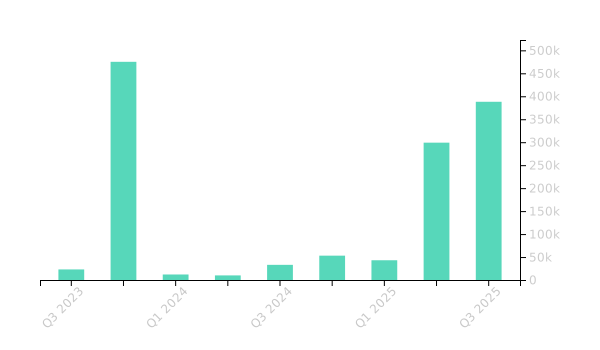
$AIFF had revenues of $485K in Q1 2026. This is an increase of 1027.91% from the same period in the prior year.
You can track AIFF financials on Quiver Quantitative's AIFF stock page.
You can access data on AIFF stock through the Quiver Quantitative API.
$AIFF Hedge Fund Activity
We have seen 15 institutional investors add shares of $AIFF stock to their portfolio, and 5 decrease their positions in their most recent quarter.
Here are some of the largest recent moves:
- SCHONFELD STRATEGIC ADVISORS LLC added 177,185 shares (+inf%) to their portfolio in Q1 2026, for an estimated $386,263
- JANE STREET GROUP, LLC added 119,906 shares (+198.8%) to their portfolio in Q1 2026, for an estimated $261,395
- UBS GROUP AG added 107,490 shares (+435.1%) to their portfolio in Q1 2026, for an estimated $234,328
- BLACKROCK, INC. added 83,105 shares (+96.3%) to their portfolio in Q1 2026, for an estimated $181,168
- GEODE CAPITAL MANAGEMENT, LLC added 42,992 shares (+37.9%) to their portfolio in Q1 2026, for an estimated $93,722
- SCIENTECH RESEARCH LLC added 41,121 shares (+inf%) to their portfolio in Q1 2026, for an estimated $89,643
- SUSQUEHANNA INTERNATIONAL GROUP, LLP removed 37,742 shares (-100.0%) from their portfolio in Q1 2026, for an estimated $82,277
To track hedge funds' stock portfolios, check out Quiver Quantitative's institutional holdings dashboard. You can access data on hedge funds moves and 13F filings through the Quiver Quantitative API 13F endpoint.
Full Release
– Comes just weeks after Firefly confirmed its active public-private partnership with the U.S. Department of War –
KENMORE, N.Y, June 02, 2026 (GLOBE NEWSWIRE) -- Firefly Neuroscience, Inc. (“Firefly” or the “Company”) (NASDAQ: AIFF), an Artificial Intelligence (“AI”) company advancing precision neuroscience, today announced the identification of a novel electrophysiological biomarker for Post-Traumatic Stress Disorder (“PTSD”) using brain scans collected on its FDA-510(k)-cleared Evoke System.
The biomarker discovery emanates partly from Firefly’s previously announced public-private partnership with the U.S. Department of War (“DoW”) to support the assessment and treatment of active-duty U.S. service members and veterans suffering from PTSD and/or Traumatic Brain Injury (“TBI”). The identification of a novel PTSD-specific electrophysiological biomarker deepens the scientific foundation of that DoW deployment and positions Firefly as what it believes to be the only company with both an active government brain health partnership and a identified neural signal marker for the condition.
PTSD affects approximately 13 million Americans in any given year, and about 6% of the U.S. population will have PTSD at some point in their life. 1 The disorder is disproportionately prevalent in military personnel; with 11–20% of Operation Iraqi Freedom and Enduring Freedom veterans experiencing PTSD annually. 2 The total U.S. economic burden of PTSD has been estimated at $232.2 billion, of which $42.7 billion is attributed directly to the military population. 3
The biomarker discovery leverages Firefly’s deep learning architecture running on NVIDIA L40S GPU-accelerated infrastructure, enabling high-throughput analysis of multi-channel electroencephalogram (EEG) and Event-Related Potential (ERP) waveforms at unprecedented scale. The Evoke System’s dual-signal approach, capturing both resting-state hyperarousal patterns and abnormal cognitive ERP responses, is particularly well-suited to PTSD diagnostics.
“By applying our AI models to a dataset that we believe to be unmatched in scale, we have identified a consistent and reproducible electrophysiological pattern distinguishing PTSD patients from healthy controls,” said Gil Issachar, Firefly’s Chief Technology Officer. “Given our previously announced DoW deployment, this discovery holds potential for providing military healthcare providers with not just a powerful assessment tool, but a scientifically grounded neural signal to anchor it.”
Greg Lipschitz, Firefly’s Chief Executive Officer, commented, “Our proprietary database is an important asset that continues to generate breakthrough cognitive brain biomarker discoveries. The convergence of this PTSD biomarker finding with our previously announced DoW partnership represents a significant milestone: we are deploying FDA-cleared technology to support the assessment and treatment of active-duty U.S. service members and veterans while, at the same time, generating the neuroscience that could support how PTSD is objectively assessed for both them and civilians going forward. Our NVIDIA L40S GPU-accelerated foundation model architecture creates a potential competitive advantage in biomarker discovery that we believe positions Firefly well across defense health, pharma partnerships, and clinical psychiatry.”
The identification of a PTSD-specific electrophysiological biomarker could potentially open commercial pathways across three channels: within the existing Firefly-DoW partnership, where an objective neural marker could deepen and expand Firefly’s government engagement; in pharmaceutical clinical trials, where it could serve as an objective efficacy endpoint addressing a longstanding bottleneck in CNS drug development; and in clinical psychiatry, where the Evoke System’s objective signal data could inform more personalized treatment decisions for the millions of people living with PTSD.
This discovery further advances Firefly’s mission to build the world’s first EEG/ERP-based brain foundation model, a large-scale AI architecture trained across all disorder categories to serve as a universal brain health intelligence platform for neurology, psychiatry, and drug development.
Sources
1 U.S. Department of Veterans Affairs, National Center for PTSD. “How Common Is PTSD in Adults?” https://www.ptsd.va.gov/understand/common/common_adults.asp
2 U.S. Department of Veterans Affairs, National Center for PTSD. “How Common is PTSD in Veterans?” https://www.ptsd.va.gov/understand/common/common_veterans.asp
3 Davis LL, Schein J, Cloutier M, et al. “The Economic Burden of Posttraumatic Stress Disorder in the United States From a Societal Perspective.” The Journal of Clinical Psychiatry, 2022.
About Firefly
Firefly Neuroscience, Inc. (NASDAQ: AIFF) is an Artificial Intelligence (“AI”) company advancing precision neuroscience, applying AI and large-scale electrophysiological data to give clinicians a more complete, objective picture of how an individual patient's brain is functioning. Firefly’s proprietary database now consists of over 200,000 EEG/ERP brain scans, making it the world’s largest known standardized EEG/ERP repository. Firefly’s EEG-based, AI-driven, and FDA-510(k)-cleared Evoke System has the potential to transform diagnostic and treatment monitoring methods for conditions such as depression, dementia, anxiety disorders, concussions, ADHD, and PTSD.
Please visit www.fireflyneuro.com for more information.
Forward-Looking Statements
Certain statements in this press release may constitute “forward-looking statements” for purposes of the federal securities laws concerning Firefly. These forward-looking statements include express or implied statements relating to Firefly’s management team’s expectations, hopes, beliefs, intentions, or strategies regarding the future. In addition, any statements that refer to projections, forecasts or other characterizations of future events or circumstances, including any underlying assumptions, are forward-looking statements. The words “anticipate,” “believe,” “contemplate,” “continue,” “could,” “estimate,” “expect,” “intends,” “may,” “might,” “plan,” “possible,” “potential,” “predict,” “project,” “should,” “will,” “would” and similar expressions may identify forward-looking statements, but the absence of these words does not mean that a statement is not forward-looking. These forward-looking statements are based on current expectations and beliefs concerning future developments and their potential effects. There can be no assurance that future developments affecting Firefly will be those that have been anticipated. These forward-looking statements involve a number of risks, uncertainties (some of which are beyond Firefly’s control) and other assumptions that may cause actual results or performance to be materially different from those expressed or implied by these forward-looking statements. These risks and uncertainties include, but are not limited to, those factors described under the heading “Risk Factors” in the reports and other filings of Firefly with the Securities and Exchange Commission. Should one or more of these risks or uncertainties materialize, or should any of Firefly’s assumptions prove incorrect, actual results may vary in material respects from those projected in these forward-looking statements. It is not possible to predict or identify all such risks. Forward-looking statements included in this press release only speak as of the date they are made, and Firefly does not undertake any obligation to update or revise any forward-looking statements, whether as a result of new information, future events or otherwise, except as may be required under applicable securities laws.
Investor & Media Contact
Stephen Kilmer
(646) 274-3580
[email protected]