


Eton Pharmaceuticals announced dosing of the first patient in a clinical study for ET-700, a treatment for Wilson disease.
Quiver AI Summary
Eton Pharmaceuticals, Inc. announced that the first patient has been dosed in a pilot clinical study of ET-700, a new extended-release zinc acetate formulation aimed at treating Wilson disease. Results from this study, which includes 36 healthy volunteers and will use PET imaging to measure intestinal copper absorption, are expected in the second half of 2026. If successful, Eton plans to initiate a pivotal clinical study in early 2027. Eton's CEO, Sean Brynjelsen, expressed optimism regarding ET-700's potential to improve treatment compliance for patients, given the current need for simpler dosing. The study will compare ET-700's effects against a standard treatment over a four-week period. The company currently has several products for rare diseases and is looking to expand its offerings, with ET-700 potentially generating significant sales if it reaches the market.
Potential Positives
- Eton Pharmaceuticals has initiated a pilot clinical study for ET-700, indicating progress in developing a treatment for Wilson disease, a rare condition with significant unmet medical needs.
- Positive topline results expected in the second half of 2026 could lead to a pivotal clinical study in early 2027, showcasing Eton's commitment to advancing its drug development pipeline.
- If successful, ET-700 has the potential to generate over $100 million in peak annual sales, highlighting significant commercial opportunities for the company.
- The study utilizes innovative PET imaging technology to assess treatment efficacy, demonstrating Eton's commitment to cutting-edge research methods in rare disease therapies.
Potential Negatives
- ET-700 is still in the pilot clinical study phase, and there is no guarantee that the study will yield positive results, which could delay potential market entry.
- The press release includes significant warnings regarding potential adverse effects of existing treatments, such as copper deficiency and gastric ulcers, which may raise concerns about the safety of the drug class.
- The forward-looking statements highlight various risks and uncertainties that could impact the company's ability to successfully develop and commercialize ET-700, creating skepticism among investors and stakeholders.
FAQ
What is ET-700 and its purpose?
ET-700 is a proprietary formulation of extended-release zinc acetate developed for treating Wilson disease.
When will the study results for ET-700 be available?
Topline results from the pilot clinical study are expected in the second half of 2026.
What is Wilson disease and its treatment need?
Wilson disease is a rare genetic disorder requiring lifelong treatment, highlighting the need for simpler dosing options like ET-700.
How many participants are involved in the clinical study?
The study includes 36 healthy volunteers randomly assigned to different treatment groups.
What is the expected market potential for ET-700?
If approved, ET-700 could surpass $100 million in peak annual sales in the U.S.
Disclaimer: This is an AI-generated summary of a press release distributed by GlobeNewswire. The model used to summarize this release may make mistakes. See the full release here.
$ETON Revenue
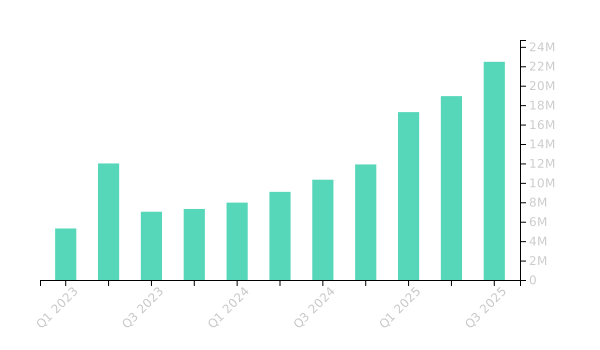
$ETON had revenues of $21.3M in Q4 2025. This is an increase of 78.88% from the same period in the prior year.
You can track ETON financials on Quiver Quantitative's ETON stock page.
$ETON Hedge Fund Activity
We have seen 42 institutional investors add shares of $ETON stock to their portfolio, and 59 decrease their positions in their most recent quarter.
Here are some of the largest recent moves:
- ROYAL BANK OF CANADA removed 478,175 shares (-99.8%) from their portfolio in Q4 2025, for an estimated $8,085,939
- DIVISADERO STREET CAPITAL MANAGEMENT, LP removed 298,000 shares (-100.0%) from their portfolio in Q4 2025, for an estimated $5,039,180
- OBERWEIS ASSET MANAGEMENT INC/ added 238,940 shares (+124.2%) to their portfolio in Q4 2025, for an estimated $4,040,475
- CANNELL CAPITAL LLC removed 238,488 shares (-52.4%) from their portfolio in Q4 2025, for an estimated $4,032,832
- TWO SIGMA INVESTMENTS, LP removed 209,819 shares (-73.3%) from their portfolio in Q4 2025, for an estimated $3,548,039
- SOLEUS CAPITAL MANAGEMENT, L.P. removed 200,000 shares (-100.0%) from their portfolio in Q4 2025, for an estimated $3,382,000
- JPMORGAN CHASE & CO removed 165,978 shares (-47.2%) from their portfolio in Q4 2025, for an estimated $2,806,687
To track hedge funds' stock portfolios, check out Quiver Quantitative's institutional holdings dashboard. You can access data on hedge funds moves and 13F filings through the Quiver Quantitative API.
$ETON Price Targets
Multiple analysts have issued price targets for $ETON recently. We have seen 3 analysts offer price targets for $ETON in the last 6 months, with a median target of $35.0.
Here are some recent targets:
- Madison El-Saadi from B. Riley Securities set a target price of $31.0 on 03/20/2026
- Swayampakula Ramakanth from HC Wainwright & Co. set a target price of $52.0 on 03/20/2026
- Chase Knickerbocker from Craig-Hallum set a target price of $35.0 on 03/20/2026
Full Release
DEER PARK, Ill., April 27, 2026 (GLOBE NEWSWIRE) -- Eton Pharmaceuticals, Inc (“Eton” or “the Company”) (Nasdaq: ETON), an innovative pharmaceutical company focused on developing and commercializing treatments for rare diseases, today announced the first patient has been dosed in a pilot clinical study assessing the efficacy of ET-700, the Company’s proprietary, patent-pending formulation of extended-release zinc acetate under development for the treatment of Wilson disease. Topline study results are expected in the second half of 2026, and if positive, would lead to a pivotal clinical study in early 2027.
“ET-700 has the potential to deliver a major advancement for patients with Wilson disease, and we’re excited to initiate this clinical study. Based on feedback from the patient community and treating physicians, there remains a meaningful need for more convenient, simpler dosing approaches for this lifelong chronic therapy, which ET-700 is designed to explore. If approved, we believe ET-700 could exceed $100 million of peak annual sales in the United States,” said Sean Brynjelsen, CEO of Eton Pharmaceuticals.
“Wilson disease requires lifelong treatment, and we believe it is important to explore therapies that are both effective and easier for patients to use in daily life. In this study, 64 C u PET imaging will be used to assess whether an extended-release zinc formulation can reduce intestinal copper absorption with a simpler dosing regimen,” said study investigator Dr. Thomas Sandahl, Clinical Professor of Hepatology at Aarhus University.
The study, which is being conducted by the Department of Hepatology and Gastroenterology at Aarhus University Hospital in Denmark, is a double-blinded, placebo-controlled clinical trial comprised of 36 healthy volunteers randomly assigned to one of three treatment groups. Using positron emission tomography (PET) scans with the radioactive tracer 64 C u Cl 2 (64-copper dichloride), the study will compare the effects on intestinal copper absorption of GALZIN 50 mg taken three times daily, ET-700 75 mg taken twice daily plus a placebo once daily, and a placebo taken three times daily.
The study treatment period will last for four weeks. PET scans will assess intestinal copper absorption by measuring the amount of 64 C u in the liver and the primary endpoint is the change in mean hepatic 64 C u standard uptake value from pre- to post-intervention between the three groups, as determined by two blinded investigators.
INDICATION
Galzin® (zinc acetate) is indicated for maintenance treatment of patients with Wilson’s disease who have been initially treated with a chelating agent.
IMPORTANT SAFETY INFORMATION
Contraindication
Hypersensitivity to zinc acetate or any of the ingredients in Galzin.
Warnings and Precautions
Copper Deficiency: Several post-marketing cases reported that zinc acetate taken over extended periods of time may result in decreased enteral copper absorption and copper deficiency. If a patient develops signs and/or symptoms of copper deficiency, interrupt zinc treatment and measure zinc, 24-hr urinary copper, and non-ceruloplasmin bound copper (NCC) levels.
Gastric Ulcer: Gastric ulcers including complications of anemia and gastric ulcer perforation with peritonitis have been reported with long-term use of zinc acetate.
General: Galzin is not recommended for the initial therapy of symptomatic patients because of the delay required for zinc-induced increase in enterocytic metallothionein and blockade of copper uptake. Symptomatic patients should be treated initially, using chelating agents. During initial therapy, neurological deterioration may occur as stores of copper are mobilized.
Information for Patients: GALZIN should be administered on an empty stomach, at least one hour before or two to three hours after meals. Capsules should be swallowed whole, not opened or chewed. Patients must be clinically monitored to determine the adequacy of zinc acetate therapy.
Monitoring Patients: Existing signs and symptoms of Wilson’s disease and 24-hour urine copper should be monitored. Neuropsychiatric evaluations including speech as well as liver function tests including bilirubin and aminotransferases, should be done as appropriate. In all treated patients,
24-hour urinary zinc levels may be a useful measure of compliance with the zinc acetate regimen.
Adverse Reactions
The most common adverse reactions are gastric irritation, elevations of serum alkaline phosphatase, amylase, and lipase suggesting pancreatitis.
To report a suspected adverse event related to GALZIN, contact Eton Pharmaceuticals, Inc. at 1-855- 224-0233 or the U.S. Food and Drug Administration (FDA) at www.fda.gov/safety/Medwatch or call1-800-FDA-1088.
Please see full Prescribing Information for more information.
About Eton Pharmaceuticals
Eton is an innovative pharmaceutical company focused on developing and commercializing treatments for rare diseases. The Company currently has ten commercial rare disease products: KHINDIVI™, INCRELEX ® , ALKINDI SPRINKLE ® , DESMODA™, GALZIN ® , HEMANGEOL ® , PKU GOLIKE ® , Carglumic Acid, Betaine Anhydrous, and Nitisinone. The Company has four additional product candidates in late-stage development: Amglidia ® , ET-700, ET-800 and ZENEO ® hydrocortisone autoinjector. For more information, please visit our website at www.etonpharma.com .
Forward-Looking Statements
Statements contained in this press release regarding matters that are not historical facts are “forward-looking statements” within the meaning of the Private Securities Litigation Reform Act of 1995, including statements associated with the expected ability of Eton to undertake certain activities and accomplish certain goals and objectives. These statements include but are not limited to statements regarding Eton’s business strategy, Eton’s plans to develop and commercialize its product candidates, the safety and efficacy of Eton’s product candidates, Eton’s plans and expected timing with respect to regulatory filings and approvals, and the size and growth potential of the markets for Eton’s product candidates. Because such statements are subject to risks and uncertainties, actual results may differ materially from those expressed or implied by such forward-looking statements. Words such as “believes,” “anticipates,” “plans,” “expects,” “intends,” “will,” “goal,” “potential” and similar expressions are intended to identify forward-looking statements. These forward-looking statements are based upon Eton’s current expectations and involve assumptions that may never materialize or may prove to be incorrect. Actual results and the timing of events could differ materially from those anticipated in such forward-looking statements as a result of various risks and uncertainties, which include, without limitation, risks associated with the process of discovering, developing and commercializing drugs that are safe and effective for use as human therapeutics, and in the endeavor of building a business around such drugs. These and other risks concerning Eton’s development programs and financial position are described in additional detail in Eton’s filings with the Securities and Exchange Commission. All forward-looking statements contained in this press release speak only as of the date on which they were made. Eton undertakes no obligation to update such statements to reflect events that occur or circumstances that exist after the date on which they were made.
Investor Relations:
Lisa M. Wilson, In-Site Communications, Inc.
T: 212-452-2793
E:
[email protected]