


Equifax Canada reports a 31% rise in first-party fraud, notably affecting credit cards and younger consumers.
Quiver AI Summary
Equifax Canada's latest Market Pulse Fraud Trends report indicates a significant rise in first-party fraud, which involves individuals falsifying their own financial information, increasing by 31 percent year-over-year from Q4 2024 to Q4 2025. The trend is especially prominent in credit card fraud, where rates nearly doubled and predominantly involved applicants submitting inconsistent financial data. Furthermore, while third-party fraud attempts in banking decreased, first-party fraud in that sector rose as well, marked by a sharp increase in falsified financial information. Younger consumers, particularly those aged 35 and under, are making up a large portion of the fraud cases in credit and auto lending. To combat this growing issue, Equifax emphasizes the importance of utilizing AI-driven fraud detection tools that can help institutions identify both types of fraud.
Potential Positives
- The report underscores the growing relevance of Equifax's AI-powered fraud detection tools, highlighting their capabilities in identifying both first-party and third-party fraud, which positions the company as a critical resource for lenders facing evolving fraud tactics.
- Equifax’s FraudIQ platform, noted in the release, has demonstrated significant efficacy in fraud loss avoidance, estimated at $3 billion annually, enhancing the company’s reputation as a leader in fraud prevention solutions.
- The increase in first-party fraud presents an opportunity for Equifax to expand its services and offerings tailored to detect and mitigate this emerging risk, potentially leading to increased demand for their products.
- The shift towards AI-based technology in combating fraud reflects Equifax's commitment to innovation, which can enhance customer trust and loyalty as businesses seek advanced solutions in an increasingly complex fraud landscape.
Potential Negatives
- First-party fraud rose by 31% year-over-year, indicating a troubling trend that could suggest weaknesses in Equifax's fraud detection and prevention measures.
- The sharp increase in first-party credit card fraud, nearly doubling within a year, raises questions about the company's ability to protect lenders from escalating fraudulent activities.
- The reliance on AI-based technology may indicate that traditional fraud prevention methods are becoming ineffective, which could undermine confidence in Equifax's solutions among clients and partners.
FAQ
What does the recent Equifax report say about first-party fraud?
The Equifax report reveals a 31% year-over-year increase in first-party fraud, with significant impacts in credit cards and younger demographics.
Which regions in Canada are most affected by first-party fraud?
Ontario and Alberta have the highest rates of first-party fraud, according to the Equifax data.
How does first-party fraud affect credit card applications?
First-party credit card fraud nearly doubled, with mismatched data from applicants becoming the dominant fraudulent behavior.
What trends are emerging in bank fraud according to the report?
First-party fraud in banking is rising, with falsified financial information cases increasing significantly in Q4 2025.
What tools does Equifax provide to combat fraud?
Equifax offers AI-powered tools like FraudIQ to help lenders identify both third-party and first-party fraud effectively.
Disclaimer: This is an AI-generated summary of a press release distributed by GlobeNewswire. The model used to summarize this release may make mistakes. See the full release here.
$EFX Insider Trading Activity
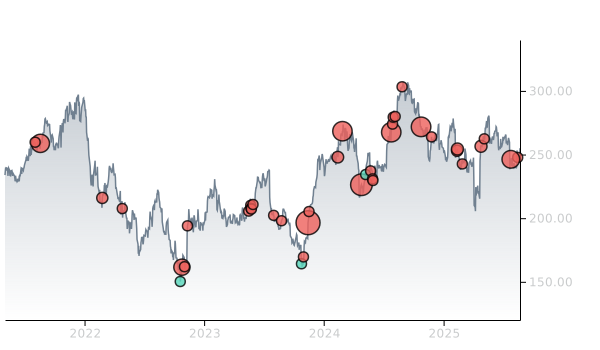
$EFX insiders have traded $EFX stock on the open market 32 times in the past 6 months. Of those trades, 1 have been purchases and 31 have been sales.
Here’s a breakdown of recent trading of $EFX stock by insiders over the last 6 months:
- MARK W BEGOR (CEO) has made 0 purchases and 25 sales selling 87,136 shares for an estimated $19,033,631.
- JAMIL FARSHCHI (EVP, Chief Technology Officer) has made 0 purchases and 3 sales selling 12,305 shares for an estimated $2,626,595.
- JOHN W JR GAMBLE (EVP, CFO & COO) has made 0 purchases and 2 sales selling 7,000 shares for an estimated $1,401,665.
- CHAD M BORTON (EVP, Pres Workforce Solutions) sold 2,535 shares for an estimated $485,452
- CECILIA MAO (EVP, Chief Product Officer) purchased 2,400 shares for an estimated $464,928
To track insider transactions, check out Quiver Quantitative's insider trading dashboard.
$EFX Revenue
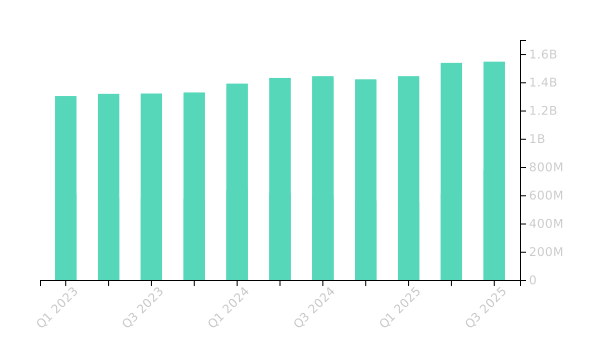
$EFX had revenues of $1.6B in Q4 2025. This is an increase of 9.24% from the same period in the prior year.
You can track EFX financials on Quiver Quantitative's EFX stock page.
$EFX Congressional Stock Trading
Members of Congress have traded $EFX stock 1 times in the past 6 months. Of those trades, 1 have been purchases and 0 have been sales.
Here’s a breakdown of recent trading of $EFX stock by members of Congress over the last 6 months:
- REPRESENTATIVE GILBERT RAY CISNEROS, JR. purchased up to $15,000 on 03/13.
To track congressional stock trading, check out Quiver Quantitative's congressional trading dashboard.
$EFX Hedge Fund Activity
We have seen 392 institutional investors add shares of $EFX stock to their portfolio, and 417 decrease their positions in their most recent quarter.
Here are some of the largest recent moves:
- CAPITAL INTERNATIONAL INVESTORS removed 3,995,916 shares (-38.3%) from their portfolio in Q4 2025, for an estimated $867,033,853
- UBS AM, A DISTINCT BUSINESS UNIT OF UBS ASSET MANAGEMENT AMERICAS LLC removed 3,145,659 shares (-74.6%) from their portfolio in Q4 2025, for an estimated $682,545,089
- PRICE T ROWE ASSOCIATES INC /MD/ removed 1,741,584 shares (-29.2%) from their portfolio in Q4 2025, for an estimated $377,888,896
- HARRIS ASSOCIATES L P added 1,723,439 shares (+29.5%) to their portfolio in Q4 2025, for an estimated $373,951,794
- PARNASSUS INVESTMENTS, LLC removed 1,654,544 shares (-94.4%) from their portfolio in Q4 2025, for an estimated $359,002,957
- FMR LLC removed 1,579,807 shares (-87.0%) from their portfolio in Q4 2025, for an estimated $342,786,522
- GENERATION INVESTMENT MANAGEMENT LLP removed 1,164,793 shares (-42.6%) from their portfolio in Q4 2025, for an estimated $252,736,785
To track hedge funds' stock portfolios, check out Quiver Quantitative's institutional holdings dashboard.
$EFX Analyst Ratings
Wall Street analysts have issued reports on $EFX in the last several months. We have seen 3 firms issue buy ratings on the stock, and 0 firms issue sell ratings.
Here are some recent analyst ratings:
- RBC Capital issued a "Outperform" rating on 11/07/2025
- Stifel issued a "Buy" rating on 10/22/2025
- Needham issued a "Buy" rating on 10/21/2025
To track analyst ratings and price targets for $EFX, check out Quiver Quantitative's $EFX forecast page.
$EFX Price Targets
Multiple analysts have issued price targets for $EFX recently. We have seen 12 analysts offer price targets for $EFX in the last 6 months, with a median target of $232.0.
Here are some recent targets:
- Kevin Mcveigh from UBS set a target price of $220.0 on 04/13/2026
- George Tong from Goldman Sachs set a target price of $208.0 on 02/09/2026
- Manav Patnaik from Barclays set a target price of $215.0 on 02/05/2026
- Shlomo Rosenbaum from Stifel set a target price of $235.0 on 02/05/2026
- Ashish Sabadra from RBC Capital set a target price of $222.0 on 02/05/2026
- Andrew Steinerman from JP Morgan set a target price of $230.0 on 02/05/2026
- Kyle Peterson from Needham set a target price of $265.0 on 02/05/2026
Full Release
First-party fraud rose 31 per cent year-over-year, with the sharpest pressure
showing up in credit cards, banking, and younger consumers
Equifax Canada Market Pulse Fraud Trends
TORONTO, April 15, 2026 (GLOBE NEWSWIRE) -- Equifax Canada’s latest Market Pulse Fraud Trends and Insights data reveals a notable shift toward first-party fraud, where individuals intentionally misrepresent their own financial information. First party fraud rates across Canada rose 31 per cent year-over-year between Q4 2024 and Q4 2025. Rates were higher in Ontario and Alberta and were more pronounced among younger demographics nationwide.
The findings point to a shift in fraud risk. While third-party fraud continues to be a major threat, a growing share of risk is now coming from applicants using their own identity but providing false, inconsistent, or exaggerated financial information.
“This concerning growth in first-party fraud activity is a trend no lender can afford to ignore,” said Carl Davies, Head of Fraud & Identity at Equifax Canada. “Traditional third-party attacks remain prevalent, but we are also seeing more cases where consumers appear to be manipulating their own information to gain access to credit or banking products.”
Credit Card: Spike in First-Party Fraud
An increase in first-party credit card fraud highlights a concerning shift in consumer behaviour, with first-party credit card fraud nearly doubling year-over-year, rising from 0.08 per cent in Q4 2024 to 0.15 per cent in Q4 2025, alongside elevated delinquency pressure in the category.
Equifax found that contradictory or mismatched data submitted by applicants became the dominant form of first-party fraud in credit cards, rising from 59 per cent of first-party cases in Q4 2024 to 77 per cent in Q4 2025. Ontario represented the highest regional exposure, with fraud-related credit loss in the sector reaching as high as $123 million.
Banking and Deposits: The Increase in Falsified Financials
A similar pattern is emerging in banking and deposits. In that category, third-party fraud attempts declined from 0.45 per cent in Q4 2024 to 0.32 per cent in Q4 2025, while first-party fraud increased from 0.51 per cent to 0.68 per cent over the same period.
The nature of the fraud is also changing. Cases involving falsified financial information in banking and deposits increased substantially from 1.5 per cent of first-party cases in Q4 2024 to 21 per cent in Q4 2025, while account abuse increased from 14 per cent to 24 per cent.
“AI-based technology helps to detect falsified documents and identities,” added Davies. “As fraud tactics evolve, Equifax offers reliable AI-powered tools that can help lenders identify both third-party attacks and signs that an applicant may be misrepresenting their financial position.”
Mortgages and Auto Loans: Hidden Losses Amidst Declining Rates
Mortgage and auto application fraud rates moved in the opposite direction overall, with auto fraud down 19.4 per cent year-over-year and mortgage fraud down 12.5 per cent. Even so, the data shows that potential losses tied to suspected fraud within delinquent portfolios remain significant.
Data also showed consumers aged 26 to 45 accounted for most suspected fraudulent mortgage applications, while those aged 35-and-under represented the highest share of fraud-related credit loss in auto delinquency balances.
Products such as FraudIQ from Equifax Canada empower businesses to mitigate risk in real time and prevent future fraud losses. The cloud-based fraud prevention platform is powered by advanced analytics and rich data sources and leverages the power of the Equifax FraudIQ Exchange consortium, Canada’s largest known fraud exchange, consisting of multi-sector fraud data from top banks, financial institutions, telecoms, auto, and other organizations. Fraud prevention platforms from Equifax have helped organizations prevent an estimated $3B in fraud loss avoidance annually.
About Equifax
At Equifax (NYSE: EFX), we believe knowledge drives progress. As a global data, analytics, and technology company, we play an essential role in the global economy by helping financial institutions, companies, employers, and government agencies make critical decisions with greater confidence. Our unique blend of differentiated data, analytics, and cloud technology drives insights to power decisions to move people forward. Headquartered in Atlanta and supported by nearly 15,000 employees worldwide, Equifax operates or has investments in 24 countries in North America, Central and South America, Europe, and the Asia Pacific region. For more information, visit
Equifax.ca
.
Contact:
Andrew Findlater
SELECT Public Relations
[email protected]
(647) 444-1197
Angie Andich
Equifax Canada Media Relations
[email protected]