


Equifax Canada's report reveals rising first-party fraud and growing fatigue among Canadians facing frequent scams, highlighting a need for improved protections.
Quiver AI Summary
Equifax Canada's Market Pulse report indicates a rise in first-party fraud, increasing from 0.25% to 0.33% between 2024 and 2025. A recent survey highlights that Canadians are becoming fatigued by the prevalence of scams, with 28% considering them a manageable annoyance, while others express feelings of anxiety or burnout due to the challenges of identifying real threats. The survey reveals significant concerns about identity theft, impersonation, and digital payment scams, with many Canadians feeling most vulnerable online. Despite awareness of the risks, risky behaviors remain common, necessitating improved education and stronger protections. There's a strong consensus that combating fraud requires collaboration across public and private sectors, along with more robust security measures and educational initiatives to safeguard Canadians in a complex digital landscape.
Potential Positives
- The press release highlights Equifax Canada's role as a leader in fraud prevention, emphasizing the company's commitment to providing insights into evolving fraud trends which enhances its reputation and trust with consumers.
- The increase in fraud awareness among the public as reported in the survey indicates a growing market need for Equifax's fraud prevention solutions, potentially boosting demand for its services.
- The strong consensus among Canadians for coordinated action across sectors supports Equifax's position as a critical player in collaboration efforts, potentially leading to strategic partnerships and increased market authority.
- The release sheds light on the public's demand for better safeguards and education, positioning Equifax to capitalize on this need through innovative products and services aimed at enhancing consumer protection.
Potential Negatives
- The increase in first-party fraud rates from 0.25% to 0.33% indicates a worsening problem in fraud detection and prevention, reflecting negatively on Equifax Canada’s ability to protect consumers.
- The overwhelming concern among Canadians regarding identity theft (67%) and phishing scams (64%) could suggest a crisis of trust in Equifax's services, as they are seen as a key player in protecting against such fraud.
- The reported feelings of fatigue and desensitization to fraud attempts among Canadians may indicate that Equifax's current fraud prevention messaging and strategies are ineffective, resulting in a diminished impact on public awareness.
FAQ
What are the recent fraud trends reported by Equifax Canada?
Equifax Canada's report shows a surge in first-party fraud, increasing from 0.25% to 0.33% between 2024 and 2025.
How do Canadians feel about the current fraud landscape?
Many Canadians report feeling fatigued by scams, with 28% considering fraud attempts a "manageable annoyance" and 16% feeling anxious.
What types of fraud concern Canadians the most?
Identity theft, impersonation scams, and digital payment fraud are among the top concerns for Canadians, according to the survey.
How can institutions improve fraud prevention in Canada?
Canadians suggest stronger security measures, better education, and coordinated actions between public and private sectors to combat fraud.
What is the outlook on education regarding fraud awareness?
There's strong support for mandatory fraud education in schools and public awareness campaigns to help Canadians recognize and avoid scams.
Disclaimer: This is an AI-generated summary of a press release distributed by GlobeNewswire. The model used to summarize this release may make mistakes. See the full release here.
$EFX Insider Trading Activity
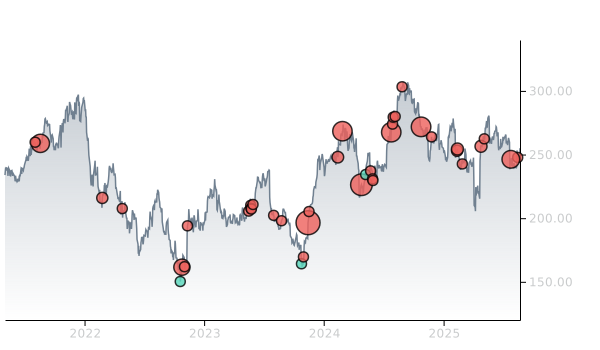
$EFX insiders have traded $EFX stock on the open market 32 times in the past 6 months. Of those trades, 1 have been purchases and 31 have been sales.
Here’s a breakdown of recent trading of $EFX stock by insiders over the last 6 months:
- MARK W BEGOR (CEO) has made 0 purchases and 25 sales selling 87,136 shares for an estimated $19,033,631.
- JAMIL FARSHCHI (EVP, Chief Technology Officer) has made 0 purchases and 3 sales selling 12,305 shares for an estimated $2,626,595.
- JOHN W JR GAMBLE (EVP, CFO & COO) has made 0 purchases and 2 sales selling 7,000 shares for an estimated $1,401,665.
- CHAD M BORTON (EVP, Pres Workforce Solutions) sold 2,535 shares for an estimated $485,452
- CECILIA MAO (EVP, Chief Product Officer) purchased 2,400 shares for an estimated $464,928
To track insider transactions, check out Quiver Quantitative's insider trading dashboard.
$EFX Revenue
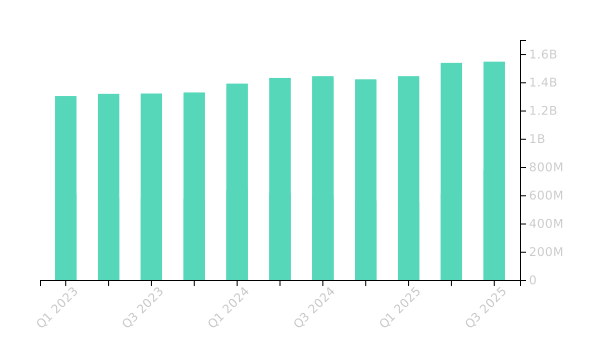
$EFX had revenues of $1.6B in Q4 2025. This is an increase of 9.24% from the same period in the prior year.
You can track EFX financials on Quiver Quantitative's EFX stock page.
$EFX Hedge Fund Activity
We have seen 397 institutional investors add shares of $EFX stock to their portfolio, and 486 decrease their positions in their most recent quarter.
Here are some of the largest recent moves:
- CAPITAL INTERNATIONAL INVESTORS removed 3,995,916 shares (-38.3%) from their portfolio in Q4 2025, for an estimated $867,033,853
- UBS AM, A DISTINCT BUSINESS UNIT OF UBS ASSET MANAGEMENT AMERICAS LLC removed 3,145,659 shares (-74.6%) from their portfolio in Q4 2025, for an estimated $682,545,089
- PRICE T ROWE ASSOCIATES INC /MD/ removed 1,741,584 shares (-29.2%) from their portfolio in Q4 2025, for an estimated $377,888,896
- HARRIS ASSOCIATES L P added 1,723,439 shares (+29.5%) to their portfolio in Q4 2025, for an estimated $373,951,794
- PARNASSUS INVESTMENTS, LLC removed 1,654,544 shares (-94.4%) from their portfolio in Q4 2025, for an estimated $359,002,957
- FMR LLC removed 1,579,807 shares (-87.0%) from their portfolio in Q4 2025, for an estimated $342,786,522
- GENERATION INVESTMENT MANAGEMENT LLP removed 1,164,793 shares (-42.6%) from their portfolio in Q4 2025, for an estimated $252,736,785
To track hedge funds' stock portfolios, check out Quiver Quantitative's institutional holdings dashboard.
$EFX Analyst Ratings
Wall Street analysts have issued reports on $EFX in the last several months. We have seen 5 firms issue buy ratings on the stock, and 0 firms issue sell ratings.
Here are some recent analyst ratings:
- RBC Capital issued a "Outperform" rating on 11/07/2025
- Stifel issued a "Buy" rating on 10/22/2025
- Needham issued a "Buy" rating on 10/21/2025
- Wells Fargo issued a "Overweight" rating on 10/15/2025
- UBS issued a "Buy" rating on 09/15/2025
To track analyst ratings and price targets for $EFX, check out Quiver Quantitative's $EFX forecast page.
$EFX Price Targets
Multiple analysts have issued price targets for $EFX recently. We have seen 13 analysts offer price targets for $EFX in the last 6 months, with a median target of $235.0.
Here are some recent targets:
- George Tong from Goldman Sachs set a target price of $208.0 on 02/09/2026
- Andrew Steinerman from JP Morgan set a target price of $230.0 on 02/05/2026
- Kyle Peterson from Needham set a target price of $265.0 on 02/05/2026
- Manav Patnaik from Barclays set a target price of $215.0 on 02/05/2026
- Ashish Sabadra from RBC Capital set a target price of $222.0 on 02/05/2026
- Shlomo Rosenbaum from Stifel set a target price of $235.0 on 02/05/2026
- Toni Kaplan from Morgan Stanley set a target price of $244.0 on 02/05/2026
Full Release
- Equifax Canada Market Pulse Fraud Trends and Insight and Fraud Survey -
TORONTO, March 03, 2026 (GLOBE NEWSWIRE) -- Equifax Canada’s Market Pulse Fraud Trends and Insights reveals that first-party fraud (when an individual uses their own, real identity to intentionally misrepresent) has surged, climbing from 0.25 per cent at the end of 2024 to 0.33 per cent by Q4 2025.
In addition, a new Equifax Canada Fraud Survey* conducted for Fraud Prevention Month shows people in Canada are feeling increasingly worn down by the steady stream of scams they face, reporting growing fatigue as fraud becomes more and more part of their everyday lives. Nearly three in ten (28 per cent) of those surveyed say the daily volume of fraud attempts has become a “manageable annoyance,” while more than a quarter feel numb to suspicious messages and simply delete them without reviewing them. Sixteen per cent say they feel “anxious and tired” trying to determine what is real and what is fake, and five per cent say they feel “completely burnt out”.
More than four in five Canadians surveyed (83 per cent) say they are worried that technology can now be used to create fake legal documents, such as pay stubs, insurance claims, or identification, that look convincingly real.
Identity theft and impersonation scams also continue to be a concern. Two-thirds of Canadians surveyed believe identity theft (67 per cent) and impersonation and phishing scams (64 per cent) are the types of fraud people in Canada are most worried about, followed by digital payment scams (59 per cent) and then investment and romance fraud (46 per cent).
The findings also highlight how widespread vulnerability has become. Six in ten Canadians surveyed say they feel most at risk of fraud in online environments, followed by one-third who feel vulnerable while on the go using public Wi-Fi and a quarter feel at risk at home. Only a small minority say they never feel vulnerable.
Despite rising awareness, risky behaviours and knowledge gaps remain. Nearly four in ten Canadians surveyed say they have accidentally clicked on a fraudulent link from an email or text message, and half say they know someone who has been a victim of identity theft. Many reported difficulty staying current as scams evolve, reinforcing the need for accessible education and support.
“Fraud seems to have become a constant presence in Canadians’ lives,” said Carl Davies, Head of Fraud & Identity at Equifax Canada . “People are exposed to scams so frequently that many are becoming desensitized, yet the risks remain very real. New technologies are also making fraud more sophisticated and harder to detect, reinforcing the need for continued awareness, stronger protections, and shared responsibility across sectors.”
The research also points to strong agreement that fraud prevention requires coordinated action across institutions and society:
- 88 per cent indicated public and private sectors must work together to combat financial crime
- 83 per cent feel the media should do more to raise awareness about how scams operate
- 80 per cent stated stricter penalties for scammers would help deter crime
- 62 per cent believe everyday scams help fund more serious criminal activity
When asked what would help Canadians stay safer, respondents pointed to stronger institutional safeguards and education:
- 68 per cent stated banks should implement stronger security measures to protect accounts
- 63 per cent responded that they wanted governments and companies using more sophisticated fraud solutions
-
59 per cent supported mandatory education in schools and public awareness campaigns
Auto insurance fraud is also on Canadians’ radar, with nearly half concerned that fraudulent activity is contributing to higher premiums for honest drivers.
“People in Canada believe that fraud is not just a personal issue, it’s a broader societal challenge,” said Julie Kuzmic Head of Consumer Advocacy and Compliance at Equifax Canada . “The findings show people want stronger safeguards, better education, and more collaboration between organizations and institutions to help them stay protected in an increasingly complex digital environment.”
* Equifax surveyed 1,570 Canadians ages 18-65, Jan. 30 to Feb. 1, 2026. A probability sample of the same size would yield a margin of error of +/- 2.5 per cent, 19 times out of 20.
About Equifax
At Equifax (NYSE: EFX), we believe knowledge drives progress. As a global data, analytics, and technology company, we play an essential role in the global economy by helping financial institutions, companies, employers, and government agencies make critical decisions with greater confidence. Our unique blend of differentiated data, analytics, and cloud technology drives insights to power decisions to move people forward. Headquartered in Atlanta and supported by nearly 15,000 employees worldwide, Equifax operates or has investments in 24 countries in North America, Central and South America, Europe, and the Asia Pacific region. For more information, visit
Equifax.ca
.
Contact:
Andrew Findlater
SELECT Public Relations
[email protected]
(647) 444-1197
Angie Andich
Equifax Canada Media Relations
[email protected]