

The energy insurance market remains soft despite rising losses and geopolitical issues, with ample capacity and intense competition.
Quiver AI Summary
The Energy Market Review published by Willis on April 16, 2026, highlights that despite an increase in loss activity, social inflation, and geopolitical instability, the energy insurance market remains significantly soft with ample capacity and competitive pricing. Upstream capacity has reached a historic $10 billion, but even the challenging loss environment, including a reported $6.8 billion in gross losses for 2025, has not spurred a hardening in prices. The market continues to attract new entrants, maintaining high levels of capacity and competition. The report notes concerns over rising liability claims and inadequate reserving but emphasizes that the market remains advantageous for buyers. Industry experts suggest that companies should ensure their business interruption declarations are robust in light of potential commodity price volatility. The report calls for a focus on risk quality and strong broker relationships as crucial elements for resilience in the current market landscape.
Potential Positives
- The energy insurance market is experiencing significant competition and abundant capacity, which is favorable for buyers and indicates a positive pricing environment for clients.
- New market entrants and broker facilities are expected to further increase upstream insurance capacity, reaching record levels, which can enhance options for clients.
- The report highlights a strong demand for risk quality and strategic engagement, showcasing Willis as a leader in providing essential insights and solutions for energy companies.
- Willis's proactive advice for clients to review their business interruption declarations demonstrates their commitment to client recovery and resilience amid market challenges.
Potential Negatives
- The energy insurance market is experiencing a significant amount of loss activity, which may lead to increasing concerns about overall market stability.
- Despite escalating losses, there is no indication of a corrective hardening in pricing, suggesting that risk levels are not accurately reflected in market rates.
- The report highlights ongoing geopolitical tensions and potential volatility in commodity prices, which could further complicate the market environment for energy insurers.
FAQ
What is the current state of the energy insurance market?
The energy insurance market remains soft with abundant capacity, intense competition, and downward pressure on rates despite rising loss activity.
How much upstream capacity is available in the market?
Upstream capacity has reached record levels of over $10 billion, with further growth expected from new entrants.
What challenges are affecting the liability insurance market?
Key concerns include global litigation, insufficient reserving, and inflation in liability claims, although the market remains profitable.
What impact might geopolitical tensions have on energy insurance?
The ongoing conflict in the Middle East raises concerns about potential losses in the operational energy insurance market.
What should energy companies consider regarding their insurance strategies?
Energy companies should review their business interruption declarations to ensure full recovery in the event of an incident.
Disclaimer: This is an AI-generated summary of a press release distributed by GlobeNewswire. The model used to summarize this release may make mistakes. See the full release here.
$WTW Insider Trading Activity
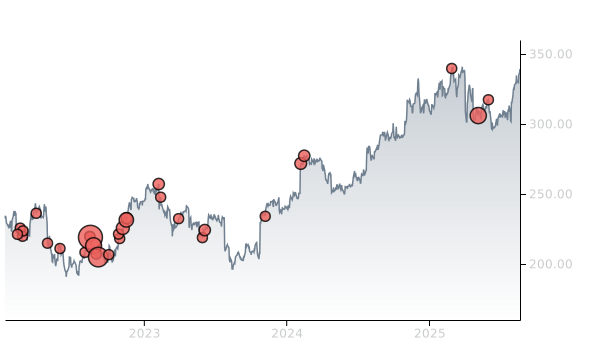
$WTW insiders have traded $WTW stock on the open market 1 times in the past 6 months. Of those trades, 0 have been purchases and 1 have been sales.
Here’s a breakdown of recent trading of $WTW stock by insiders over the last 6 months:
- MATTHEW FURMAN (General Counsel) sold 3,000 shares for an estimated $912,008
To track insider transactions, check out Quiver Quantitative's insider trading dashboard.
$WTW Revenue
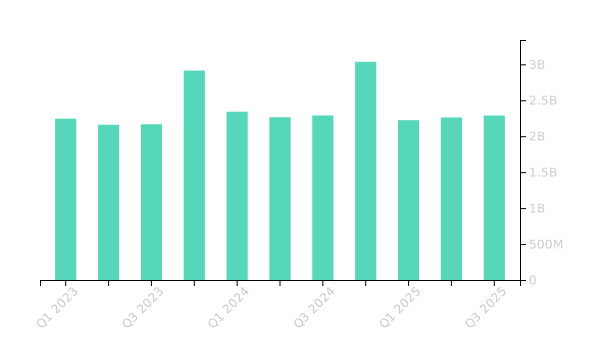
$WTW had revenues of $2.9B in Q4 2025. This is a decrease of -3.26% from the same period in the prior year.
You can track WTW financials on Quiver Quantitative's WTW stock page.
$WTW Hedge Fund Activity
We have seen 289 institutional investors add shares of $WTW stock to their portfolio, and 375 decrease their positions in their most recent quarter.
Here are some of the largest recent moves:
- DODGE & COX added 3,293,334 shares (+90.7%) to their portfolio in Q4 2025, for an estimated $1,082,189,552
- HARRIS ASSOCIATES L P added 1,318,482 shares (+30.7%) to their portfolio in Q4 2025, for an estimated $433,253,185
- FMR LLC removed 1,119,109 shares (-33.6%) from their portfolio in Q4 2025, for an estimated $367,739,217
- UBS AM, A DISTINCT BUSINESS UNIT OF UBS ASSET MANAGEMENT AMERICAS LLC added 866,006 shares (+inf%) to their portfolio in Q4 2025, for an estimated $284,569,571
- BANK OF MONTREAL /CAN/ added 817,301 shares (+657.3%) to their portfolio in Q4 2025, for an estimated $268,565,108
- BLACKROCK, INC. removed 794,851 shares (-8.6%) from their portfolio in Q4 2025, for an estimated $261,188,038
- T. ROWE PRICE INVESTMENT MANAGEMENT, INC. removed 476,225 shares (-16.8%) from their portfolio in Q4 2025, for an estimated $156,487,535
To track hedge funds' stock portfolios, check out Quiver Quantitative's institutional holdings dashboard.
$WTW Analyst Ratings
Wall Street analysts have issued reports on $WTW in the last several months. We have seen 3 firms issue buy ratings on the stock, and 1 firms issue sell ratings.
Here are some recent analyst ratings:
- Barclays issued a "Underweight" rating on 01/08/2026
- Keefe, Bruyette & Woods issued a "Outperform" rating on 01/06/2026
- TD Cowen issued a "Buy" rating on 11/10/2025
- Piper Sandler issued a "Overweight" rating on 10/31/2025
To track analyst ratings and price targets for $WTW, check out Quiver Quantitative's $WTW forecast page.
$WTW Price Targets
Multiple analysts have issued price targets for $WTW recently. We have seen 13 analysts offer price targets for $WTW in the last 6 months, with a median target of $354.0.
Here are some recent targets:
- Joshua Shanker from B of A Securities set a target price of $347.0 on 04/14/2026
- Yaron Kinar from Mizuho set a target price of $353.0 on 04/13/2026
- Ryan Tunis from Cantor Fitzgerald set a target price of $354.0 on 04/09/2026
- Elyse Greenspan from Wells Fargo set a target price of $351.0 on 04/09/2026
- Alex Scott from Barclays set a target price of $322.0 on 04/08/2026
- Meyer Shields from Keefe, Bruyette & Woods set a target price of $384.0 on 04/07/2026
- Vincent Sinisi from Morgan Stanley set a target price of $320.0 on 04/06/2026
Full Release
LONDON, April 16, 2026 (GLOBE NEWSWIRE) -- Despite mounting loss activity, rising social inflation and geopolitical volatility, the energy insurance market remains deeply soft, with abundant capacity, intense competition and continued downward pressure on rates, according to the Energy Market Review published today by Willis, a WTW business (NASDAQ: WTW).
Upstream capacity has reached record levels of over $10 billion with further growth expected from new market entrants and broker facilities. Loss activity, capital reallocation and macroeconomic volatility have the potential to stem the softening cycle in the immediate term. However, there is no single structural catalyst in sight to drive a meaningful turn in pricing.
The downstream market saw gross losses of $6.8 billion in 2025, with further deterioration from losses toward the end of 2025 and early 2026. Despite the loss heavy backdrop, the market continues to attract new entrants, in both MGA platforms and traditional Lloyd’s markets, keeping high levels of capacity available and ongoing competition, even as losses escalate.
Whilst international liability markets remain a broadly profitable class with healthy capacity, the spread of global litigation, insufficient reserving and the increase in liability over and above normal inflation levels remain key concerns. Despite these underlying concerns, capacity and competition are acting to sustain a liability market that is beneficial to buyers and shows no sign of hardening in the immediate future.
Recent geopolitical tensions in the Middle East have inevitably heightened focus on exposures. It remains to be seen whether the ongoing conflict in the Middle East will generate any significant losses across the operational energy insurance market.
Rupert Mackenzie, Global Head of Natural Resources at Willis, said: “As 2026 progresses, the energy insurance market remains highly favourable for buyers. Deteriorating loss trends, whether from heavy downstream refinery losses, upstream construction tails or liability claims inflation have not yet driven corrective hardening. Loss severity remains insufficient to counteract broader industry capital oversupply, arguably leaving pricing disconnected from underlying risk. With commodity price volatility potentially an ongoing issue in the coming quarter, we would urge buyers to review their business interruption declarations to ensure they can make a full recovery should an event occur.”
Marie Reiter, Global Head of Broking Strategy, Natural Resources, Willis added: “Risk quality and strategic engagement matter more than ever. Clear risk data, flexible placement structures and strong broker-to-market relationships remain essential differentiators to create resilience and stability for energy companies in readiness to withstand unexpected shocks and future upturns in the market environment.”
The complete report can be downloaded here.
About WTW
At WTW (NASDAQ: WTW), we provide data-driven, insight-led solutions in the areas of people, risk and capital. Leveraging the global view and local expertise of our colleagues serving 140 countries and markets, we help organizations sharpen their strategy, enhance organizational resilience, motivate their workforce and maximize performance.
Working shoulder to shoulder with our clients, we uncover opportunities for sustainable success—and provide perspective that moves you. Learn more at wtwco.com.
Media Contacts
Lauren David
Jo Barrett