


Counterpart Health's whitepaper shows AI technology improves diagnosis and care in underserved neighborhoods, enhancing patient outcomes and reducing hospitalizations.
Quiver AI Summary
Counterpart Health, a subsidiary of Clover Health Investments, has released a whitepaper highlighting how its Counterpart Assistant (CA) technology enhances value-based care in socioeconomically disadvantaged neighborhoods, where primary care often faces challenges due to limited resources and fragmented data. The analysis shows that patients in these areas who are attributed to a CA primary care provider experienced significantly higher diagnosis rates for chronic diseases like diabetes and chronic kidney disease, with earlier detection of disease stages compared to a control group. Moreover, CA attribution is linked to reduced acute care utilization, indicating a shift towards more proactive, long-term care. Dr. David Tsay and CEO Conrad Wai emphasize that CA equips clinicians with essential tools to identify and manage high-risk patients effectively, improving overall patient outcomes while easing administrative burdens. This whitepaper is part of Counterpart's ongoing effort to demonstrate the positive impact of its AI-powered platform on healthcare delivery.
Potential Positives
- Counterpart Health's whitepaper highlights significantly improved diagnosis rates for chronic diseases among patients in socioeconomically disadvantaged neighborhoods, indicating a strong impact of their CA technology.
- The use of CA technology is associated with earlier diagnosis of conditions like CKD and diabetes, which can lead to better management and outcomes for patients.
- Reported reductions in acute care utilization suggest that CA technology helps shift the focus from reactive to proactive care, likely improving overall healthcare efficiency and patient outcomes.
- This whitepaper builds upon previous analyses, reinforcing the effectiveness of CA in delivering guideline-aligned care in challenging operational environments, thus enhancing the company's credibility in the healthcare sector.
Potential Negatives
- Potential overreliance on new technology: The press release emphasizes the benefits of the CA technology but does not address possible concerns regarding the dependability and implementation challenges of AI-powered solutions in clinical settings.
- Insufficient discussion of limitations: While promising improvements in diagnosis and care coordination are highlighted, the release lacks acknowledgment of any existing gaps or limitations in the CA technology or its application in diverse healthcare environments.
- Focus on specific demographics may raise concerns: The emphasis on socioeconomically disadvantaged neighborhoods, while important, may draw criticism regarding the scalability and generalizability of the CA benefits across broader patient populations.
FAQ
What is Counterpart Health?
Counterpart Health is a subsidiary of Clover Health that utilizes AI to enhance physician capabilities and support value-based care.
How does Counterpart Assistant improve patient outcomes?
Counterpart Assistant aids in early detection, tracking disease progression, and proactive interventions, improving diagnosis rates and reducing hospitalizations.
What are the key findings of the latest whitepaper?
The whitepaper shows significant increases in diagnosis rates and reduces acute care utilization among patients in socioeconomically disadvantaged neighborhoods.
How does CA technology assist non-urban practices?
CA technology streamlines care delivery and helps non-urban practices manage chronic conditions by providing essential clinical insights and tools.
Where can I learn more about Counterpart Health?
You can learn more about Counterpart Health by visiting their website at www.counterparthealth.com.
Disclaimer: This is an AI-generated summary of a press release distributed by GlobeNewswire. The model used to summarize this release may make mistakes. See the full release here.
$CLOV Insider Trading Activity
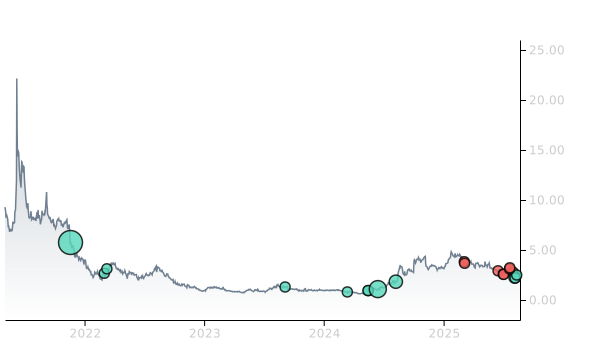
$CLOV insiders have traded $CLOV stock on the open market 13 times in the past 6 months. Of those trades, 4 have been purchases and 9 have been sales.
Here’s a breakdown of recent trading of $CLOV stock by insiders over the last 6 months:
- VIVEK GARIPALLI has made 2 purchases buying 446,980 shares for an estimated $998,996 and 0 sales.
- CONRAD WAI (CEO, Counterpart Health) has made 0 purchases and 2 sales selling 209,797 shares for an estimated $692,968.
- JAMIE L. REYNOSO (CEO, Medicare Advantage) has made 0 purchases and 7 sales selling 72,514 shares for an estimated $199,934.
- ANNA U LOENGARD has made 2 purchases buying 26,500 shares for an estimated $68,755 and 0 sales.
To track insider transactions, check out Quiver Quantitative's insider trading dashboard.
$CLOV Hedge Fund Activity
We have seen 119 institutional investors add shares of $CLOV stock to their portfolio, and 94 decrease their positions in their most recent quarter.
Here are some of the largest recent moves:
- BLACKROCK, INC. added 20,029,317 shares (+193.2%) to their portfolio in Q2 2025, for an estimated $55,881,794
- GEODE CAPITAL MANAGEMENT, LLC added 4,812,368 shares (+95.7%) to their portfolio in Q2 2025, for an estimated $13,426,506
- MILLENNIUM MANAGEMENT LLC removed 4,745,791 shares (-81.8%) from their portfolio in Q2 2025, for an estimated $13,240,756
- STATE STREET CORP added 4,580,664 shares (+156.5%) to their portfolio in Q2 2025, for an estimated $12,780,052
- VANGUARD GROUP INC added 3,665,917 shares (+17.8%) to their portfolio in Q2 2025, for an estimated $10,227,908
- BANK OF AMERICA CORP /DE/ added 2,748,783 shares (+217.5%) to their portfolio in Q2 2025, for an estimated $7,669,104
- NORTHERN TRUST CORP added 2,341,788 shares (+226.4%) to their portfolio in Q2 2025, for an estimated $6,533,588
To track hedge funds' stock portfolios, check out Quiver Quantitative's institutional holdings dashboard.
$CLOV Analyst Ratings
Wall Street analysts have issued reports on $CLOV in the last several months. We have seen 1 firms issue buy ratings on the stock, and 0 firms issue sell ratings.
Here are some recent analyst ratings:
- Canaccord Genuity issued a "Buy" rating on 08/07/2025
To track analyst ratings and price targets for $CLOV, check out Quiver Quantitative's $CLOV forecast page.
$CLOV Price Targets
Multiple analysts have issued price targets for $CLOV recently. We have seen 2 analysts offer price targets for $CLOV in the last 6 months, with a median target of $3.55.
Here are some recent targets:
- Richard Close from Canaccord Genuity set a target price of $4.1 on 08/07/2025
- Jonathan Yong from UBS set a target price of $3.0 on 08/06/2025
Full Release
SAN FRANCISCO, Oct. 30, 2025 (GLOBE NEWSWIRE) -- Counterpart Health, Inc. (“Counterpart”), a wholly owned subsidiary of Clover Health Investments, Corp. (Nasdaq: CLOV) (“Clover,” “Clover Health” or the “Company”) and a leading AI-powered physician-enablement platform, today released a whitepaper demonstrating how Counterpart Assistant (CA) technology supports value‑based care in high Area Deprivation Index (ADI) neighborhoods .
Primary care in high ADI neighborhoods is frequently delivered by small, non‑urban practices operating with limited care‑coordination infrastructure and fragmented clinical data. The analysis in Counterpart’s latest whitepaper examines how CA’s advanced clinical technology supports early detection, disease progression tracking, and proactive interventions, capabilities not typically available to such practices.
Key highlights from the whitepaper include:
Higher Diagnosis Rates: Patients from socioeconomically disadvantaged neighborhoods (SEDN) attributed to a CA PCP who joined Clover Health from another MA plan were more likely to receive their first known diagnosis of diabetes, chronic kidney disease (CKD), chronic heart failure (CHF), or chronic obstructive pulmonary disease (COPD) in their first year after plan enrollment. Diagnosis rates were 75% higher for diabetes; 89% higher for CKD; 89% higher for CHF; and 70% higher for COPD.
Diagnosis at Earlier Stages: Patients from this population with CKD or diabetes were diagnosed at earlier clinical stages of disease. For CKD patients, initial clinical markers reflected CKD Stage 2, on average, versus Stage 3A. For diabetes patients, A1C levels were indicative of an earlier stage of disease with average A1Cs at 6.8% compared to 7.1% in the comparison group.
Less Frequent Acute Care Utilization: CA PCP attribution was associated with significantly less acute care utilization, including fewer all-cause inpatient hospitalizations (ranging from -7.6% to -21.2%) and 30-day readmissions (ranging from -11.5% to -20.8%) in members across all four studied chronic diseases.
These associations are consistent with a shift toward proactive, longitudinal care in clinics that face material operational constraints.
"Early detection opens a critical window for intervention before conditions progress and can fundamentally change disease trajectories in these communities that often have high chronic disease burden," said Dr. David Tsay, MD PhD, Chief Medical Officer at Counterpart Health and co-author of the whitepaper. "Our data shows that when primary care teams have the right tools, patients experience better outcomes, including fewer hospitalizations and a reduced need for acute interventions."
This whitepaper is Counterpart’s sixth retrospective data analysis measuring CA’s clinical impact. The case study builds on earlier analyses by showing that CA can streamline delivery and support more consistent, guideline‑aligned care in socioeconomically disadvantaged settings, core practices for managing complex chronic conditions.
"Many physicians today, particularly those treating underserved communities, lack the data and technology infrastructure needed to deliver effective, value-based care," said Conrad Wai, CEO of Counterpart Health. "CA addresses this gap, integrating AI-powered clinical insights directly into workflows so clinicians can identify high-risk patients and intervene earlier without adding administrative burden. This approach allows resource-constrained practices to deliver proactive care at scale.”
To learn more about Counterpart Health, visit: www.counterparthealth.com .
About Counterpart Health
Counterpart Health
, a subsidiary of Clover Health Investments, Corp., or Clover Health, is a leading AI-powered physician enablement platform transforming care delivery. Born out of Clover Health as Clover Assistant, Counterpart Health’s flagship software platform, Counterpart Assistant, provides clinically intuitive insights that help clinicians better manage chronic conditions and deliver high-quality care. Counterpart Health extends this powerful data-driven technology platform beyond Clover Health’s Medicare Advantage plan, bringing its benefits to a wider audience to improve patient outcomes and reduce healthcare costs nationwide. Several published studies demonstrate the technology’s impact on
Diabetes
,
Chronic Kidney Disease
, and
Congestive Heart Failure
management,
Chronic Obstructive Pulmonary Disease
, and
Clinical Quality
.
Investor Relations:
Ryan Schmidt
[email protected]
Press Inquiries:
[email protected]