


Celldex completed enrollment for barzolvolimab’s Phase 3 trials in CSU, ahead of schedule, with results expected in late 2026.
Quiver AI Summary
Celldex announced the completion of enrollment in its global Phase 3 program for barzolvolimab, targeting chronic spontaneous urticaria (CSU), six months ahead of schedule. The program consists of two trials, EMBARQ-CSU1 and EMBARQ-CSU2, with a total of 1,939 patients enrolled across 43 countries, representing the largest study in antihistamine refractory CSU. The company anticipates reporting topline data by Q4 2026 and plans to submit a Biologics License Application (BLA) in 2027. Barzolvolimab aims to transform CSU treatment by addressing its root cause, mast cell activation, showing promising results in earlier studies, including significant symptom relief and improved quality of life for patients. The ongoing Phase 3 trials are designed to confirm the treatment's efficacy and safety, with re-randomization for placebo patients to active treatment at 24 weeks.
Potential Positives
- Completion of enrollment in the Phase 3 program of barzolvolimab six months ahead of guidance demonstrates strong demand and urgency for improved treatments in chronic spontaneous urticaria (CSU).
- 1,939 patients enrolled across 43 countries and over 500 sites represent the largest clinical program for antihistamine refractory CSU, potentially increasing the robustness of the data and the likelihood of positive outcomes.
- The drug barzolvolimab has shown significant potential for transforming the treatment landscape for CSU, with promising Phase 2 results indicating a best-in-class profile with high rates of complete response and improvements in quality of life.
Potential Negatives
- The statement outlines a lengthy timeline for the BLA submission planned for 2027, which may indicate a delay in bringing the treatment to market compared to competitors.
- The press release emphasizes a significant unmet need in CSU, suggesting that existing treatments are inadequate and highlighting the potential shortcomings of the company's current or previous products.
- The forward-looking statements include numerous risks and uncertainties that could impact the successful development and commercialization of barzolvolimab and other drug candidates, which may raise concerns among investors about the company's future prospects.
FAQ
What is barzolvolimab and its purpose?
Barzolvolimab is a humanized monoclonal antibody aimed at treating chronic spontaneous urticaria (CSU) by targeting mast cells directly.
When will topline results from the trials be available?
Topline data from the Phase 3 trials of barzolvolimab is expected in the fourth quarter of 2026.
When does the BLA submission for barzolvolimab occur?
The Biologics License Application (BLA) submission for barzolvolimab is planned for 2027.
How many patients were enrolled in the Phase 3 trials?
A total of 1,939 patients were enrolled, making it the largest program for antihistamine refractory CSU.
What symptoms does chronic spontaneous urticaria (CSU) cause?
CSU is characterized by spontaneous hives, severe itching, and unpredictable angioedema episodes, severely impacting quality of life.
Disclaimer: This is an AI-generated summary of a press release distributed by GlobeNewswire. The model used to summarize this release may make mistakes. See the full release here.
$CLDX Insider Trading Activity
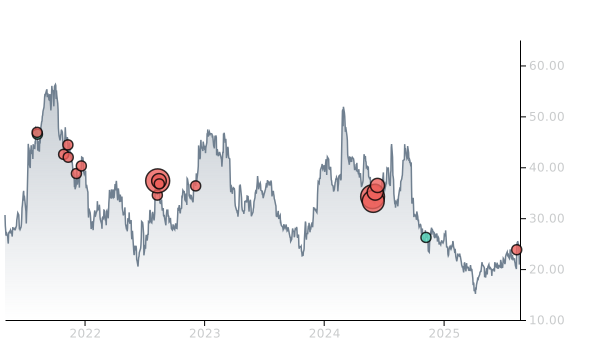
$CLDX insiders have traded $CLDX stock on the open market 2 times in the past 6 months. Of those trades, 0 have been purchases and 2 have been sales.
Here’s a breakdown of recent trading of $CLDX stock by insiders over the last 6 months:
- RICHARD M. WRIGHT sold 49,298 shares for an estimated $1,183,176
- FREDDY A. JIMENEZ (SVP & GENERAL COUNSEL) sold 4,166 shares for an estimated $121,209
To track insider transactions, check out Quiver Quantitative's insider trading dashboard.
$CLDX Hedge Fund Activity
We have seen 80 institutional investors add shares of $CLDX stock to their portfolio, and 103 decrease their positions in their most recent quarter.
Here are some of the largest recent moves:
- WELLINGTON MANAGEMENT GROUP LLP added 2,279,605 shares (+39.3%) to their portfolio in Q4 2025, for an estimated $61,914,071
- POINT72 ASSET MANAGEMENT, L.P. removed 2,135,585 shares (-54.8%) from their portfolio in Q4 2025, for an estimated $58,002,488
- BRAIDWELL LP added 1,266,420 shares (+214.0%) to their portfolio in Q4 2025, for an estimated $34,395,967
- STATE STREET CORP added 555,579 shares (+19.5%) to their portfolio in Q4 2025, for an estimated $15,089,525
- ADAR1 CAPITAL MANAGEMENT, LLC added 537,325 shares (+491.0%) to their portfolio in Q4 2025, for an estimated $14,593,747
- COMMODORE CAPITAL LP removed 463,335 shares (-15.3%) from their portfolio in Q4 2025, for an estimated $12,584,178
- DIMENSIONAL FUND ADVISORS LP added 394,633 shares (+153.5%) to their portfolio in Q4 2025, for an estimated $10,718,232
To track hedge funds' stock portfolios, check out Quiver Quantitative's institutional holdings dashboard.
$CLDX Analyst Ratings
Wall Street analysts have issued reports on $CLDX in the last several months. We have seen 1 firms issue buy ratings on the stock, and 1 firms issue sell ratings.
Here are some recent analyst ratings:
- Mizuho issued a "Outperform" rating on 10/21/2025
- Barclays issued a "Underweight" rating on 10/13/2025
To track analyst ratings and price targets for $CLDX, check out Quiver Quantitative's $CLDX forecast page.
$CLDX Price Targets
Multiple analysts have issued price targets for $CLDX recently. We have seen 3 analysts offer price targets for $CLDX in the last 6 months, with a median target of $48.0.
Here are some recent targets:
- Etzer Darout from Barclays set a target price of $24.0 on 12/17/2025
- Joseph Catanzaro from Mizuho set a target price of $48.0 on 10/21/2025
- Edward Nash from Canaccord Genuity set a target price of $62.0 on 09/17/2025
Full Release
- Enrollment completed six months ahead of guidance, driven by significant unmet need for better treatments in CSU
- Topline data expected Q4 2026
-
BLA submission planned for 2027
HAMPTON, N.J., Feb. 25, 2026 (GLOBE NEWSWIRE) -- Celldex (NASDAQ:CLDX) announced today the completion of enrollment in the Company’s global Phase 3 program of barzolvolimab in chronic spontaneous urticaria (CSU), which consists of two Phase 3 trials—EMBARQ-CSU1 and EMBARQ-CSU2. 1,939 patients were enrolled—the largest program conducted in antihistamine refractory CSU, including patients with advanced therapy experienced/refractory CSU. The studies included 43 countries and over 500 sites.
“Completing enrollment in these large Phase 3 CSU studies 6 months ahead of guidance highlights the significant unmet need in CSU and speaks to the excitement from patients and physicians about barzolvolimab and its potential as a best-in-disease treatment,” said Anthony S. Marucci, Co-founder, President and Chief Executive Officer of Celldex. “We are extremely grateful to these patients, their families and their treating physicians for their enthusiasm and participation in the EMBARQ-CSU1 and EMBARQ-CSU2 studies. We look forward to reporting topline results later this year and remain focused on completing preparations to support bringing this much needed treatment to more than 1.8 million patients in the United States suffering from CSU.”
Barzolvolimab uniquely targets the root cause of CSU—the mast cell—and has the potential to transform the CSU treatment landscape by providing rapid, profound and durable efficacy that is unparalleled in CSU, offering new hope for the patients suffering from this often severe and debilitating disease. Based on results from the completed Phase 2 study of barzolvolimab in CSU, barzolvolimab has the potential to deliver a best-in-class and best-in-disease clinical profile—symptom free complete control and dramatic improvements in quality of life and angioedema. Up to 51% of patients on study had a complete response and were symptom free (UAS7=0; no itch/no hives) at 12 weeks, which continued to deepen over 52 weeks of active therapy to up to 71% of patients. This profound clinical benefit continued even after patients were off therapy with up to 41% of patients reporting complete response seven months after receiving their last dose. Patients also reported dramatic improvements in angioedema control and quality of life. At 12 weeks, up to 65% of barzolvolimab treated patients were angioedema free (AAS7=0), which increased to up to 77% at Week 52 and remained at up to 64% seven months after last dose. At 12 weeks, up to 67% of patients treated with barzolvolimab reported their CSU had no impact on their quality of life (DLQI 0/1), which increased to up to 82% at Week 52 and remained at up to 48% seven months after last dose.
The Phase 3 Program is designed to establish the efficacy and safety of barzolvolimab in adult patients with CSU who remain symptomatic despite H1 antihistamine treatment. Both Phase 3 trials are randomized, double-blind, placebo-controlled, parallel group, global studies. 1,939 patients were randomized (n=963 EMBARQ-CSU1; n=976 EMBARQ-CSU2) evenly to barzolvolimab 150 mg every 4 weeks (following 300 mg loading dose), barzolvolimab 300 mg every 8 weeks (following 450 mg loading dose) or placebo for 52 weeks. At 24 weeks, patients on placebo are re-randomized to active treatment across both dosing groups. The primary endpoint of the study will evaluate the clinical effect of barzolvolimab in reducing urticaria activity (weekly urticaria activity score; UAS7) at Week 12 . The study is designed to detect a clinically meaningful difference between each of the active arms vs placebo in the overall population as well as in the subpopulation of omalizumab refractory participants. The primary endpoint analysis will be performed when all patients have completed the placebo controlled portion of the study at 24 weeks. A global Phase 3b long term extension study (LTE) has been established and is ongoing, which patients can enter following completion of the EMBARQ-CSU Phase 3 trials.
Please visit clinicaltrials.gov for additional information on EMBARQ-CSU1; NCT06445023 and EMBARQ-CSU2; NCT06455202 ) .
About Barzolvolimab
Barzolvolimab is a humanized monoclonal antibody with a novel mechanism of action that targets mast cells by binding with high specificity to a unique part of the KIT receptor and potently inhibiting its activity. The KIT receptor is abundantly expressed by mast cells and critical for their function and survival. Mast cells are drivers of inflammatory responses such as hypersensitivity and allergic reactions and, in certain inflammatory diseases, such as chronic urticarias, mast cell activation plays a central role in the onset and progression of the disease. Based on data from robust, randomized, placebo controlled Phase 2 studies, barzolvolimab has significant potential as a first-in-class and best-in-disease treatment option for patients with chronic spontaneous urticaria (CSU), cold urticaria (ColdU) and symptomatic dermographism (SD). Barzolvolimab is currently being studied in Phase 3 studies in CSU and ColdU/SD and Phase 2 studies in prurigo nodularis (PN) and atopic dermatitis (AD), with additional indications planned for the future.
About Chronic Spontaneous Urticaria (CSU)
CSU is an underdiagnosed disease of misery marked by spontaneous hives, unbearable itch, and unpredictable episodes of disfiguring swelling (angioedema) that causes substantial mental health burden, profound impact on quality of life and is associated with a 1.7-fold increase in all cause mortality at 5 years. Mast cell activation plays a central role in the onset and progression of CSU. While the goal of CSU treatment is the complete absence of symptoms, the vast majority of patients today, even those receiving the most advanced approved and available therapies, continue to suffer from itch, hives, swelling, sleep disruption, and unrelenting anxiety about when the next flare up will occur.
About Celldex
Celldex is pioneering new horizons in immunology to deliver life-changing therapies. We are relentless in our pursuit of novel antibody-based treatments that engage the human immune system and directly affect critical pathways to improve the lives of patients with allergic, inflammatory and autoimmune disorders.
Visit
www.celldex.com
.
Forward Looking Statement
This release contains "forward-looking statements" made pursuant to the safe harbor provisions of the Private Securities Litigation Reform Act of 1995. These statements are typically preceded by words such as "believes," "expects," "anticipates," "intends," "will," "may," "should," or similar expressions. These forward-looking statements reflect management's current knowledge, assumptions, judgment and expectations regarding future performance or events. Although management believes that the expectations reflected in such statements are reasonable, they give no assurance that such expectations will prove to be correct or that those goals will be achieved, and you should be aware that actual results could differ materially from those contained in the forward-looking statements. Forward-looking statements are subject to a number of risks and uncertainties, including, but not limited to, our ability to successfully complete research and further development and commercialization of Company drug candidates, including barzolvolimab (also referred to as CDX-0159) and CDX-622, in current or future indications; the uncertainties inherent in clinical testing and accruing patients for clinical trials; our limited experience in bringing programs through Phase 3 clinical trials; our ability to manage and successfully complete multiple clinical trials and the research and development efforts for our multiple products at varying stages of development; the availability, cost, delivery and quality of clinical materials produced by our own manufacturing facility or supplied by contract manufacturers, who may be our sole source of supply; the timing, cost and uncertainty of obtaining regulatory approvals; the failure of the market for the Company's programs to continue to develop; our ability to protect the Company's intellectual property; the loss of any executive officers or key personnel or consultants; competition; changes in the regulatory landscape or the imposition of regulations that affect the Company's products; our ability to continue to obtain capital to meet our long-term liquidity needs on acceptable terms, or at all, including the additional capital which will be necessary to complete the clinical trials that we have initiated or plan to initiate; and other factors listed under "Risk Factors" in our annual report on Form 10-K and quarterly reports on Form 10-Q.
All forward-looking statements are expressly qualified in their entirety by this cautionary notice. You are cautioned not to place undue reliance on any forward-looking statements, which speak only as of the date of this release. We have no obligation, and expressly disclaim any obligation, to update, revise or correct any of the forward-looking statements, whether as a result of new information, future events or otherwise.
Company Contact
Sarah Cavanaugh
Senior Vice President, Corporate Affairs & Administration
(508) 864-8337
[email protected]
Patrick Till
Meru Advisors
(484) 788-8560
[email protected]