


Castle Biosciences' TissueCypher test is clinically validated for risk stratification in Barrett’s esophagus, enhancing patient management.
Quiver AI Summary
Castle Biosciences, Inc. announced the publication of a systematic review and meta-analysis confirming that the TissueCypher® Barrett’s Esophagus test effectively stratifies the risk of patients with Barrett's esophagus (BE) developing esophageal cancer. The study, published in the Journal of Clinical Gastroenterology, synthesizes data from six previous studies and illustrates that TissueCypher can identify patients at higher risk for progression to high-grade dysplasia or esophageal adenocarcinoma better than traditional methods. Key findings reveal that patients with high-risk TissueCypher results are significantly more likely to progress to cancer. This test, which analyzes standard esophageal biopsies, enhances personalized patient care by allowing clinicians to tailor management strategies based on individual risk levels. Castle Biosciences continues to focus on developing innovative diagnostic tools aimed at improving health outcomes.
Potential Positives
- Publication of a new systematic review and meta-analysis confirming the clinical validity of the TissueCypher® Barrett’s Esophagus test enhances the company's credibility in the diagnostic field.
- TissueCypher is shown to significantly outperform traditional pathology in identifying patients at risk of progression to esophageal cancer, indicating its potential to improve patient outcomes.
- The results provide strong evidence for personalized patient care, which aligns with the company’s mission of improving health through innovative, actionable testing solutions.
- The comprehensive validation of the TissueCypher test across multiple studies strengthens its market position and could lead to increased adoption in clinical practices.
Potential Negatives
- Forward-looking statements indicate uncertainty regarding the future efficacy and application of the TissueCypher test, implying that actual results may not achieve claimed benefits.
- The reliance on a systematic review and meta-analysis for validation suggests that the company's test may still face scrutiny or doubt until further independent studies are conducted.
- The mention of risks and uncertainties related to study outcomes may create concerns for investors regarding the reliability and positioning of the TissueCypher test in the market.
FAQ
What is the TissueCypher® Barrett’s Esophagus test?
The TissueCypher test is a precision medicine test predicting the risk of progression from Barrett's esophagus to cancer.
What are the key findings of the new systematic review?
The review shows TissueCypher reliably identifies patients at high risk of progressing to high-grade dysplasia or esophageal adenocarcinoma.
How does TissueCypher enhance patient care?
TissueCypher enables personalized care by helping identify high-risk patients for earlier intervention while maintaining routine surveillance for low-risk individuals.
How many studies were included in the meta-analysis?
The meta-analysis consolidated data from six previously published studies to validate TissueCypher's performance.
What methodology does TissueCypher use?
TissueCypher employs an AI-driven spatialomics approach to identify molecular signatures that precede dysplasia development.
Disclaimer: This is an AI-generated summary of a press release distributed by GlobeNewswire. The model used to summarize this release may make mistakes. See the full release here.
$CSTL Insider Trading Activity
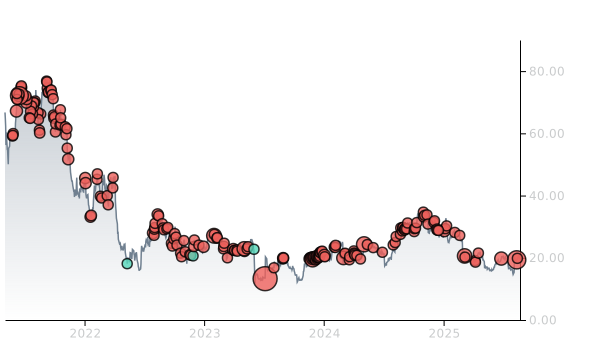
$CSTL insiders have traded $CSTL stock on the open market 29 times in the past 6 months. Of those trades, 0 have been purchases and 29 have been sales.
Here’s a breakdown of recent trading of $CSTL stock by insiders over the last 6 months:
- DEREK J MAETZOLD (Pres. & Chief Exec. Officer) has made 0 purchases and 21 sales selling 97,731 shares for an estimated $2,360,308.
- KRISTEN M OELSCHLAGER (Chief Operating Officer) has made 0 purchases and 4 sales selling 62,294 shares for an estimated $1,651,677.
- TOBIN W JUVENAL (Chief Commercial Officer) has made 0 purchases and 3 sales selling 5,393 shares for an estimated $191,751.
- FRANK STOKES (Chief Financial Officer) sold 5,388 shares for an estimated $189,011
To track insider transactions, check out Quiver Quantitative's insider trading dashboard.
$CSTL Revenue
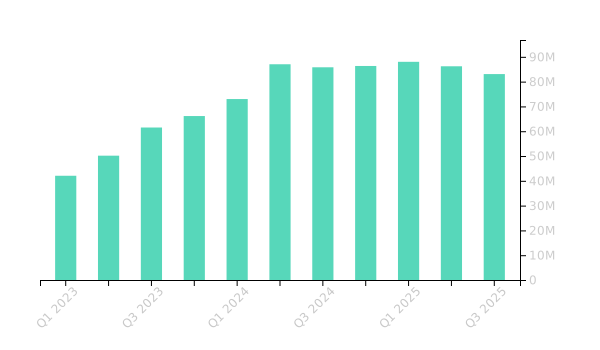
$CSTL had revenues of $83M in Q3 2025. This is a decrease of -3.19% from the same period in the prior year.
You can track CSTL financials on Quiver Quantitative's CSTL stock page.
$CSTL Hedge Fund Activity
We have seen 98 institutional investors add shares of $CSTL stock to their portfolio, and 99 decrease their positions in their most recent quarter.
Here are some of the largest recent moves:
- AIGH CAPITAL MANAGEMENT LLC added 707,287 shares (+inf%) to their portfolio in Q3 2025, for an estimated $16,104,924
- CITADEL ADVISORS LLC removed 637,600 shares (-71.8%) from their portfolio in Q3 2025, for an estimated $14,518,152
- PARK WEST ASSET MANAGEMENT LLC removed 556,485 shares (-100.0%) from their portfolio in Q2 2025, for an estimated $11,363,423
- WELLINGTON MANAGEMENT GROUP LLP removed 407,211 shares (-100.0%) from their portfolio in Q3 2025, for an estimated $9,272,194
- SUMMIT PARTNERS PUBLIC ASSET MANAGEMENT, LLC added 400,000 shares (+inf%) to their portfolio in Q3 2025, for an estimated $9,108,000
- WASATCH ADVISORS LP removed 380,653 shares (-36.3%) from their portfolio in Q3 2025, for an estimated $8,667,468
- POINT72 ASSET MANAGEMENT, L.P. added 336,958 shares (+inf%) to their portfolio in Q3 2025, for an estimated $7,672,533
To track hedge funds' stock portfolios, check out Quiver Quantitative's institutional holdings dashboard.
$CSTL Analyst Ratings
Wall Street analysts have issued reports on $CSTL in the last several months. We have seen 3 firms issue buy ratings on the stock, and 0 firms issue sell ratings.
Here are some recent analyst ratings:
- BTIG issued a "Buy" rating on 11/05/2025
- Baird issued a "Outperform" rating on 11/04/2025
- Canaccord Genuity issued a "Buy" rating on 09/09/2025
To track analyst ratings and price targets for $CSTL, check out Quiver Quantitative's $CSTL forecast page.
$CSTL Price Targets
Multiple analysts have issued price targets for $CSTL recently. We have seen 3 analysts offer price targets for $CSTL in the last 6 months, with a median target of $38.0.
Here are some recent targets:
- Mark Massaro from BTIG set a target price of $38.0 on 11/05/2025
- Catherine Ramsey from Baird set a target price of $41.0 on 11/04/2025
- Kyle Mikson from Canaccord Genuity set a target price of $37.0 on 09/09/2025
Full Release
FRIENDSWOOD, Texas, Dec. 12, 2025 (GLOBE NEWSWIRE) -- Castle Biosciences, Inc. (Nasdaq: CSTL), a company improving health through innovative tests that guide patient care, today announced the publication of a new systematic review and meta-analysis (SRMA) demonstrating that the TissueCypher ® Barrett’s Esophagus test provides clinically validated risk stratification for patients with Barrett’s esophagus (BE). The findings confirm that TissueCypher can outperform traditional pathology or clinical factors alone to identify patients at increased risk of developing esophageal cancer.
The paper, titled “The Tissue Systems Pathology Test Predicts Risk of Progression in Patients With Barrett’s Esophagus: Systematic Review and Meta-Analysis,” was published in the Journal of Clinical Gastroenterology . The analysis consolidated data from six previously published studies and found that TissueCypher consistently identifies patients at greater risk of progression to high-grade dysplasia (HGD) or esophageal adenocarcinoma (EAC), a key step toward enabling personalized, risk-aligned patient management aimed at preventing cancer.
“Our findings provide strong evidence that TissueCypher delivers meaningful risk stratification for patients with Barrett’s esophagus,” said Caitlin C. Houghton, M.D., board-certified foregut surgeon at Keck Medicine of USC in Los Angeles, California, and lead author of the study. “By identifying which patients are truly at high risk for progression to esophageal cancer — and which are not — TissueCypher can help physicians personalize care, flagging those who may benefit from earlier intervention and providing confidence in continuing routine surveillance for those at low risk.”
SRMAs represent rigorous, high-quality evidence for clinical validation because they synthesize findings across multiple studies to provide overall estimates of performance. The results of this SRMA represent the most comprehensive validation of the TissueCypher test to date, reinforcing its value as an evidence-based tool for risk stratification in BE. The study demonstrates TissueCypher’s predictive performance across patients with non-dysplastic BE (NDBE), indefinite for dysplasia (IND) and low-grade dysplasia (LGD), and shows that the test outperforms histologic assessment in identifying patients at greatest risk of progression.
Key findings of the SRMA indicate TissueCypher can help physicians:
- Identify patients at highest risk: Across six published studies, patients with high-risk TissueCypher results were 6.7 times more likely to progress to HGD or EAC within five years than those with low-risk results (p<0.0001).
- Guide care with confidence: Patients with high or intermediate-risk results had an annual progression rate of 2.8% , and those with high-risk results had a rate of 5.6% per year , both above the 1.7% annual progression rate typically reported for patients with LGD, a clinical benchmark for therapeutic intervention.
By integrating data across multiple studies, this analysis confirms that TissueCypher provides consistent, reproducible performance and supports its potential to help physicians deliver risk-aligned care, identifying patients most likely to progress and tailoring management strategies that can improve outcomes while reducing unnecessary procedures.
About TissueCypher Barrett’s Esophagus Test
TissueCypher is a precision medicine test designed and extensively validated to predict a patient’s personalized risk of progression from Barrett’s esophagus to high-grade dysplasia or esophageal adenocarcinoma. Indicated for patients with non-dysplastic BE, indefinite for dysplasia or with low-grade dysplasia, TissueCypher’s five-year risk assessment is designed to help physicians tailor care to each patient’s risk of developing HGD or EAC.
Backed by 17 peer-reviewed publications and studied in biopsies from more than 8,000 patients, TissueCypher has been shown to be the strongest independent predictor of progression compared with traditional histopathological risk assessment. Using an AI-driven spatialomics approach, the test identifies molecular signatures that often precede the development of dysplasia, which can enable earlier identification, treatment, and management of patients at increased risk of cancer. TissueCypher is designed to integrate seamlessly into routine endoscopic practice by analyzing standard esophageal pinch biopsies, delivering actionable insights without requiring additional procedures. Learn more at www.CastleBiosciences.com/TissueCypher .
About Castle Biosciences
Castle Biosciences (Nasdaq: CSTL) is a leading diagnostics company improving health through innovative tests that guide patient care. With a primary focus in dermatologic and gastroenterological disease, we develop personalized, clinically actionable solutions that help improve disease management and patient outcomes.
We put people first—empowering patients and clinicians and informing care decisions through rigorous science and advanced molecular tests that support more confident treatment planning. To learn more, visit www.CastleBiosciences.com and connect with us on LinkedIn , Instagram , Facebook and X .
DecisionDx-Melanoma, DecisionDx-CM Seq , i31-SLNB, i31-ROR, DecisionDx-SCC, MyPath Melanoma, AdvanceAD-Tx, TissueCypher, DecisionDx-UM, DecisionDx-PRAME and DecisionDx-UM Seq are trademarks of Castle Biosciences, Inc.
Forward-Looking Statements
This press release contains forward-looking statements within the meaning of Section 27A of the Securities Act of 1933, as amended, and Section 21E of the Securities Exchange Act of 1934, as amended, which are subject to the “safe harbor” created by those sections. These forward-looking statements include, but are not limited to, statements concerning: TissueCypher’s ability to provide risk insights beyond pathology or clinical factors alone and enable more personalized surveillance and treatment strategies for BE patients that may help prevent cancer, including supporting earlier intervention for those at higher risk for progression to esophageal cancer, reducing unnecessary procedures for those at lower risk of progression, and supporting risk-aligned management of patients with a finding of indefinite for dysplasia. The words “believe,” “may,” “can” and similar expressions are intended to identify forward-looking statements, although not all forward-looking statements contain these identifying words. We may not actually achieve the plans, intentions or expectations disclosed in our forward-looking statements, and you should not place undue reliance on our forward-looking statements. Actual results or events could differ materially from the plans, intentions and expectations disclosed in the forward-looking statements that we make. These forward-looking statements involve risks and uncertainties that could cause our actual results to differ materially from those in the forward-looking statements, including, without limitation: subsequent study or trial results and findings may contradict earlier study or trial results and findings or may not support the results obtained in these studies, including with respect to the discussion of our tests in this press release; actual application of our tests may not provide the aforementioned benefits to patients; and the risks set forth under the heading “Risk Factors” in our Annual Report on Form 10-K for the year ended December 31, 2024, and our Quarterly Report on Form 10-Q for the quarter ended September 30, 2025, each as filed with the SEC, and in our other filings with the SEC. The forward-looking statements are applicable only as of the date on which they are made, and we do not assume any obligation to update any forward-looking statements, except as may be required by law.
Investor Contact:
Camilla Zuckero
[email protected]
Media Contact:
Allison Marshall
[email protected]
Source:
Castle Biosciences, Inc.