


Castle Biosciences presents new data on DecisionDx-Melanoma's efficacy in guiding sentinel lymph node biopsy decisions for melanoma patients.
Quiver AI Summary
Castle Biosciences, Inc. has announced new data highlighting the clinical value of its DecisionDx-Melanoma test in enhancing sentinel lymph node biopsy (SLNB) decision-making and recurrence risk prediction for patients with cutaneous melanoma. These findings will be presented at the 2nd European Congress on Dermato-Oncology in Paris on November 17-18, 2025. The test integrates tumor biology and clinicopathologic features to provide personalized risk assessments, showing improved accuracy over traditional methods, particularly in identifying patients who can safely forgo SLNB. One study demonstrated that the DecisionDx-Melanoma's i31-SLNB algorithm significantly outperformed the Melanoma Institute Australia nomogram in predicting SLN positivity, while another highlighted its effectiveness in predicting outcomes for patients with SLN-negative melanoma. This underscores the test's potential to guide more informed patient management and reduce unnecessary procedures in melanoma care.
Potential Positives
- New data demonstrate the clinical value of DecisionDx-Melanoma in improving sentinel lymph node biopsy decision-making and recurrence risk prediction for cutaneous melanoma, potentially enhancing patient outcomes.
- The i31-SLNB algorithm showed superior performance compared to traditional methods, allowing for more accurate identification of patients who can safely avoid unnecessary surgical procedures.
- Findings from the studies support DecisionDx-Melanoma's role as a crucial tool for better risk stratification, which can guide personalized patient management and treatment approaches.
Potential Negatives
- The press release relies heavily on forward-looking statements, which include risks and uncertainties that could lead to outcomes differing from expectations, showing potential volatility in their results and credibility.
- While the new data highlights the performance of DecisionDx-Melanoma, the reliance on its ability to enhance clinical decision-making could be perceived as an admission that existing methods are inadequate.
- High rates of false negatives and recurrence identified in the data may raise concerns about the reliability and safety of the current testing procedure and treatment protocols in melanoma patients.
FAQ
What is DecisionDx-Melanoma?
DecisionDx-Melanoma is a gene expression profile test that analyzes tumor biology to provide personalized risk assessments for cutaneous melanoma patients.
How does DecisionDx-Melanoma improve SLNB decision-making?
The test enhances Sentinel Lymph Node Biopsy (SLNB) decision-making by accurately predicting SLN positivity and recurrence risks in melanoma patients.
Where will the new DecisionDx-Melanoma data be presented?
The new data will be featured in oral presentations at the 2nd European Congress on Dermato-Oncology in Paris, France, on Nov. 17–18, 2025.
What are the benefits of the i31-SLNB algorithm?
The i31-SLNB algorithm offers more precise predictions for SLN positivity, helping identify patients who can safely avoid unnecessary procedures.
How has DecisionDx-Melanoma been validated?
DecisionDx-Melanoma has been clinically validated in over 10,000 patient samples and has been ordered more than 220,000 times since its launch.
Disclaimer: This is an AI-generated summary of a press release distributed by GlobeNewswire. The model used to summarize this release may make mistakes. See the full release here.
$CSTL Insider Trading Activity
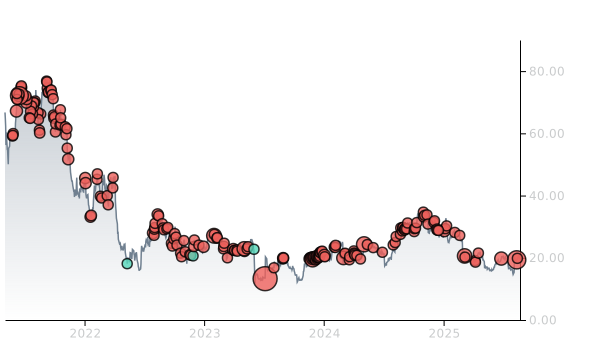
$CSTL insiders have traded $CSTL stock on the open market 23 times in the past 6 months. Of those trades, 0 have been purchases and 23 have been sales.
Here’s a breakdown of recent trading of $CSTL stock by insiders over the last 6 months:
- DEREK J MAETZOLD (Pres. & Chief Exec. Officer) has made 0 purchases and 16 sales selling 81,663 shares for an estimated $1,734,991.
- KRISTEN M OELSCHLAGER (Chief Operating Officer) has made 0 purchases and 4 sales selling 62,294 shares for an estimated $1,651,677.
- FRANK STOKES (Chief Financial Officer) sold 5,388 shares for an estimated $189,011
- TOBIN W JUVENAL (Chief Commercial Officer) has made 0 purchases and 2 sales selling 700 shares for an estimated $24,775.
To track insider transactions, check out Quiver Quantitative's insider trading dashboard.
$CSTL Hedge Fund Activity
We have seen 94 institutional investors add shares of $CSTL stock to their portfolio, and 92 decrease their positions in their most recent quarter.
Here are some of the largest recent moves:
- AIGH CAPITAL MANAGEMENT LLC added 707,287 shares (+inf%) to their portfolio in Q3 2025, for an estimated $16,104,924
- CITADEL ADVISORS LLC added 630,133 shares (+243.9%) to their portfolio in Q2 2025, for an estimated $12,867,315
- PARK WEST ASSET MANAGEMENT LLC removed 556,485 shares (-100.0%) from their portfolio in Q2 2025, for an estimated $11,363,423
- BRAIDWELL LP added 457,488 shares (+125.3%) to their portfolio in Q2 2025, for an estimated $9,341,904
- WELLINGTON MANAGEMENT GROUP LLP removed 421,317 shares (-50.9%) from their portfolio in Q2 2025, for an estimated $8,603,293
- BELLEVUE GROUP AG removed 301,103 shares (-100.0%) from their portfolio in Q2 2025, for an estimated $6,148,523
- CUBIST SYSTEMATIC STRATEGIES, LLC removed 237,698 shares (-100.0%) from their portfolio in Q2 2025, for an estimated $4,853,793
To track hedge funds' stock portfolios, check out Quiver Quantitative's institutional holdings dashboard.
$CSTL Analyst Ratings
Wall Street analysts have issued reports on $CSTL in the last several months. We have seen 4 firms issue buy ratings on the stock, and 0 firms issue sell ratings.
Here are some recent analyst ratings:
- BTIG issued a "Buy" rating on 11/05/2025
- Baird issued a "Outperform" rating on 11/04/2025
- Canaccord Genuity issued a "Buy" rating on 09/09/2025
- Scotiabank issued a "Sector Outperform" rating on 05/21/2025
To track analyst ratings and price targets for $CSTL, check out Quiver Quantitative's $CSTL forecast page.
$CSTL Price Targets
Multiple analysts have issued price targets for $CSTL recently. We have seen 4 analysts offer price targets for $CSTL in the last 6 months, with a median target of $39.0.
Here are some recent targets:
- Mark Massaro from BTIG set a target price of $38.0 on 11/05/2025
- Catherine Ramsey from Baird set a target price of $41.0 on 11/04/2025
- Kyle Mikson from Canaccord Genuity set a target price of $37.0 on 09/09/2025
- Sung Ji Nam from Scotiabank set a target price of $40.0 on 05/21/2025
Full Release
FRIENDSWOOD, Texas, Nov. 14, 2025 (GLOBE NEWSWIRE) -- Castle Biosciences, Inc. (Nasdaq: CSTL), a company improving health through innovative tests that guide patient care, today announced new data demonstrating the clinical value of its DecisionDx-Melanoma test in improving sentinel lymph node (SLN) biopsy (SLNB) decision making and enhancing recurrence risk prediction in patients with cutaneous melanoma (CM). The data will be featured in two oral presentations at the 2 nd European Congress on Dermato-Oncology (ECDO), taking place Nov. 17–18, 2025, in Paris, France.
“DecisionDx-Melanoma continues to demonstrate strong performance in helping physicians make more informed, risk-aligned decisions about sentinel lymph node biopsy,” said J. Michael Guenther, M.D., presenting author for both studies and surgical oncologist at St. Elizabeth Physicians in Edgewood, Kentucky. “These new data reinforce how the test can accurately identify patients with a low likelihood of sentinel node positivity who can safely consider forgoing the procedure, as well as those who remain at risk of recurrence even when their node is negative. Together, the findings highlight how DecisionDx-Melanoma can support more precise surgical planning and ongoing patient management.”
SLNB helps stage patients with CM by determining whether cancer cells have spread beyond the primary tumor site, information that can help guide prognosis and treatment decisions. Current guidelines recommend considering SLNB when the estimated probability of a positive node exceeds 5%. Traditionally, that estimate is driven primarily by Breslow thickness and ulceration, which are key pathologic components used in staging. However, up to 88% of SLNB procedures yield negative results, and as many as 16% of SLN-negative patients still experience disease recurrence within five years, underscoring the need for tools that better identify who is likely to have a positive node and who may remain at risk despite a negative result. 1,2
DecisionDx-Melanoma helps address this clinical challenge. The test uses tumor biology to generate a personalized class result from an independently validated gene-expression-profiling (GEP) score. The report also includes two distinct integrated algorithms: i31-SLNB, which predicts likelihood of SLN positivity, and i31-ROR, which assesses recurrence risk. By combining the GEP score with select clinicopathologic features, DecisionDx-Melanoma provides a comprehensive, personalized risk assessment to support more informed patient management decisions, such as consideration of SLNB.
Guenther will present both oral presentations at ECDO 2025:
Abstract 153: The i31-SLNB for cutaneous melanoma outperforms the clinicopathologic-only MIA nomogram at identifying patients at low risk of having a positive sentinel lymph node biopsy: A prospective, multicenter study
- Session 3: Short Presentations Young Investigators
- Session Date: Monday, November 17
- Session Time: 11:45 a.m.-12:15 p.m. Central European Time
- Summary : New data from this prospective, multicenter study show that DecisionDx-Melanoma’s i31-SLNB algorithm more precisely predicts SLN positivity compared to the Melanoma Institute Australia (MIA) nomogram, which estimates a patient’s likelihood of SLN positivity based solely on clinical and pathologic risk factors. The i31-SLNB demonstrated significantly greater discriminative performance than the MIA nomogram (AUC=0.74 vs. 0.61; p=0.001), reflecting superior sensitivity and specificity, and more accurately identified patients at both low (<5%) and high (>10%) risk of SLN positivity. Patients predicted by the i31-SLNB to have less than 5% risk had an actual SLN positivity rate of only 2.6%, compared to 5.8% in patients classified as low risk by the MIA tool. These findings show that the i31-SLNB more accurately identifies patients who could safely avoid the procedure, while the MIA nomogram’s low-risk group exceeded the 5% threshold. Conversely, among patients predicted to have greater than 10% risk, the actual SLN positivity rate was 21.4% with the i31-SLNB versus 13.8% with MIA, demonstrating that the i31-SLNB more effectively identifies those truly at higher risk. By integrating tumor biology with clinical and pathologic features, the i31-SLNB is designed to provide critical guidance to help physicians determine which patients should undergo, and which may safely forgo, an SLNB procedure. This personalized approach can help reduce unnecessary surgeries and associated risks while supporting more informed, risk-aligned care for patients with melanoma.
Abstract 140: The 31-gene expression profile is an independent predictor of poor 5-year outcomes and identifies high-risk cutaneous melanoma in patients with a negative sentinel lymph node
- Session 8: Short Presentations Young Investigators
- Session Date: Tuesday, November 18
- Session Time: 1:30-2:15 p.m. Central European Time
- Summary : New data from a multicenter study of 810 patients with early-stage (stage I–II), SLN-negative CM, meaning no cancer cells were found in the lymph node, show that the DecisionDx-Melanoma test (31-GEP) is an independent predictor of recurrence and significantly improves risk prediction beyond American Joint Committee on Cancer (AJCC) staging alone. Patients with a high-risk (Class 2B) test result had markedly lower five-year recurrence-free survival than those with Class 1A or Class 1B/2A results (p<0.001), and adding the DecisionDx-Melanoma test results to AJCC staging significantly increased prognostic accuracy (ANOVA χ²=7.75, p=0.02). By combining the biologic information of the tumor with traditional staging, DecisionDx-Melanoma is designed to enhance five-year prognostic accuracy in SLN-negative patients and potentially provide additional clarity for identifying those at higher risk of recurrence. These findings support the test’s potential to help clinicians make more risk-aligned therapeutic decisions and tailor follow-up care according to a patient’s individual risk.
Electronic posters associated with both oral presentations will also be available to view throughout the conference.
About DecisionDx-Melanoma
DecisionDx-Melanoma is a gene expression profile (GEP) test designed to analyze tumor biology to deliver a personalized risk assessment for patients with stage I–III cutaneous melanoma, enhancing risk stratification beyond American Joint Committee on Cancer (AJCC) staging alone. By combining molecular insights with select clinicopathologic features, the test provides two distinct outputs: a personalized risk of sentinel lymph node (SLN) positivity and a personalized risk of recurrence and/or metastasis. This clinically actionable information is designed to help guide risk-aligned patient management decisions, including SLN biopsy consideration, follow-up intensity, imaging and referrals.
DecisionDx-Melanoma is supported by more than 50 peer-reviewed publications, including prospective studies and meta-analyses, and was developed in collaboration with more than 100 leading U.S. institutions. The test has been clinically validated in more than 10,000 patient samples, ordered more than 220,000 times since launch, and has been shown to be associated with improved patient survival. Learn more at www.CastleBiosciences.com .
About Castle Biosciences
Castle Biosciences (Nasdaq: CSTL) is a leading diagnostics company improving health through innovative tests that guide patient care. With a primary focus in dermatologic and gastroenterological disease, we develop personalized, clinically actionable solutions that help improve disease management and patient outcomes.
We put people first—empowering patients and clinicians and informing care decisions through rigorous science and advanced molecular tests that support more confident treatment planning. To learn more, visit www.CastleBiosciences.com and connect with us on LinkedIn , Instagram , Facebook and X .
DecisionDx-Melanoma, DecisionDx-CM Seq , i31-SLNB, i31-ROR, DecisionDx-SCC, MyPath Melanoma, AdvanceAD-Tx, TissueCypher, DecisionDx-UM, DecisionDx-PRAME and DecisionDx-UM Seq are trademarks of Castle Biosciences, Inc.
Forward-Looking Statements
This press release contains forward-looking statements within the meaning of Section 27A of the Securities Act of 1933, as amended, and Section 21E of the Securities Exchange Act of 1934, as amended, which are subject to the “safe harbor” created by those sections. These forward-looking statements include, but are not limited to, statements concerning: DecisionDx-Melanoma’s ability to provide (i) comprehensive, personalized results to guide risk-aligned management decisions for patients diagnosed with cutaneous melanoma, and (ii) precise and clinically meaningful risk stratification; DecisionDx-Melanoma’s performance versus other tests currently on the market;. The words “can,” “may” and similar expressions are intended to identify forward-looking statements, although not all forward-looking statements contain these identifying words. We may not actually achieve the plans, intentions or expectations disclosed in our forward-looking statements, and you should not place undue reliance on our forward-looking statements. Actual results or events could differ materially from the plans, intentions and expectations disclosed in the forward-looking statements that we make. These forward-looking statements involve risks and uncertainties that could cause our actual results to differ materially from those in the forward-looking statements, including, without limitation: subsequent study or trial results and findings may contradict earlier study or trial results and findings or may not support the results obtained in these studies, including with respect to the discussion of our tests in this press release; actual application of our tests may not provide the aforementioned benefits to patients; and the risks set forth under the heading “Risk Factors” in our Annual Report on Form 10-K for the year ended December 31, 2024, and our Quarterly Report on Form 10-Q for the quarter ended September 30, 2025, each as filed with the SEC, and in our other filings with the SEC. The forward-looking statements are applicable only as of the date on which they are made, and we do not assume any obligation to update any forward-looking statements, except as may be required by law.
- Chen J, Xu Y, Zhou Y, Wang Y, Zhu H, Shi Y. Prognostic role of sentinel lymph node biopsy for patients with cutaneous melanoma: A retrospective study of surveillance, epidemiology, and end-result population-based data. Oncotarget 2016;7(29):45671–7
- Jones EL, Jones TS, Pearlman NW, et al. Long-term follow-up and survival of patients following a recurrence of melanoma after a negative sentinel lymph node biopsy result. JAMA Surg. 2013;148(5):456-461. doi:10.1001/jamasurg.2013.1335
Investor Contact:
Camilla Zuckero
[email protected]
Media Contact:
Allison Marshall
[email protected]