


Plinabulin plus docetaxel improves survival and reduces adverse events in non-squamous EGFR WT NSCLC post anti-PD-(L)1 therapy.
Quiver AI Summary
BeyondSpring Inc. announced positive findings from the DUBLIN-3 Phase 3 study, indicating that the combination of Plinabulin and docetaxel offers significant benefits for non-squamous EGFR wild-type non-small cell lung cancer (NSCLC) patients who have progressed after anti-PD-(L)1 therapy. The results showed improvements in overall survival (OS), progression-free survival (PFS), and objective response rate (ORR), with Plinabulin+docetaxel demonstrating a median OS of 15.8 months compared to 11.7 months for docetaxel alone. The company plans to initiate the global Phase 3 DUBLIN-4 trial to further evaluate this combination therapy, as there have been no new treatment options approved for patients with resistance to anti-PD-(L)1 immunotherapy in the last decade. Additionally, Plinabulin was shown to reduce severe adverse events, bolstering its profile as a viable late-stage therapeutic option in this patient population.
Potential Positives
- Plinabulin + docetaxel showed significant improvements in overall survival (OS), progression-free survival (PFS), and objective response rate (ORR) in patients with non-squamous EGFR wild-type NSCLC who progressed after anti-PD-(L)1 therapy, reinforcing its potential as an effective late-stage therapy.
- Initiation of the global Phase 3 DUBLIN-4 trial is planned, which is expected to support future New Drug Application (NDA) submissions for Plinabulin, signaling continued commitment to developing and validating this treatment option.
- The treatment demonstrated a reduction in new brain metastasis and a significant decrease in chemotherapy-induced adverse events, highlighting its improved safety profile compared to standard therapies.
Potential Negatives
- Multiple late-stage trials have failed to show overall survival improvement over docetaxel, indicating potential challenges for Plinabulin's market acceptance.
- The data comes from post-hoc analyses rather than primary study outcomes, which may raise questions about the robustness of the findings.
- The reliance on adverse event reductions may not be sufficient to convince regulatory bodies and physicians to adopt the new treatment regimen without substantial overall survival data.
FAQ
What are the results of the DUBLIN-3 study for NSCLC patients?
The DUBLIN-3 study showed that Plinabulin + docetaxel improved overall survival, progression-free survival, and objective response rates in NSCLC patients.
What is Plinabulin's role in treating advanced NSCLC?
Plinabulin is a first-in-class therapy that enhances immune function and shows significant survival benefits for NSCLC patients who progressed after anti-PD-(L)1 therapy.
What is the DUBLIN-4 trial about?
The DUBLIN-4 trial will evaluate Plinabulin + docetaxel vs. docetaxel alone in NSCLC patients who progressed on prior treatments.
How does Plinabulin compare to docetaxel alone?
Plinabulin + docetaxel showed improved median overall survival of 15.8 months compared to 11.7 months with docetaxel alone in clinical trials.
What safety benefits does Plinabulin offer?
Plinabulin significantly reduces docetaxel-induced adverse events, including grade 4 neutropenia, enhancing patient tolerability and safety during treatment.
Disclaimer: This is an AI-generated summary of a press release distributed by GlobeNewswire. The model used to summarize this release may make mistakes. See the full release here.
$BYSI Insider Trading Activity
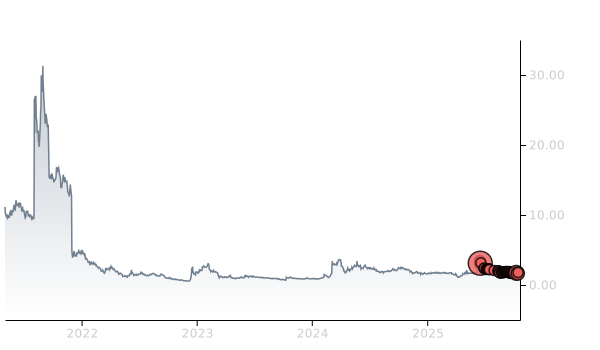
$BYSI insiders have traded $BYSI stock on the open market 63 times in the past 6 months. Of those trades, 0 have been purchases and 63 have been sales.
Here’s a breakdown of recent trading of $BYSI stock by insiders over the last 6 months:
- CAPITAL CHINA LIFE SCIENCES USD FUND III, L.P. DECHENG has made 0 purchases and 63 sales selling 854,615 shares for an estimated $2,019,941.
To track insider transactions, check out Quiver Quantitative's insider trading dashboard.
$BYSI Hedge Fund Activity
We have seen 7 institutional investors add shares of $BYSI stock to their portfolio, and 8 decrease their positions in their most recent quarter.
Here are some of the largest recent moves:
- DECHENG CAPITAL LLC removed 245,377 shares (-5.4%) from their portfolio in Q3 2025, for an estimated $444,132
- GEODE CAPITAL MANAGEMENT, LLC added 59,272 shares (+23.1%) to their portfolio in Q3 2025, for an estimated $107,282
- NORTHERN TRUST CORP added 54,469 shares (+334.0%) to their portfolio in Q3 2025, for an estimated $98,588
- VANGUARD GROUP INC added 23,000 shares (+4.4%) to their portfolio in Q3 2025, for an estimated $41,630
- TWO SIGMA SECURITIES, LLC removed 22,031 shares (-100.0%) from their portfolio in Q2 2025, for an estimated $51,772
- CITADEL ADVISORS LLC removed 18,679 shares (-100.0%) from their portfolio in Q2 2025, for an estimated $43,895
- UBS GROUP AG removed 5,613 shares (-80.8%) from their portfolio in Q3 2025, for an estimated $10,159
To track hedge funds' stock portfolios, check out Quiver Quantitative's institutional holdings dashboard.
Full Release
-
In DUBLIN-3 non-squamous EGFR WT NSCLC patients who progressed after anti-PD-(L)1, Plinabulin + docetaxel showed consistent and clinically meaningful improvements in OS, PFS, and ORR, reinforcing Plinabulin as a late-stage therapy with consistent survival benefit in anti-PD-(L)1-progressed NSCLC patients.
-
Supported by anti-cancer efficacy and safety in significant reduction exposure-adjusted grade 3/4 adverse events in DUBLIN-3, BeyondSpring will conduct DUBLIN-4, a global, double-blind Phase 3 registrational trial. This study will evaluate Plinabulin + docetaxel vs. docetaxel in non-squamous EGFR wild-type NSCLC after progression on anti-PD-(L)1 and chemotherapy
,
and is intended to serve as the global confirmatory study.
FLORHAM PARK, N.J., Dec. 11, 2025 (GLOBE NEWSWIRE) -- BeyondSpring Inc. (NASDAQ: BYSI), a clinical-stage biopharmaceutical company developing first-in-class immune-modulating cancer therapies, today announced new post-hoc analyses from its global Phase 3 DUBLIN-3 Study (Lancet Resp Med 12:775, 2024), showing that Plinabulin plus docetaxel provides clinically meaningful benefit for patients with EGFR wild-type (WT) non-squamous (NSQ) non-small cell lung cancer (NSCLC) who progressed after anti-PD-(L)1 immunotherapy . The findings were presented by Dr. Trevor Feinstein of Piedmont Cancer Center and acting chair of the Lung Disease Group for the OneOncology network at the 2025 IASLC/ASCO North America Conference on Lung Cancer (NACLC) .
More than 60% of NSCLC patients eventually develop resistance to anti-PD-(L)1 therapy, yet no new treatments have been approved in a decade. Nine late-stage trials , including ADC and anti-PD-(L)1combination regimens, have failed to show overall survival improvement over docetaxel . Plinabulin is a late-stage therapeutic candidate that has demonstrated consistent survival benefit in this rapidly growing population with major unmet medical need.
In a mechanism-driven, post-hoc subset analysis of DUBLIN-3, non-squamous EGFR WT NSCLC patients who progressed after anti-PD-(L)1 therapy with at least 3 months of prior clinical benefit, Plinabulin + docetaxel (DP) combination showed clinically meaningful improvement compared to docetaxel alone (D).
- Median overall survival (OS): DP 15.8 months vs. D 11.7 months (HR=0.55),
- Median progression-free survival (PFS): DP 5.6 vs. D 3.8 months (HR=0.67),
-
Objective response rate (ORR): 18.2% vs. 8.0%
.
These benefits reflect Plinabulin ’s first-in-class dendritic-cell maturation mechanism, which helps to restore antigen presentation and T-cell function after acquired resistance to checkpoint inhibitors .
BeyondSpring plans to initiate a global Phase 3 DUBLIN-4 trial following its End-of-Phase 2 meeting with the U.S. FDA . DUBLIN-4 , together with DUBLIN-3, is expected to support a future NDA submission in non-squamous EGFR wild-type NSCLC following progression on anti-PD-(L)1 therapy.
Post-hoc analysis of DUBLIN-3 intent-to-treat (ITT, N=559) EGFR WT NSCLC population showed additional clinically meaningful benefits for the Plinabulin + docetaxel combination compared to docetaxel.
- Meaningful improvement in metastasis-free survival : Metastasis-free survival improved to 15.34 months (DP) versus 7.7 months (D, HR=0.52, p=0.0012), consistent with Plinabulin’s DC maturation and durable anti-cancer benefit.
-
Reduction in new brain metastasis:
The incidence of new brain metastasis was reduced to 4.32% (DP) vs. 7.83% (D), consistent with Plinabulin’s brain-penetrant properties which demonstrated survival benefit in glioblastoma anal model as a monotherapy.
-
Improved safety:
Plinabulin significantly reduced docetaxel-induced grade 4 neutropenia (5.13% vs. 33.58%, p<0.0001).
Plinabulin combination had significantly decreased exposure-adjusted grade 3/4 adverse events vs. docetaxel (p=0.0235), supporting prolonged treatment exposure and contributing to improved clinical outcomes.
“Patients who relapse after anti-PD-(L)1 therapy represent one of the most significant unmet needs in NSCLC, with docetaxel as the only treatment option while multiple late-stage clinical trials have failed to improve upon it,” said Dr. Trevor Feinstein .
Dr. Lan Huang , Co-Founder, Chairman, and CEO of BeyondSpring, said, “These new analyses suggest Plinabulin’s unique ability to potentially reinvigorate anti-tumor immune function and improve outcomes in patients who have developed resistance to checkpoint inhibitors. The post-hoc analysis data from DUBLIN-3 are consistent with our findings from the prospective 303 study in similar patients, as presented at the Society for Immunotherapy of Cancer (SITC) 2025 Annual Meeting. The observed reductions in brain metastasis and the substantial improvement in metastasis-free survival further highlight Plinabulin’s differentiated clinical profile. These findings provide strong momentum as we move forward with our global confirmatory Phase 3 DUBLIN-4 trial .”
About Plinabulin
Plinabulin is a first-in-class, brain-penetrating, dendritic
-
cell maturation small molecule.
It has been used in over 700 cancer patients
,
with good tolerability and showed durable anti-cancer benefit across multiple clinical studies. As a reversible binder at a distinct tubulin pocket, plinabulin does not change tubulin dynamics or antagonize tubulin stabilizing agents, such as docetaxel, which contributes to its differentiated activity and tolerability compared to other tubulin binders. In addition, plinabulin significantly reduces chemotherapy-induced neutropenia and could thereby increase docetaxel tolerability.
About DUBLIN-3 Study (103 Study)
DUBLIN-3 (n=559, NCT02504489) was a multicenter, single-blinded (patient) and randomized, phase 3 trial in 58 medical centers (US, China, and Australia). Only patients with EGFR wild-type NSCLC who had progressed after first-line platinum-based therapy were enrolled. Patients were randomized (1:1) to receive docetaxel (75 mg/m
2
) on Day 1 and either plinabulin (30 mg/m
2
) or placebo on Days 1 and 8 in 21-day cycles until progression, unacceptable toxicity, withdrawal, or death. Treated patients were included in the safety analysis and ITT population in the primary efficacy analyses. The primary endpoint for the study was OS, and secondary endpoints were PFS, ORR, Duration of Response (DoR), Grade 4 neutropenia and Quality of Life. The study was published in Lancet Resp Med 12:775, 2024.
About BeyondSpring
BeyondSpring
(NASDAQ: BYSI) is a clinical-stage biopharmaceutical company developing first-in-class therapies addressing high unmet medical needs. Its lead asset, Plinabulin, is in late-stage clinical development as an anti-cancer agent in NSCLC and other indications. Plinabulin’s novel mechanism as a dendritic cell maturation agent supports both anti-cancer activity and immune modulation, offering a unique approach to resensitizing tumors resistant to checkpoint inhibitors. Learn more at
https://beyondspringpharma.com
.
Investor Contact:
[email protected]
Media Contact:
[email protected]