


20/20 BioLabs announces a licensing agreement to commercialize a patented algorithm for earlier detection of aggressive prostate tumors.
Quiver AI Summary
20/20 BioLabs has entered into a global licensing agreement with the University of South Carolina to commercialize a patented algorithm that improves the early detection of aggressive prostate tumors through the analysis of changes in prostate-specific antigen (PSA) levels over time. This innovative tool aims to identify dangerous prostate cancers earlier, enabling effective and less invasive interventions before traditional PSA thresholds are reached. The algorithm will be integrated into 20/20 BioLabs' OneTest for Cancer platform and offered to other clinical labs as a software service. With this addition, the company seeks to enhance cancer screening processes while minimizing unnecessary treatments for patients with less aggressive conditions. There are also plans for further research on similar algorithms for other cancer markers.
Potential Positives
- 20/20 BioLabs has secured an exclusive, worldwide licensing agreement with the University of South Carolina to commercialize a patented algorithm that improves the early detection of dangerous prostate cancers, enhancing its position in the cancer detection market.
- The incorporation of this advanced algorithm into 20/20 BioLabs’ OneTest for Cancer platform can lead to earlier, less invasive treatments, potentially saving lives and improving patient outcomes.
- By developing additional algorithms for other cancer markers in collaboration with Dr. Hébert, 20/20 BioLabs showcases its commitment to innovation and expansion in multi-cancer early detection technologies.
Potential Negatives
- In the forward-looking statements section, the company acknowledges that actual results may differ materially from expectations, highlighting potential risks that could negatively impact their financial condition and business operations.
- The licensing agreement is dependent on the algorithm's effectiveness in clinical settings, and any shortcomings in actual performance could lead to reputational damage or financial losses.
- The company may face competition from other firms developing similar cancer detection technologies, which could hinder its market penetration and profitability goals.
FAQ
What is the main purpose of the new patented algorithm?
The algorithm helps identify dangerous prostate tumors earlier by analyzing changes in PSA levels over time.
How will 20/20 BioLabs use the proprietary algorithm?
20/20 BioLabs will incorporate the algorithm into its OneTest for Cancer platform for multi-cancer early detection.
What does PSA velocity indicate in prostate cancer screening?
PSA velocity helps distinguish between men at higher risk for aggressive prostate cancer and those with less serious conditions.
What is the relevance of the licensing agreement with the University of South Carolina?
This agreement allows 20/20 BioLabs to commercialize the algorithm for enhanced prostate cancer screening and improve early detection.
Are there plans to develop similar algorithms for other cancers?
Yes, 20/20 BioLabs and Dr. Hébert aim to create algorithms for ovarian and pancreatic cancer markers like CA 125 and CA 19.9.
Disclaimer: This is an AI-generated summary of a press release distributed by GlobeNewswire. The model used to summarize this release may make mistakes. See the full release here.
$AIDX Revenue
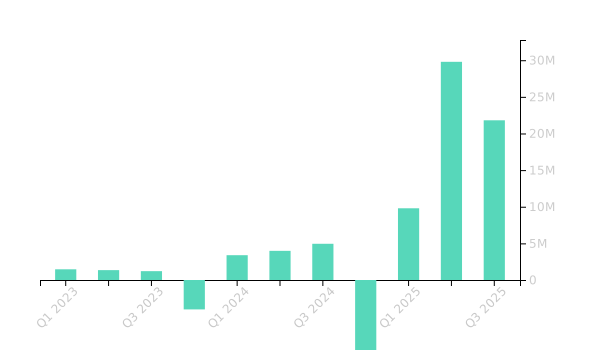
$AIDX had revenues of $538.3K in Q4 2025. This is an increase of 0.41% from the same period in the prior year.
You can track AIDX financials on Quiver Quantitative's AIDX stock page.
You can access data on AIDX stock through the Quiver Quantitative API.
$AIDX Hedge Fund Activity
We have seen 2 institutional investors add shares of $AIDX stock to their portfolio, and 0 decrease their positions in their most recent quarter.
Here are some of the largest recent moves:
- UBS GROUP AG added 8,314 shares (+inf%) to their portfolio in Q1 2026, for an estimated $15,630
- TOTH FINANCIAL ADVISORY CORP added 157 shares (+inf%) to their portfolio in Q1 2026, for an estimated $295
To track hedge funds' stock portfolios, check out Quiver Quantitative's institutional holdings dashboard. You can access data on hedge funds moves and 13F filings through the Quiver Quantitative API 13F endpoint.
$AIDX Price Targets
Multiple analysts have issued price targets for $AIDX recently. We have seen 3 analysts offer price targets for $AIDX in the last 6 months, with a median target of $2.0.
Here are some recent targets:
- Michael Okunewitch from Maxim Group set a target price of $5.0 on 05/11/2026
- David Kwan from TD Cowen set a target price of $1.75 on 04/02/2026
- Kevin Krishnaratne from Scotiabank set a target price of $2.0 on 02/04/2026
Full Release
Patented Algorithm Designed to Help Identify Otherwise Dangerous Prostate Tumors Earlier Using Repeat Blood Test Results
Licensing Agreement Expands 20/20 BioLabs’ AI-Enabled Multi-Cancer Early Detection Platform
GAITHERSBURG, Md., May 12, 2026 (GLOBE NEWSWIRE) -- 20/20 BioLabs, Inc. (“20/20”) (Nasdaq: AIDX), an early market entrant in cutting-edge, AI powered laboratory-based blood tests for the early detection and prevention of cancers and chronic diseases, today announced that it has entered into an exclusive, worldwide licensing agreement with the University of South Carolina to commercialize a patented algorithm developed by a team headed by James Hébert, Sc.D. , Director of the South Carolina Statewide Cancer Prevention and Control Program and Health Sciences Distinguished Professor in the Department of Epidemiology and Biostatistics.
The technology analyzes changes in prostate-specific antigen (PSA) levels over time, thus helping to identify rapidly growing prostate tumors that pose the greatest chance of causing disability and death. This enables detection of dangerous prostate cancers even before PSA levels cross standard thresholds, typically 4.0 ng/mL according to guidelines. This permits earlier, less invasive and more effective therapeutic interventions while the tumor is still confined to the prostate organ. 20/20 BioLabs plans to incorporate the algorithm into its OneTest for Cancer platform, a blood-based multi-cancer early detection test designed to evaluate cancer risk using established protein biomarkers, clinical factors, and AI-driven analytics. The algorithm will also be made available to other clinical laboratories worldwide under software-as-a-service licenses.
PSA is a naturally occurring molecule produced by the prostate. Aggressive prostate cancers often show rapid PSA rise and a steep slope while benign causes of PSA elevation do not typically show acceleration over time. By analyzing serial PSA results taken over time, the algorithm can distinguish men who may be at higher risk for aggressive prostate cancer from those whose PSA patterns may indicate a less serious condition.
“This license adds an important longitudinal risk assessment tool to our OneTest for Cancer as well as PSA screening by other labs and supports our broader mission of making early cancer detection more accessible, affordable, and actionable,” said Jonathan Cohen, Chief Executive Officer of 20/20 BioLabs. “Prostate cancer screening has long faced the challenge of identifying clinically meaningful risk while avoiding unnecessary concern or inappropriate follow-up and treatment for men with less aggressive conditions. We believe Dr. Hébert’s work can help address that challenge by adding deeper analytical context to PSA results over time.”
In addition to this license involving PSA velocity, 20/20 Biolabs and Dr. Hébert anticipate conducting joint research to develop similar velocity algorithms for other protein tumor markers like CA 125 and CA 19.9 for ovarian and pancreatic cancers respectively.
“I am pleased that this highly effective method for detecting aggressive prostate cancer is being made available to the public through 20/20 BioLabs’ OneTest for Cancer,” said Dr. Hébert. “Multiple PSA tests performed at regular intervals over a few years is consistent with the practice of active surveillance that is now recommended by the National Comprehensive Cancer Network (NCCN), a not-for-profit alliance of 33 leading U.S. cancer centers dedicated to improving patient care, conducting research, and providing education.”
The licensing agreement was facilitated through USC’s Office of Economic Engagement’s Technology Commercialization Office , which works to advance university innovations by connecting researchers with industry partners.
“This partnership highlights the critical role universities play in driving innovation and economic growth,” said Stephen J. Cutler, Ph.D., Vice President for Economic Development at the University of South Carolina. “By moving discoveries like Dr. Hébert’s algorithm into the marketplace, we are advancing both public health and the development of high-impact health technologies.”
“Collaborations like this exemplify how university discoveries can move from the lab to the marketplace,” said Chase Kasper, Deputy Director of the Office of Engagement, who oversees technology transfer and licensing efforts at USC. “We are excited that our industry partners can incorporate innovations from USC’s research enterprise and translate them into greater applications, products, and services for the public benefit.”
About 20/20 BioLabs
20/20 BioLabs, Inc. (Nasdaq: AIDX) develops and commercializes AI-powered, laboratory-based blood tests for the early detection and prevention of cancers and chronic diseases. The company offers two families of lab tests under the OneTest brand. OneTest™ for Cancer is a multi-cancer early detection, or MCED, blood test, and OneTest for Longevity , which measures inflammatory biomarkers, launched in February 2026. OneTest’s affordable, accurate, actionable tests can be conveniently accessed at home using new, upper arm collection devices that avoid painful needles. Tests are run in its College of American Pathologists (CAP) accredited, Clinical Laboratory Improvement Amendments (CLIA) licensed laboratory in Gaithersburg, MD.
20/20 BioLabs’ pioneering Clinical Laboratory Innovation Accelerator, or CLIAx, is a shared CLIA laboratory for overseas diagnostics start-ups seeking to launch novel lab tests in the US without the expense of establishing and operating their own, independent lab. The Company’s legacy business also includes a pioneering field test kit for screening suspicious powders for bioterror agents known as BioCheck. For more information visit 2020biolabs.com .
About the University of South Carolina
The University of South Carolina is a globally recognized, high-impact research university committed to a superior student experience and dedicated to innovation in learning, research and community engagement. Founded in 1801, the university is a top-tier Carnegie Foundation research institution offering more than 350 academic degree programs, including distinguished programs in engineering, law, medicine, nursing, public health and the arts. More than 50,000 students are enrolled at one of 20 locations throughout the state, including the research campus in Columbia. With the nation’s top first-year experience, best public honors college and 60 nationally ranked academic programs — including top-ranked programs in international business — the university is helping to build healthier, more educated communities in South Carolina and around the world.
Forward-Looking Statements
Certain statements in this release are “forward-looking statements” within the meaning of Section 27A of the Securities Act of 1933, as amended, and Section 21E of the Securities Exchange Act of 1934, as amended. These forward-looking statements involve known and unknown risks and uncertainties and are based on the Company’s current expectations and projections about future events that it believes may affect its financial condition, results of operations, business strategy, and financial needs. Forward-looking statements can be identified by words such as “may,” “could,” “will,” “should,” “would,” “expect,” “plan,” “intend,” “anticipate,” “believe,” “estimate,” “predict,” “potential,” “project,” “continue,” or the negative of these terms or other comparable expressions. Actual results may differ materially from those expressed or implied by such forward-looking statements. A number of factors could cause actual results to differ materially from those contained in these forward-looking statements, including, but not limited to, the risks described in the Company’s filings with the U.S. Securities and Exchange Commission (the “SEC”), available on the SEC’s website at www.sec.gov , including the Company’s Registration Statement on Form S-1, as amended (File No. 333-292125), as well as in our other reports filed or furnished from time to time with the SEC. The Company undertakes no obligation to publicly update or revise any forward-looking statements to reflect events or circumstances that occur after the date of this release or to reflect the occurrence of unanticipated events, except as required by applicable law. Although the Company believes the expectations expressed in these forward-looking statements are reasonable, it cannot guarantee future results, and investors are cautioned that actual outcomes may differ materially from those anticipated.
Investor Relations
Chris Tyson
MZ Group
Direct: 949-491-8235
[email protected]