

Encaleret shows promise in improving symptoms and functionality in ADH1, with FDA acceptance of its NDA and ongoing trials.
Quiver AI Summary
BridgeBio Pharma has announced promising results from its Phase 3 CALIBRATE trial for encaleret in treating autosomal dominant hypocalcemia type 1 (ADH1). The study showed that 100% of participants receiving encaleret experienced improvements in at least one ADH1 symptom, compared to 46% in the standard care group. The treatment also demonstrated increased endogenous parathyroid hormone (PTH) secretion and improved bone turnover in participants. Additionally, the FDA has accepted BridgeBio's new drug application for encaleret and granted it Priority Review, with a target action date set for May 8, 2027. The company has begun dosing participants in its registrational Phase 3 study, RECLAIM-HP, focusing on chronic hypoparathyroidism. These findings highlight encaleret's potential to address both the biological underpinnings of ADH1 and improve patient outcomes.
Potential Positives
- Encaleret significantly improved patient outcomes in the CALIBRATE trial, with 100% of participants reporting improvements in at least one symptom of ADH1 compared to only 46% in the standard care group.
- The FDA has accepted BridgeBio’s NDA for encaleret for ADH1 and granted it Priority Review, enhancing the company's credibility and potential market impact with a PDUFA target action date set for May 8, 2027.
- The first participant has been dosed in RECLAIM-HP, a crucial Phase 3 study for encaleret in chronic hypoparathyroidism, indicating progress in clinical development and further validating the drug’s potential therapeutic applications.
Potential Negatives
- There is uncertainty regarding the long-term efficacy and safety of encaleret as highlighted by the company's caution that initial clinical data may not predict final outcomes.
- The press release indicates that results demonstrating improvements in symptoms and daily functioning with encaleret may not be replicated in future studies, which poses a risk to the perceived value of the treatment.
- The acceptance of the NDA by the FDA does not guarantee the eventual approval of encaleret, which adds a layer of risk for investors and stakeholders.
FAQ
What is the significance of encaleret for ADH1 patients?
Encaleret increases bone turnover and improves symptoms in ADH1 patients, with 100% reporting symptom improvements compared to standard care.
What are the FDA's plans for encaleret?
The FDA has accepted the NDA for encaleret in ADH1 and granted Priority Review, targeting a decision by May 8, 2027.
What was presented at the ASBMR 2026 Annual Meeting?
BridgeBio presented data showing that encaleret improves bone turnover and patient-reported outcomes in patients with ADH1.
What are the goals of the RECLAIM-HP study?
RECLAIM-HP aims to evaluate encaleret's efficacy and safety in adults and adolescents with chronic hypoparathyroidism over 24 weeks.
How does encaleret compare to standard care for symptom management?
Encaleret showed greater efficacy, with more significant improvements in fatigue, muscle cramps, and other symptoms compared to standard care.
Disclaimer: This is an AI-generated summary of a press release distributed by GlobeNewswire. The model used to summarize this release may make mistakes. See the full release here.
$BBIO Insider Trading Activity
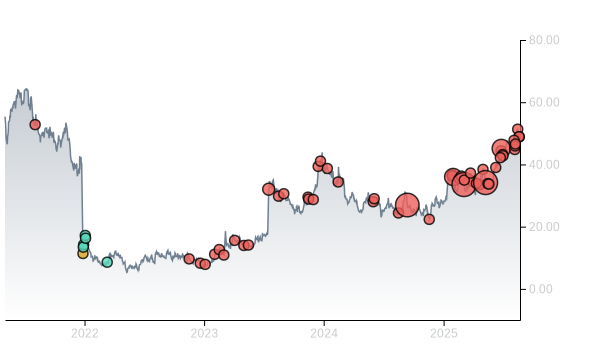
$BBIO insiders have traded $BBIO stock on the open market 43 times in the past 6 months. Of those trades, 0 have been purchases and 43 have been sales.
Here’s a breakdown of recent trading of $BBIO stock by insiders over the last 6 months:
- JENNIFER E. COOK has made 0 purchases and 6 sales selling 278,192 shares for an estimated $21,920,434.
- NEIL KUMAR (Chief Executive Officer) has made 0 purchases and 28 sales selling 161,083 shares for an estimated $11,643,908.
- ANDREA ELLIS sold 17,167 shares for an estimated $1,442,028
- RANDAL W. SCOTT has made 0 purchases and 4 sales selling 10,000 shares for an estimated $671,455.
- HANNAH VALANTINE has made 0 purchases and 2 sales selling 5,004 shares for an estimated $341,523.
- MARICEL APULI (Chief Accounting Officer) has made 0 purchases and 2 sales selling 4,000 shares for an estimated $303,280.
To track insider transactions, check out Quiver Quantitative's insider trading dashboard. You can access data on insider stock transactions through the Quiver Quantitative API insider transaction endpoint.
$BBIO Congressional Stock Trading
Members of Congress have traded $BBIO stock 2 times in the past 6 months. Of those trades, 2 have been purchases and 0 have been sales.
Here’s a breakdown of recent trading of $BBIO stock by members of Congress over the last 6 months:
- REPRESENTATIVE GILBERT RAY CISNEROS, JR. has traded it 2 times. They made 2 purchases worth up to $30,000 on 05/11, 04/29 and 0 sales.
To track congressional stock trading, check out Quiver Quantitative's congressional trading dashboard. You can access data on congressional stock trades through the Quiver Quantitative API Congress trades endpoint.
$BBIO Hedge Fund Activity
We have seen 247 institutional investors add shares of $BBIO stock to their portfolio, and 216 decrease their positions in their most recent quarter.
Here are some of the largest recent moves:
- BLACKROCK, INC. removed 3,920,601 shares (-27.6%) from their portfolio in Q2 2026, for an estimated $292,006,362
- WELLINGTON MANAGEMENT GROUP LLP added 2,824,971 shares (+113.7%) to their portfolio in Q2 2026, for an estimated $210,403,840
- JPMORGAN CHASE & CO added 2,397,995 shares (+inf%) to their portfolio in Q2 2026, for an estimated $178,602,667
- PRICE T ROWE ASSOCIATES INC /MD/ removed 2,075,272 shares (-54.6%) from their portfolio in Q2 2026, for an estimated $154,566,258
- FRAZIER LIFE SCIENCES MANAGEMENT, L.P. removed 1,900,000 shares (-55.1%) from their portfolio in Q2 2026, for an estimated $141,512,000
- VIKING GLOBAL INVESTORS LP removed 1,893,215 shares (-16.0%) from their portfolio in Q2 2026, for an estimated $141,006,653
- SIXTH STREET PARTNERS MANAGEMENT COMPANY, L.P. added 1,709,417 shares (+inf%) to their portfolio in Q2 2026, for an estimated $127,317,378
To track hedge funds' stock portfolios, check out Quiver Quantitative's institutional holdings dashboard. You can access data on hedge funds moves and 13F filings through the Quiver Quantitative API 13F endpoint.
$BBIO Price Targets
Multiple analysts have issued price targets for $BBIO recently. We have seen 7 analysts offer price targets for $BBIO in the last 6 months, with a median target of $102.0.
Here are some recent targets:
- Salim Syed from Mizuho set a target price of $96.0 on 06/16/2026
- Whitney Ijem from Canaccord Genuity set a target price of $104.0 on 06/03/2026
- Raghuram Selvaraju from HC Wainwright & Co. set a target price of $110.0 on 05/28/2026
- Sean Laaman from Morgan Stanley set a target price of $98.0 on 05/28/2026
- Eric Joseph from Citigroup set a target price of $82.0 on 05/19/2026
- Cory Kasimov from Evercore ISI Group set a target price of $130.0 on 05/08/2026
- Danielle Brill from Truist Securities set a target price of $102.0 on 04/29/2026
Full Release
- Encaleret administration increased bone turnover, based on its action to recover endogenous PTH secretion in patients with ADH1
- 100% of participants who received encaleret reported improvements in at least one ADH1 symptom compared to 46% of participants who received standard of care
- Improvements in ADH1-related impacts on daily functioning were also more frequently reported with encaleret compared to standard of care
- The FDA has accepted BridgeBio’s NDA for encaleret in ADH1 and granted Priority Review, with a PDUFA target action date of May 8, 2027; the Company also submitted an MAA to the EMA
- The first participant was dosed in RECLAIM-HP, the registrational Phase 3 study of encaleret in adults and adolescents with chronic hypoparathyroidism
PALO ALTO, Calif., Oct. 11, 2026 (GLOBE NEWSWIRE) -- BridgeBio Pharma, Inc. (Nasdaq: BBIO) (“BridgeBio” or the “Company”), a commercial-stage, multi-product biopharmaceutical company focused on developing medicines for genetic conditions, today presented bone turnover results and patient-reported outcomes from the Phase 3 CALIBRATE trial of encaleret in autosomal dominant hypocalcemia type 1 (ADH1). The data were presented in oral presentations at the American Society for Bone and Mineral Research (ASBMR) 2026 Annual Meeting in Boston, Massachusetts. Additionally, the Company dosed the first participant in RECLAIM-HP, its registrational Phase 3 study of encaleret in adults and adolescents with chronic hypoparathyroidism.
Erik Imel, M.D. of Indiana University School of Medicine, presented an oral presentation on 24-week CALIBRATE data showing that encaleret-mediated increases in parathyroid hormone (PTH) may help restore native bone physiology in ADH1. Key findings include:
- Encaleret stimulated endogenous PTH secretion to at or above the lower limit of normal in 91% of participants, compared with 0% on standard of care (SoC)
-
Bone turnover markers increased in the encaleret-treated group vs conventional therapy, as assessed by markers of bone formation and resorption
“In ADH1, suppressed PTH secretion results in hypocalcemia and a tendency toward an overall reduced bone turnover state. The observed increases in bone turnover markers following encaleret administration are consistent with the effects of restored endogenous PTH secretion,” said Dr. Imel. “These findings suggest that encaleret is addressing the underlying biology of the disease, not just correcting blood calcium.”
Additionally, Steven Ing, M.D. of Ohio State University and CALIBRATE Investigator, presented an oral presentation on patient-reported outcomes demonstrating that treatment with encaleret improved ADH1 symptom burden and daily functioning compared to participants treated with standard of care (calcium supplementation and/or active vitamin D). Key findings include:
- 100% of participants who received encaleret reported improvements in at least one ADH1 symptom compared to 46% of participants who received standard of care
- Symptom improvement with encaleret treatment compared to SoC at 24 weeks included fatigue (61.3% versus 27.3%), muscle cramps (58.1% versus 36.4%), muscle spasms (58.1% versus 18.2%), tingling (51.6% versus 9.1%) and brain fog (48.4% versus 9.1%)
-
Improvements in ADH1-related impacts on daily functioning were more frequently reported with encaleret compared to SoC, including mood and emotions (61.3% versus 27.3%), physical activities (45.2% versus 9.1%), daily life (35.5% versus 18.2%) and work life (35.5% versus 9.1%)
In partnership with the HypoPARAthyroidism Association (HPA), BridgeBio also shared findings in a poster from regional family genetic testing events that evaluated a proband-initiated model designed to bring no-cost genetic testing and counseling directly to at-risk relatives in their home region. Key findings include:
- 44% of participants (N=27) were symptomatic at the time of testing, and 77% of those individuals had exhibited symptoms for more than 2 years
-
BridgeBio and HPA will continue to support regional family genetic testing via this model, which may offer an innovative and scalable approach to shorten the path to diagnosis for families affected by ADH1
BridgeBio also dosed the first participant in RECLAIM-HP (NCT07805356), a global, randomized, double-blind, placebo-controlled Phase 3 study designed to evaluate the efficacy and safety of oral encaleret in adults and adolescents with chronic hypoparathyroidism. Approximately 160 participants will be enrolled and randomized 3:1 to receive encaleret or placebo during the 24-week double-blind treatment period. The primary endpoint is the proportion of participants achieving both blood and urine calcium within the target range at Week 24. Key secondary endpoints include reduction in and/or independence from conventional therapy, patient reported outcomes, bone mineral metabolism, and long-term safety.
“For people living with chronic hypoparathyroidism, the effects of inadequate disease control can build over time, potentially increasing the risk of kidney complications,” said Patty Keating, Executive Director of HPA. “Our community needs research that asks whether we can do better by reducing the long-term burden of managing the condition day to day. I am thrilled that the first participant was dosed in RECLAIM-HP as it is an important step toward answering that question.”
The first participant dosed in RECLAIM-HP follows a period of significant progress for the encaleret program. The FDA has accepted BridgeBio’s NDA for encaleret in ADH1 and granted Priority Review, with a PDUFA target action date of May 8, 2027. The Company has also submitted an MAA to the EMA for encaleret in ADH1.
In addition to the oral presentations and posters related to ADH1, BridgeBio also shared a poster featuring data showing a lack of peripheral FGFR1 inhibition at clinically relevant infigratinib exposures, supporting the safety profile observed in children with achondroplasia in the PROPEL clinical program.
About Autosomal Dominant Hypocalcemia Type 1 (ADH1)
ADH1 is a common form of genetic hypoparathyroidism caused by gain-of-function variants in the calcium-sensing receptor gene (
CASR
). The calcium-sensing receptor (CaSR) constantly monitors and balances blood calcium levels by regulating parathyroid hormone secretion and calcium reabsorption in the kidneys. Individuals with ADH1 typically experience hypocalcemia, hypercalciuria, and inappropriately low levels of PTH. Symptoms of hypocalcemia may include severe muscle cramps, muscle spasms (tetany), a burning or prickling sensation in the hands or feet (paresthesia), brain fog, fatigue, and seizures. Hypercalciuria may result in kidney calcification (nephrocalcinosis), kidney stones (nephrolithiasis), and kidney failure.
About Chronic Hypoparathyroidism
Chronic hypoparathyroidism is a rare endocrine condition characterized by insufficient production of parathyroid hormone (PTH), most commonly resulting from damage to or removal of the parathyroid glands during neck surgery. Insufficient PTH disrupts calcium homeostasis, resulting in hypocalcemia and a range of symptoms and complications, including muscle cramps and spasms, tingling, and fatigue. Conventional therapy consists of calcium supplements and active vitamin D and are associated with long-term complications including excess calcium excretion in the urine, kidney stones, nephrocalcinosis, and chronic kidney disease.
Chronic hypoparathyroidism is estimated to affect more than 200,000 people across the U.S. and EU.
About Encaleret
Encaleret is an investigational, orally administered small molecule under investigation to treat ADH1 and chronic hypoparathyroidism that is designed to selectively negatively modulate the calcium-sensing receptor. Encaleret has been granted Fast Track Designation by the U.S. FDA and Orphan Drug Designation in the U.S., European Union, and Japan.
About BridgeBio
BridgeBio exists to develop transformative medicines for genetic conditions. Millions of people worldwide living with genetic conditions lack treatment options, often because drug development for small patient populations can be commercially challenging. We aim to bridge the gap between advancements in genetic science and meaningful medicines for underserved patient populations. Our decentralized, hub-and-spoke model is designed for speed, precision, and scalability. Autonomous and empowered teams focus on individual conditions, while a central hub provides the clinical, regulatory, and commercial capabilities needed to bring innovation to market. For more information, visit
bridgebio.com
and follow us on
LinkedIn
,
X
,
Facebook
,
Instagram
,
YouTube,
and
TikTok
.
BridgeBio Forward-Looking Statements
This press release contains forward-looking statements. Statements in this press release may include statements that are not historical facts and are considered forward-looking within the meaning of Section 27A of the Securities Act of 1933, as amended (the Securities Act), and Section 21E of the Securities Exchange Act of 1934, as amended (the Exchange Act), which are usually identified by the use of words such as “anticipates,” “believes,” “continues,” “estimates,” “expects,” “hopes,” “intends,” “may,” “plans,” “projects,” “remains,” “seeks,” “should,” “will,” and variations of such words or similar expressions, or the negative of these terms or other comparable terminology are intended to identify forward-looking statements, though not all forward-looking statements necessarily contain these identifying words. BridgeBio intends these forward-looking statements to be covered by the safe harbor provisions for forward-looking statements contained in Section 27A of the Securities Act and Section 21E of the Exchange Act. These forward-looking statements include statements regarding the potential clinical significance and therapeutic implications of data regarding encaleret, including the potential for encaleret-mediated increases in endogenous PTH secretion to restore native bone physiology and address the underlying biology of ADH1, the potential for encaleret to improve ADH1-related symptoms and daily functioning, and the potential role of encaleret as an oral treatment for chronic hypoparathyroidism and its potential to regulate blood and urine calcium independently of parathyroid hormone; the design, conduct, enrollment, timing and endpoints of RECLAIM-HP, including the anticipated enrollment of approximately 160 adults and adolescents with chronic hypoparathyroidism; the potential for encaleret to reduce the burden associated with chronic hypoparathyroidism and conventional therapy; the potential long-term consequences of inadequate disease control, including an increased risk of kidney complications; and BridgeBio’s plans to continue supporting regional family genetic testing and the potential for the proband-initiated genetic testing model to provide an innovative and scalable approach to shorten the path to diagnosis for families affected by ADH1. Although the Company believes that its plans, intentions, expectations and strategies as reflected in or suggested by those forward-looking statements are reasonable, the Company can give no assurance that the plans, intentions, expectations or strategies will be attained or achieved. Furthermore, actual results may differ materially from those described in the forward-looking statements and will be affected by a number of risks, uncertainties and assumptions, including, but not limited to, initial and ongoing data from the Company’s clinical trials not being indicative of final data; the risk that results from patient-reported outcomes, exploratory analyses or other analyses may not be predictive of future clinical outcomes or treatment effects; that observed increases in PTH secretion and bone turnover or improvements in symptoms and daily functioning may not be replicated in additional analyses or studies or translate into meaningful long-term clinical benefits; that mechanistic interpretations regarding encaleret’s potential to restore native bone physiology, address the underlying biology of ADH1 or regulate calcium independently of parathyroid hormone may not be borne out by additional data; the design, enrollment, conduct, timing and success of ongoing and planned clinical trials, including RECLAIM-HP; that RECLAIM-HP may not enroll the anticipated number of participants or proceed according to the anticipated design or timeline; that results from prior clinical studies may not be replicated in RECLAIM-HP or other future studies; that encaleret may not demonstrate the anticipated efficacy, safety or therapeutic benefit in adults or adolescents with chronic hypoparathyroidism; that encaleret may not demonstrate the ability to normalize blood and urine calcium, reduce or eliminate conventional therapy, improve patient-reported outcomes, or favorably affect bone mineral metabolism or long-term safety; that the potential role of encaleret as an oral treatment for chronic hypoparathyroidism may not be demonstrated in further clinical development; that the anticipated long-term consequences of inadequate disease control, including kidney complications, may differ from current expectations; that BridgeBio’s plans to continue supporting regional family genetic testing may change and that the proband-initiated genetic testing model may not prove scalable or meaningfully shorten the path to diagnosis for families affected by ADH1; the impacts of current macroeconomic and geopolitical events, including changing conditions from hostilities in Ukraine and the Middle East, increasing rates of inflation and changing interest rates, on business operations and expectations, as well as those risks set forth in the Risk Factors section of the Company’s most recent Quarterly Report on Form 10-Q and Annual Report on Form 10-K and the Company’s other filings with the U.S. Securities and Exchange Commission. Moreover, the Company operates in a very competitive and rapidly changing environment in which new risks emerge from time to time. These forward-looking statements are based upon the current expectations and beliefs of the Company’s management as of the date of this press release, and are subject to certain risks and uncertainties that could cause actual results to differ materially from those described in the forward-looking statements. Except as required by applicable law, BridgeBio assumes no obligation to update publicly any forward-looking statements, whether as a result of new information, future events or otherwise.
BridgeBio Media Contact:
Kaitlyn Reilly, Director, Communications
[email protected]
(650) 789-8220
BridgeBio Investor Contact:
Kristen Kelleher, Director, Investor Relations
[email protected]