


Assembly Biosciences plans Phase 2 trials for ABI-6250 in cholestatic liver diseases, targeting PBC and PSC, starting Q1 2027.
Quiver AI Summary
Assembly Biosciences, Inc. announced plans to expand the clinical development of its oral entry inhibitor candidate ABI-6250, originally aimed at treating chronic hepatitis delta virus (HDV) infection, into primary biliary cholangitis (PBC) and primary sclerosing cholangitis (PSC) as part of its strategy to address cholestatic liver diseases. The company expects to initiate a Phase 2 study focusing on these conditions in the first quarter of 2027, following a successful Phase 1a trial in healthy participants. ABI-6250 targets the sodium taurocholate co-transporting polypeptide (NTCP), which is crucial for bile acid transport and HDV entry, making it a potentially effective treatment for PBC and PSC, the latter of which currently has no approved therapies. The expansion follows supportive preclinical data and input from a recent pre-IND meeting with the FDA. The company aims to develop innovative therapies to improve outcomes for patients plagued by chronic liver diseases and recognizes the significant unmet medical needs in treating PBC and PSC.
Potential Positives
- Expansion of the ABI-6250 program into PBC and PSC addresses significant unmet medical needs, particularly for PSC where there are currently no approved treatments.
- Conducting clinical evaluations in cholestatic liver diseases demonstrates the company's commitment to innovative therapeutic approaches and could lead to a differentiated treatment option for patients.
- Support from preclinical data and positive Phase 1a findings bolsters confidence in the drug's potential efficacy and safety, facilitating the transition to Phase 2 trials.
- Constructive feedback from a pre-IND meeting with the FDA suggests regulatory support for ABI-6250’s development in cholestatic liver diseases, which may aid in expediting the approval process.
Potential Negatives
- The press release highlights that ABI-6250 is still an investigational product candidate that has not been approved globally, indicating potential regulatory hurdles ahead.
- There is no established safety and efficacy for ABI-6250, which may raise concerns among investors and healthcare professionals about the viability of the drug.
- The timeline for initiating the Phase 2 study in cholestatic liver diseases is contingent on regulatory feedback, introducing uncertainty to the company's development timeline.
FAQ
What is ABI-6250 and its purpose?
ABI-6250 is an investigational oral entry inhibitor targeting chronic hepatitis delta virus (HDV) and cholestatic liver diseases like PBC and PSC.
When is the Phase 2 study for ABI-6250 expected to begin?
The Phase 2 study for ABI-6250 in cholestatic liver diseases is anticipated to initiate in Q1 of 2027.
What diseases does ABI-6250 target?
ABI-6250 targets chronic hepatitis delta virus (HDV), primary biliary cholangitis (PBC), and primary sclerosing cholangitis (PSC).
What unmet medical needs does ABI-6250 address?
ABI-6250 aims to address gaps in treatment options for PBC patients who do not respond to existing therapies and for PSC, which has no approved treatments.
What makes ABI-6250 unique among treatments for these diseases?
ABI-6250 offers a mechanistically distinct approach by targeting the NTCP receptor, crucial for bile acid transport and HDV entry into liver cells.
Disclaimer: This is an AI-generated summary of a press release distributed by GlobeNewswire. The model used to summarize this release may make mistakes. See the full release here.
$ASMB Insider Trading Activity
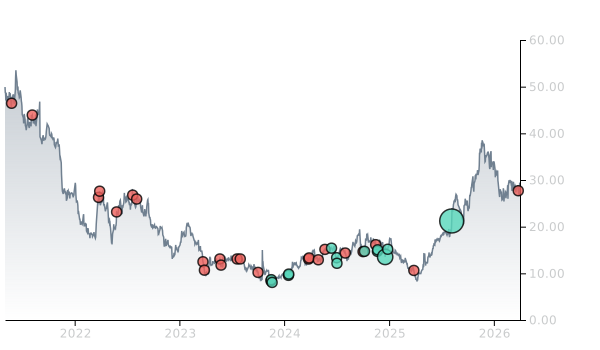
$ASMB insiders have traded $ASMB stock on the open market 4 times in the past 6 months. Of those trades, 0 have been purchases and 4 have been sales.
Here’s a breakdown of recent trading of $ASMB stock by insiders over the last 6 months:
- JEANETTE M BJORKQUIST (PFO and PAO) has made 0 purchases and 2 sales selling 328 shares for an estimated $8,754.
- NICOLE S WHITE (Chief Manufacturing Officer) has made 0 purchases and 2 sales selling 197 shares for an estimated $5,257.
To track insider transactions, check out Quiver Quantitative's insider trading dashboard. You can access data on insider stock transactions through the Quiver Quantitative API insider transaction endpoint.
$ASMB Hedge Fund Activity
We have seen 44 institutional investors add shares of $ASMB stock to their portfolio, and 33 decrease their positions in their most recent quarter.
Here are some of the largest recent moves:
- FRAZIER LIFE SCIENCES MANAGEMENT, L.P. removed 456,249 shares (-100.0%) from their portfolio in Q4 2025, for an estimated $15,517,028
- POINT72 ASSET MANAGEMENT, L.P. removed 256,504 shares (-42.7%) from their portfolio in Q1 2026, for an estimated $7,117,986
- FRANKLIN RESOURCES INC removed 210,528 shares (-100.0%) from their portfolio in Q1 2026, for an estimated $5,842,152
- PARKMAN HEALTHCARE PARTNERS LLC added 161,870 shares (+64.9%) to their portfolio in Q1 2026, for an estimated $4,491,892
- ADAGE CAPITAL PARTNERS GP, L.L.C. added 161,000 shares (+inf%) to their portfolio in Q1 2026, for an estimated $4,467,750
- MILLENNIUM MANAGEMENT LLC added 135,429 shares (+137.9%) to their portfolio in Q1 2026, for an estimated $3,758,154
- BLACKSTONE INC. removed 129,035 shares (-28.8%) from their portfolio in Q4 2025, for an estimated $4,388,480
To track hedge funds' stock portfolios, check out Quiver Quantitative's institutional holdings dashboard. You can access data on hedge funds moves and 13F filings through the Quiver Quantitative API 13F endpoint.
$ASMB Price Targets
Multiple analysts have issued price targets for $ASMB recently. We have seen 2 analysts offer price targets for $ASMB in the last 6 months, with a median target of $46.5.
Here are some recent targets:
- Patrick R. Trucchio from HC Wainwright & Co. set a target price of $50.0 on 05/04/2026
- Vamil Divan from Guggenheim set a target price of $43.0 on 04/06/2026
Full Release
– Phase 2 study in cholestatic liver diseases, focused on PBC and PSC, anticipated to initiate in Q1 2027 –
– Builds on completed Phase 1a study and ongoing development in HDV –
SOUTH SAN FRANCISCO, Calif., May 22, 2026 (GLOBE NEWSWIRE) -- Assembly Biosciences, Inc. (Nasdaq: ASMB), a biotechnology company developing innovative therapeutics targeting serious viral diseases, today announced plans to expand the clinical development of ABI-6250, its oral entry inhibitor candidate for chronic hepatitis delta virus (HDV) infection, into primary biliary cholangitis (PBC) and primary sclerosing cholangitis (PSC), broadening the program into cholestatic liver diseases.
“We are excited to expand the ABI-6250 program into PBC and PSC, where there remains significant unmet medical need despite existing PBC therapies, and in the case of PSC, no approved treatments,” said Anuj Gaggar, MD, PhD, chief medical officer of Assembly Bio. “The NTCP receptor plays an integral role in both HDV entry and bile acid transport into liver cells, making it a compelling target across multiple liver diseases. We believe ABI-6250 has the potential to address key drivers of disease pathology in these conditions and look forward to advancing clinical evaluation in these populations.”
ABI-6250 is currently being evaluated for chronic HDV infection and has completed a Phase 1a clinical trial in healthy participants. It is an investigational oral small-molecule inhibitor of the sodium taurocholate co-transporting polypeptide (NTCP), a membrane protein selectively expressed on hepatocytes that facilitates bile acid transport into cells and also serves as the entry receptor for HDV infection. By inhibiting NTCP, ABI-6250 blocks the uptake of bile acids into liver cells, a mechanism directly relevant to cholestatic liver diseases, where bile acid accumulation drives liver inflammation and liver injury.
“Treatment options for cholestatic liver diseases have expanded in recent years, but important gaps remain, particularly for patients with PSC for whom no treatments currently are approved and for those with PBC who do not adequately respond to the current therapies,” said Christopher Bowlus, MD, Lena Valente Professor and Chief, Division of Gastroenterology and Hepatology, University of California, Davis. “Targeting NTCP represents a mechanistically distinct approach compared to currently approved therapies, given its central role in bile acid transport. An oral agent like ABI-6250 that modulates this pathway could offer a differentiated strategy to impact disease biology and patient symptoms.”
The company believes the expansion of ABI-6250 into PBC and PSC is supported by preclinical data, the compound’s pharmacologic profile, and clinical findings from the Phase 1a study. These data demonstrated target engagement, including dose-dependent elevations in plasma total bile acids, consistent with NTCP inhibition. In addition, chronic toxicology studies have been completed and support the potential for longer-term dosing in planned Phase 2 trials. The company plans to initiate a Phase 2 clinical study of ABI-6250 in HDV in the fourth quarter of 2026. In addition, a Phase 2 basket study in cholestatic liver diseases, focused on PBC and PSC, is expected to begin in the first quarter of 2027, subject to regulatory feedback.
Assembly Bio recently conducted a pre-IND meeting with the U.S. Food and Drug Administration to discuss the planned development of ABI-6250 in cholestatic liver diseases. While official meeting minutes are pending, the company believes the discussion was constructive and provided helpful guidance to support advancement of the program.
PBC and PSC are chronic, autoimmune cholestatic liver diseases characterized by impaired bile flow, accumulation of bile acids in the liver and progressive liver damage. Clinical symptoms for both PBC and PSC include itch and fatigue, with development of fibrosis and cirrhosis as the diseases progress. There are multiple therapies available for the treatment of PBC; however, a significant percentage of individuals have an inadequate response to these treatments, and there remains an unmet medical need for improved treatment of PBC. There is a significant unmet medical need for the management of PSC as there are currently no approved therapies.
ABI-6250 is an investigational product candidate that has not been approved anywhere globally, and its safety and efficacy have not been established.
About Assembly Biosciences
Assembly Biosciences is a biotechnology company dedicated to the development of innovative small-molecule therapeutics designed to change the path of serious viral and liver diseases and improve the lives of patients worldwide. Led by an accomplished team of leaders in antiviral and liver disease drug development, Assembly Bio is committed to improving outcomes for patients struggling with the serious, chronic impacts of herpesvirus, hepatitis delta virus (HDV) infections, cholestatic liver diseases and hepatitis B virus (HBV). For more information, visit assemblybio.com.
Forward-Looking Statements
The information in this press release contains forward-looking statements that are subject to certain risks and uncertainties that could cause actual results to materially differ. These risks and uncertainties include: Assembly Bio’s ability to realize the potential benefits of its collaboration with Gilead Sciences, Inc. (Gilead), including all financial aspects of the collaboration and equity investments; Assembly Bio’s ability to initiate and complete clinical studies involving its therapeutic product candidates, including studies contemplated by Assembly Bio’s collaboration with Gilead, in the currently anticipated timeframes or at all; safety and efficacy data from clinical or nonclinical studies may not warrant further development of Assembly Bio’s product candidates; clinical and nonclinical data may not differentiate Assembly Bio’s product candidates from other companies’ candidates; Assembly Bio’s ability to maintain financial resources necessary to continue its research activities, clinical studies and other business operations; potential effects of changes in government regulation; results of nonclinical studies may not be representative of disease behavior in a clinical setting and may not be predictive of the outcomes of clinical studies; and other risks identified from time to time in Assembly Bio’s reports filed with the U.S. Securities and Exchange Commission (the SEC). You are urged to consider statements that include the words may, will, would, could, should, might, believes, hopes, estimates, projects, potential, expects, plans, anticipates, intends, continues, forecast, designed, goal or the negative of those words or other comparable words to be uncertain and forward-looking. Assembly Bio intends such forward-looking statements to be covered by the safe harbor provisions contained in Section 27A of the Securities Act of 1933, as amended, and Section 21E of the Securities Exchange Act of 1934, as amended. More information about Assembly Bio’s risks and uncertainties are more fully detailed under the heading “Risk Factors” in Assembly Bio’s filings with the SEC, including its most recent Annual Report on Form 10-K, Quarterly Reports on Form 10-Q and Current Reports on Form 8-K. Except as required by law, Assembly Bio assumes no obligation to update publicly any forward-looking statements, whether as a result of new information, future events or otherwise.
Contacts:
Investors:
Patrick Till
Meru Advisors
(484) 788-8560
[email protected]
Media:
Jamie Strachota
Sam Brown Healthcare Communications, Inc.
(703) 819-7647
[email protected]