


PYRUKYND is now the EU's sole approved treatment for thalassemia, alongside recent approvals in the U.S. and Gulf countries.
Quiver AI Summary
Agios Pharmaceuticals, Inc. announced that the European Commission has granted marketing authorization for PYRUKYND (mitapivat), making it the only approved medication in the EU for adults with both transfusion-dependent and non-transfusion-dependent alpha- or beta-thalassemia. This oral pyruvate kinase activator is designed to treat anemia associated with these conditions and is currently also approved in the U.S., Saudi Arabia, and the UAE. The approval is based on results from Phase 3 clinical trials, which highlighted its potential to significantly improve patient outcomes. Agios plans to partner with Avanzanite Bioscience B.V. for the distribution of PYRUKYND in Europe, furthering their commitment to addressing the needs of thalassemia patients. Thalassemia is a rare inherited blood disease that leads to reduced hemoglobin production, resulting in significant health burdens for affected individuals.
Potential Positives
- PYRUKYND is now the only approved treatment for both transfusion-dependent and non-transfusion-dependent thalassemia across all EU member states, highlighting its significance in the market.
- The European Commission's approval reinforces the transformative potential of PYRUKYND, validating Agios Pharmaceuticals' commitment to addressing critical healthcare needs for patients with rare diseases.
- Agios has secured marketing authorizations for PYRUKYND in key international markets including the U.S., Saudi Arabia, United Arab Emirates, and now the EU, demonstrating strong global market presence.
- Agios' partnership with Avanzanite Bioscience B.V. for the commercialization of PYRUKYND in Europe is poised to enhance distribution and accessibility of the treatment for thalassemia patients.
Potential Negatives
- Approval of PYRUKYND in the EU comes with significant safety warnings, including risks of acute hemolysis and hepatocellular injury, which may deter some healthcare providers from prescribing the medication.
- The partnership with Avanzanite Bioscience for distribution in Europe may raise concerns about Agios' control over the commercialization and marketing strategies for PYRUKYND.
- The significant cautionary note regarding forward-looking statements highlights the uncertainties around Agios' ability to deliver on its commercial expectations, which could impact investor confidence.
FAQ
What is PYRUKYND approved for in the EU?
PYRUKYND is approved for the treatment of anemia in adults with transfusion-dependent and non-transfusion-dependent thalassemia.
Who is distributing PYRUKYND in Europe?
Avanzanite Bioscience B.V. will continue to distribute and commercialize PYRUKYND in Europe.
What recent approvals has mitapivat received?
Mitapivat is now approved in the U.S., Saudi Arabia, UAE, and EU for thalassemia treatment.
What are the Phase 3 trials for PYRUKYND?
The ENERGIZE and ENERGIZE-T trials evaluated mitapivat's efficacy in non-transfusion-dependent and transfusion-dependent thalassemia patients.
What is the significance of the orphan designation for PYRUKYND?
The orphan medicinal product designation highlights the unique treatment options PYRUKYND provides for patients with thalassemia.
Disclaimer: This is an AI-generated summary of a press release distributed by GlobeNewswire. The model used to summarize this release may make mistakes. See the full release here.
$AGIO Insider Trading Activity
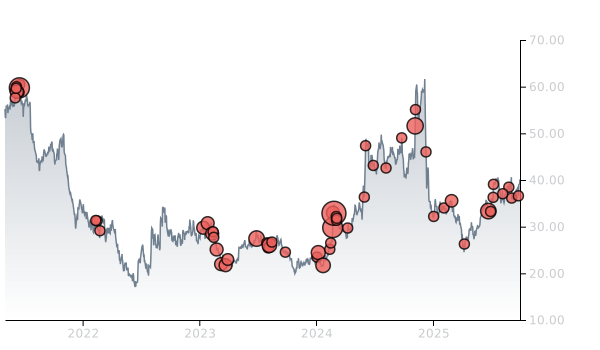
$AGIO insiders have traded $AGIO stock on the open market 16 times in the past 6 months. Of those trades, 0 have been purchases and 16 have been sales.
Here’s a breakdown of recent trading of $AGIO stock by insiders over the last 6 months:
- BRIAN GOFF (Chief Executive Officer) has made 0 purchases and 4 sales selling 37,771 shares for an estimated $1,168,514.
- TSVETA MILANOVA (Chief Commercial Officer) has made 0 purchases and 3 sales selling 9,066 shares for an estimated $270,253.
- JAMES WILLIAM BURNS (Chief Legal Officer) has made 0 purchases and 2 sales selling 6,212 shares for an estimated $193,276.
- CECILIA JONES (Chief Financial Officer) has made 0 purchases and 2 sales selling 6,073 shares for an estimated $188,451.
- KRISHNAN VISWANADHAN (Chief Corp Dev & Strategy) has made 0 purchases and 2 sales selling 5,918 shares for an estimated $184,967.
- SARAH GHEUENS (Chief Medical Officer) has made 0 purchases and 2 sales selling 5,872 shares for an estimated $181,475.
- THEODORE JAMES JR. WASHBURN (Principal Accounting Officer) sold 5,272 shares for an estimated $152,255
To track insider transactions, check out Quiver Quantitative's insider trading dashboard. You can access data on insider stock transactions through the Quiver Quantitative API insider transaction endpoint.
$AGIO Revenue
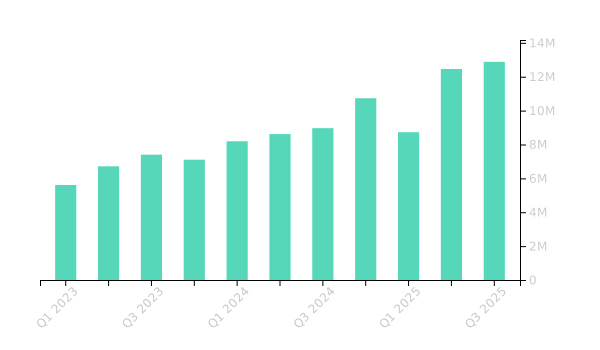
$AGIO had revenues of $20.7M in Q1 2026. This is an increase of 137.75% from the same period in the prior year.
You can track AGIO financials on Quiver Quantitative's AGIO stock page.
You can access data on AGIO stock through the Quiver Quantitative API.
$AGIO Congressional Stock Trading
Members of Congress have traded $AGIO stock 2 times in the past 6 months. Of those trades, 2 have been purchases and 0 have been sales.
Here’s a breakdown of recent trading of $AGIO stock by members of Congress over the last 6 months:
- REPRESENTATIVE GILBERT RAY CISNEROS, JR. has traded it 2 times. They made 2 purchases worth up to $30,000 on 03/03, 12/11 and 0 sales.
To track congressional stock trading, check out Quiver Quantitative's congressional trading dashboard. You can access data on congressional stock trades through the Quiver Quantitative API Congress trades endpoint.
$AGIO Hedge Fund Activity
We have seen 115 institutional investors add shares of $AGIO stock to their portfolio, and 152 decrease their positions in their most recent quarter.
Here are some of the largest recent moves:
- BELLEVUE GROUP AG removed 3,714,736 shares (-100.0%) from their portfolio in Q4 2025, for an estimated $101,115,113
- PARADIGM BIOCAPITAL ADVISORS LP removed 2,673,555 shares (-100.0%) from their portfolio in Q4 2025, for an estimated $72,774,167
- LYNX1 CAPITAL MANAGEMENT LP added 2,531,944 shares (+3179.9%) to their portfolio in Q1 2026, for an estimated $85,655,665
- COMMODORE CAPITAL LP removed 2,338,287 shares (-100.0%) from their portfolio in Q4 2025, for an estimated $63,648,172
- MACQUARIE GROUP LTD removed 1,958,101 shares (-100.0%) from their portfolio in Q4 2025, for an estimated $53,299,509
- D. E. SHAW & CO., INC. added 1,469,437 shares (+399.6%) to their portfolio in Q4 2025, for an estimated $39,998,075
- TCG CROSSOVER MANAGEMENT, LLC removed 1,181,841 shares (-100.0%) from their portfolio in Q1 2026, for an estimated $39,981,681
To track hedge funds' stock portfolios, check out Quiver Quantitative's institutional holdings dashboard. You can access data on hedge funds moves and 13F filings through the Quiver Quantitative API 13F endpoint.
$AGIO Analyst Ratings
Wall Street analysts have issued reports on $AGIO in the last several months. We have seen 4 firms issue buy ratings on the stock, and 0 firms issue sell ratings.
Here are some recent analyst ratings:
- Leerink Partners issued a "Outperform" rating on 12/26/2025
- B of A Securities issued a "Buy" rating on 12/24/2025
- Citigroup issued a "Buy" rating on 11/26/2025
- Truist Securities issued a "Buy" rating on 11/24/2025
To track analyst ratings and price targets for $AGIO, check out Quiver Quantitative's $AGIO forecast page.
$AGIO Price Targets
Multiple analysts have issued price targets for $AGIO recently. We have seen 7 analysts offer price targets for $AGIO in the last 6 months, with a median target of $40.0.
Here are some recent targets:
- Gregory Renza from Truist Securities set a target price of $36.0 on 04/30/2026
- Greg Harrison from B of A Securities set a target price of $41.0 on 04/21/2026
- Emily Bodnar from HC Wainwright & Co. set a target price of $50.0 on 04/20/2026
- Tessa Romero from JP Morgan set a target price of $36.0 on 04/06/2026
- Salveen Richter from Goldman Sachs set a target price of $32.0 on 04/01/2026
- Samantha Semenkow from Citigroup set a target price of $46.0 on 03/05/2026
- Andrew Berens from Leerink Partners set a target price of $40.0 on 12/26/2025
Full Release
-
PYRUKYND is the only medicine approved in the EU for adults with transfusion-dependent and non-transfusion-dependent alpha- or beta-thalassemia
- Mitapivat is now approved for thalassemia in the U.S., Saudi Arabia, United Arab Emirates, and EU
-
Avanzanite Bioscience B.V., a specialty pharmaceutical company, will continue to distribute and commercialize PYRUKYND in Europe
CAMBRIDGE, Mass., May 22, 2026 (GLOBE NEWSWIRE) -- Agios Pharmaceuticals, Inc. (Nasdaq: AGIO), a commercial-stage biopharmaceutical company focused on delivering innovative medicines for patients with rare diseases, today announced that the European Commission (EC) has granted marketing authorization for PYRUKYND ® (mitapivat), an oral pyruvate kinase (PK) activator, in adults for the treatment of anemia associated with transfusion-dependent and non-transfusion-dependent alpha- or beta-thalassemia, with an orphan medicinal product designation. With this decision, PYRUKYND becomes the only medicine approved in all European Union (EU) member states for this broad patient population.
“Thalassemia imposes a profound daily burden on patients, which is compounded by a lack of accessible treatment options for all forms of the disease,” said Maria Domenica Cappellini, M.D., Professor of Internal Medicine, University of Milan, Italy, and an investigator in the PYRUKYND thalassemia Phase 3 clinical program. “The Phase 3 results demonstrate the potential for PYRUKYND to address this burden and improve outcomes for those in need, regardless of their genotype or transfusion status. This approval is a major advancement that can help thousands of patients across the EU manage this debilitating and life-threatening disease.”
The EC’s decision is based on the results from the global, randomized, double-blind, placebo-controlled ENERGIZE and ENERGIZE-T Phase 3 trials in adults with non-transfusion-dependent and transfusion-dependent alpha- or beta-thalassemia, respectively.
“The EC approval of PYRUKYND is an important achievement, marking meaningful progress for patients living with thalassemia,” said Brian Goff, Chief Executive Officer, Agios. “Securing approvals across four key markets – the U.S., Saudi Arabia, United Arab Emirates, and now the EU – validates the transformative potential of this novel medicine. We look forward to continuing our partnership with Avanzanite to bring PYRUKYND to thalassemia patients across the EU, furthering our commitment to advancing innovation for the global community.”
In 2025, Agios entered into an exclusive agreement with Avanzanite Bioscience B.V. (Avanzanite) for the commercialization and distribution of PYRUKYND across the European Economic Area, the United Kingdom, and Switzerland. Headquartered in Amsterdam, Avanzanite is a commercial-stage specialty pharmaceutical company dedicated to bringing rare disease medicines to patients across Europe.
“The global thalassemia community has long awaited new, convenient, safe, and effective treatment options that help alleviate the debilitating symptoms of this disease,” said Androulla Eleftheriou, Ph.D., Executive Director, Thalassaemia International Federation. “The EC’s decision is a welcome step forward, introducing patients in the EU to an oral medicine with demonstrated therapeutic benefits. With four regulatory approvals in geographic areas significantly affected by thalassemia, this milestone reflects growing momentum to improve outcomes for patients worldwide.”
Mitapivat is now approved for adults with thalassemia in the EU, Saudi Arabia, and United Arab Emirates under the brand name PYRUKYND, as well as in the U.S. under the brand name AQVESME™ (mitapivat). The medicine is also approved as PYRUKYND for adults with PK deficiency in both the U.S. and in Europe.
About Thalassemia
Thalassemia is a rare, inherited blood disease that affects the production of hemoglobin, the protein in red blood cells responsible for carrying oxygen throughout the body. The disease is categorized into two main types: alpha-thalassemia and beta-thalassemia, depending on which globin chain of the hemoglobin is affected. By disrupting hemoglobin production, thalassemia reduces the number of circulating red blood cells and shortens their lifespan, which leads to anemia, fatigue, and serious complications.
Some individuals with thalassemia require regular transfusions (classified as transfusion-dependent thalassemia), while others only need them intermittently (classified as non-transfusion-dependent thalassemia). All patients with thalassemia experience a significant disease burden, including comorbidities, reduced quality of life, and shortened life expectancy.
An estimated 18,000 to 23,000 children and adults are living with thalassemia in the U.S. and five largest European countries (France, Germany, Italy, Spain, and the United Kingdom; EU5).
About ENERGIZE and ENERGIZE-T
ENERGIZE (
NCT04770753
) and ENERGIZE-T (
NCT04770779
) are global, double-blind, placebo-controlled Phase 3 trials evaluating the efficacy and safety of mitapivat in adults with alpha- or beta-thalassemia.
The ENERGIZE trial randomized 194 non-transfusion-dependent alpha- or beta-thalassemia patients 2:1 to receive either mitapivat 100 mg twice daily or placebo. The primary endpoint was hemoglobin response, defined as an increase of ≥1.0 g/dL in average hemoglobin concentration from Week 12 through Week 24 compared with baseline. Key secondary endpoints included changes from baseline in average fatigue scores and in average hemoglobin concentration from Week 12 to Week 24. The trial also assessed safety and tolerability.
The ENERGIZE-T trial randomized 258 transfusion-dependent alpha- or beta-thalassemia patients 2:1 to receive either mitapivat 100 mg twice daily or placebo. The primary endpoint was transfusion reduction response, defined as a ≥50% reduction in transfused red blood cell (RBC) units with a reduction of ≥2 units of RBCs transfused in any consecutive 12-week period through Week 48 compared with baseline. Several transfusion reduction measures were included as key secondary endpoints, and achievement of transfusion independence was a secondary endpoint. The trial also assessed safety and tolerability.
For each trial, patients who completed the double-blind period had the option to transition into a corresponding open-label extension period, during which all patients receive mitapivat.
About PYRUKYND
®
(mitapivat)
U.S. INDICATION
PYRUKYND is a pyruvate kinase activator indicated for the treatment of hemolytic anemia in adults with pyruvate kinase (PK) deficiency.
U.S. IMPORTANT SAFETY INFORMATION
Acute Hemolysis:
Acute hemolysis with subsequent anemia has been observed following abrupt interruption or discontinuation of PYRUKYND in a dose-ranging study. Avoid abruptly discontinuing PYRUKYND. Gradually taper the dose of PYRUKYND to discontinue treatment if possible. When discontinuing treatment, monitor patients for signs of acute hemolysis and anemia including jaundice, scleral icterus, dark urine, dizziness, confusion, fatigue, or shortness of breath.
Hepatocellular Injury in Another Condition: In patients with another condition treated with mitapivat at a higher dose than that recommended for patients with PK deficiency, liver injury has been observed. These events were characterized by a time to onset within the first 6 months of treatment with peak elevations of alanine aminotransferase of >5x upper limit of normal (ULN) with or without jaundice. All patients discontinued treatment with mitapivat, and these events improved upon treatment discontinuation.
Obtain liver tests prior to the initiation of PYRUKYND and monthly thereafter for the first 6 months and as clinically indicated. Interrupt PYRUKYND if clinically significant increases in liver tests are observed or alanine aminotransferase is >5x ULN. Discontinue PYRUKYND if hepatic injury due to PYRUKYND is suspected.
Adverse Reactions: The most common adverse reactions including laboratory abnormalities (≥10%) in patients with PK deficiency were estrone decreased (males), increased urate, back pain, estradiol decreased (males), and arthralgia.
Drug Interactions:
- Strong CYP3A Inhibitors and Inducers: Avoid concomitant use.
- Moderate CYP3A Inhibitors: Do not titrate PYRUKYND beyond 20 mg twice daily.
- Moderate CYP3A Inducers: Consider alternatives that are not moderate inducers. If there are no alternatives, adjust PYRUKYND dosage.
- Sensitive CYP3A, CYP2B6, CYP2C Substrates Including Hormonal Contraceptives: Avoid concomitant use with substrates that have narrow therapeutic index.
- UGT1A1 Substrates: Avoid concomitant use with substrates that have narrow therapeutic index.
-
P-gp Substrates: Avoid concomitant use with substrates that have narrow therapeutic index.
Hepatic Impairment: Avoid use of PYRUKYND in patients with moderate and severe hepatic impairment.
Please see full Prescribing Information for PYRUKYND.
About AQVESME™ (mitapivat)
U.S. INDICATION
AQVESME is indicated for the treatment of anemia in adults with alpha- or beta-thalassemia.
U.S. IMPORTANT SAFETY INFORMATION
BOXED WARNING: HEPATOCELLULAR INJURY
AQVESME can cause serious hepatocellular injury. Measure liver laboratory tests (ALT, AST, alkaline phosphatase and total bilirubin with fractionation) at baseline and every 4 weeks for 24 weeks and then as clinically indicated. Avoid use of AQVESME in patients with cirrhosis. Discontinue AQVESME if hepatic injury is suspected.
Because of the risk of hepatocellular injury, AQVESME is available only through a restricted program under a Risk Evaluation and Mitigation Strategy (REMS) called the AQVESME REMS.
WARNINGS AND PRECAUTIONS
Hepatocellular Injury
AQVESME can cause hepatocellular injury. Avoid use of AQVESME in patients with cirrhosis. In patients with thalassemia treated with AQVESME, liver injury with and without jaundice has been observed within the first 6 months of exposure. Obtain liver tests (including ALT, AST, alkaline phosphatase, total bilirubin with fractionation) prior to the initiation of AQVESME, then every 4 weeks for the first 24 weeks, and as clinically indicated thereafter. Interrupt AQVESME if clinically significant increases in liver tests are observed or alanine aminotransferase is >5 times the upper limit of normal (ULN). Complete a comprehensive evaluation to rule out other causes of liver injury when drug-induced liver injury is suspected. Discontinue AQVESME if hepatocellular injury due to AQVESME is suspected.
Symptoms and signs of early liver injury may mimic those of thalassemia. Advise patients to report new or worsening symptoms of loss of appetite, nausea, right-upper-quadrant abdominal pain, vomiting, scleral icterus, jaundice, or dark urine while on AQVESME treatment.
During the double-blind period, 2 of 301 patients (0.66%) with thalassemia treated with AQVESME experienced adverse reactions suggestive of hepatocellular injury. Three additional patients experienced adverse reactions suggestive of hepatocellular injury during the open-label extension periods after switching from placebo to AQVESME. Of these 5 patients, 2 had serious liver injury requiring hospitalization, including 1 patient who developed jaundice (peak bilirubin 32 mg/dL). Another patient developed jaundice (peak bilirubin 4 mg/dL) without requiring hospitalization. These reactions were characterized by a time to onset within the first 6 months of treatment with peak elevations of alanine aminotransferase of >5×ULN with or without jaundice. All patients discontinued treatment with AQVESME, and these reactions improved upon treatment discontinuation.
AQVESME REMS
AQVESME is available only through a restricted program under a REMS called the AQVESME REMS because of the risk of hepatocellular injury.
Adverse Reactions
The most common adverse reactions among patients taking AQVESME were headache and insomnia.
Drug Interactions
- Strong CYP3A Inhibitors and Inducers: Avoid concomitant use.
- Moderate CYP3A Inhibitors: Avoid concomitant use.
- Moderate CYP3A Inducers: Consider alternatives that are not moderate inducers. If there are no alternatives, see full Prescribing Information for recommended dosage for drug interactions with moderate CYP3A inducers.
- Sensitive CYP3A Substrates, including hormonal contraceptives: Avoid concomitant use with substrates that have narrow therapeutic index.
- CYP2B6, CYP2C, and UGT1A1 Substrates: Monitor patients for efficacy of the substrates with narrow therapeutic index.
-
P-gp Substrates: Monitor patients for adverse reactions of the substrates with narrow therapeutic index.
Hepatic Impairment
Avoid use of AQVESME in patients with cirrhosis (Child-Pugh Class A, B, or C).
Please see full Prescribing Information for AQVESME, including Boxed Warning.
About Agios: Fueled by Connections to Transform Rare Diseases™
At Agios, our vision is to redefine the future of rare disease treatment. Fueled by connections, we build trusted partnerships with communities – collaborating to develop and deliver innovative medicines that have the potential to transform lives. With a foundation in hematology, we combine biological expertise with real-world insights to advance a growing pipeline of rare disease medicines that reflect the priorities of the people we serve. Agios is a commercial-stage biopharmaceutical company headquartered in Cambridge, Massachusetts. To learn more, visit
www.agios.com
and follow us on
LinkedIn
and
X
.
Available Information about Agios
To achieve broad dissemination, Agios may disclose information to the public through a variety of disclosure channels including press releases, SEC filings, and public conference calls and webcasts. Some of the information distributed through these disclosure channels may be considered material information. Investors and others should note that Agios plans to use its website (
www.agios.com
) as a distribution channel to announce and give notice of Agios’ upcoming events and presentations (including, but not limited to, presentations at medical or healthcare conferences). Such information, which may be deemed material, will be available on the Investors section of the company’s website under the “Events & Presentations” tab. In addition, you may sign up to automatically receive email alerts about Agios’ upcoming events and presentations (“Calendar Alerts”) by visiting the “Email Alerts” option under the “IR Resources” tab of the Investors section of the company’s website and submitting your email address.
Cautionary Note Regarding Forward-Looking Statements
This press release contains forward-looking statements within the meaning of The Private Securities Litigation Reform Act of 1995. Such forward-looking statements include those regarding the potential benefits of PYRUKYND
®
(mitapivat); Agios’ commercial expectations for PYRUKYND in Europe and elsewhere; and the potential benefits of Agios’ strategic plans and focus. The words “anticipate,” “expect,” “goal,” “hope,” “milestone,” “plan,” “potential,” “possible,” “strategy,” “will,” “vision,” and similar expressions are intended to identify forward-looking statements, although not all forward-looking statements contain these identifying words. Such statements are subject to numerous important factors, risks and uncertainties that may cause actual events or results to differ materially from Agios’ current expectations and beliefs. For example, there can be no guarantee that any product candidate Agios is developing will successfully commence or complete necessary preclinical and clinical development phases, or that development of any of Agios’ product candidates will successfully continue. There can be no guarantee that any positive developments in Agios’ business will result in stock price appreciation. Management's expectations and, therefore, any forward-looking statements in this press release could also be affected by risks and uncertainties relating to a number of other important factors, including, without limitation: risks and uncertainties related to the impact of pandemics or other public health emergencies to Agios’ business, operations, strategy, goals and anticipated milestones, including its ongoing and planned research activities, ability to conduct ongoing and planned clinical trials, clinical supply of current or future drug candidates, commercial supply of current or future approved products, and launching, marketing and selling current or future approved products; Agios’ results of clinical trials and preclinical studies, including subsequent analysis of existing data and new data received from ongoing and future studies; the content and timing of decisions made by the U.S. FDA, the EMA or other regulatory authorities, investigational review boards at clinical trial sites and publication review bodies; Agios’ ability to obtain and maintain requisite regulatory approvals and to enroll patients in its planned clinical trials; unplanned cash requirements and expenditures; competitive factors; Agios' ability to obtain, maintain and enforce patent and other intellectual property protection for any product candidates it is developing; Agios’ ability to establish and maintain key collaborations; uncertainty regarding any royalty payments related to the sale of its oncology business or any milestone or royalty payments related to its in-licensing of AG-236, and the uncertainty of the timing of any such payments; uncertainty of the results and effectiveness of the use of Agios’ cash and cash equivalents; and general economic and market conditions. These and other risks are described in greater detail under the caption "Risk Factors" included in Agios’ public filings with the Securities and Exchange Commission. Any forward-looking statements contained in this press release speak only as of the date hereof, and Agios expressly disclaims any obligation to update any forward-looking statements, whether as a result of new information, future events or otherwise, except as required by law.
Contacts:
Investor Contact
Morgan Sanford, Vice President, Investor Relations
Agios Pharmaceuticals
[email protected]
Media Contact
Eamonn Nolan, Senior Director, Corporate Communications
Agios Pharmaceuticals
[email protected]